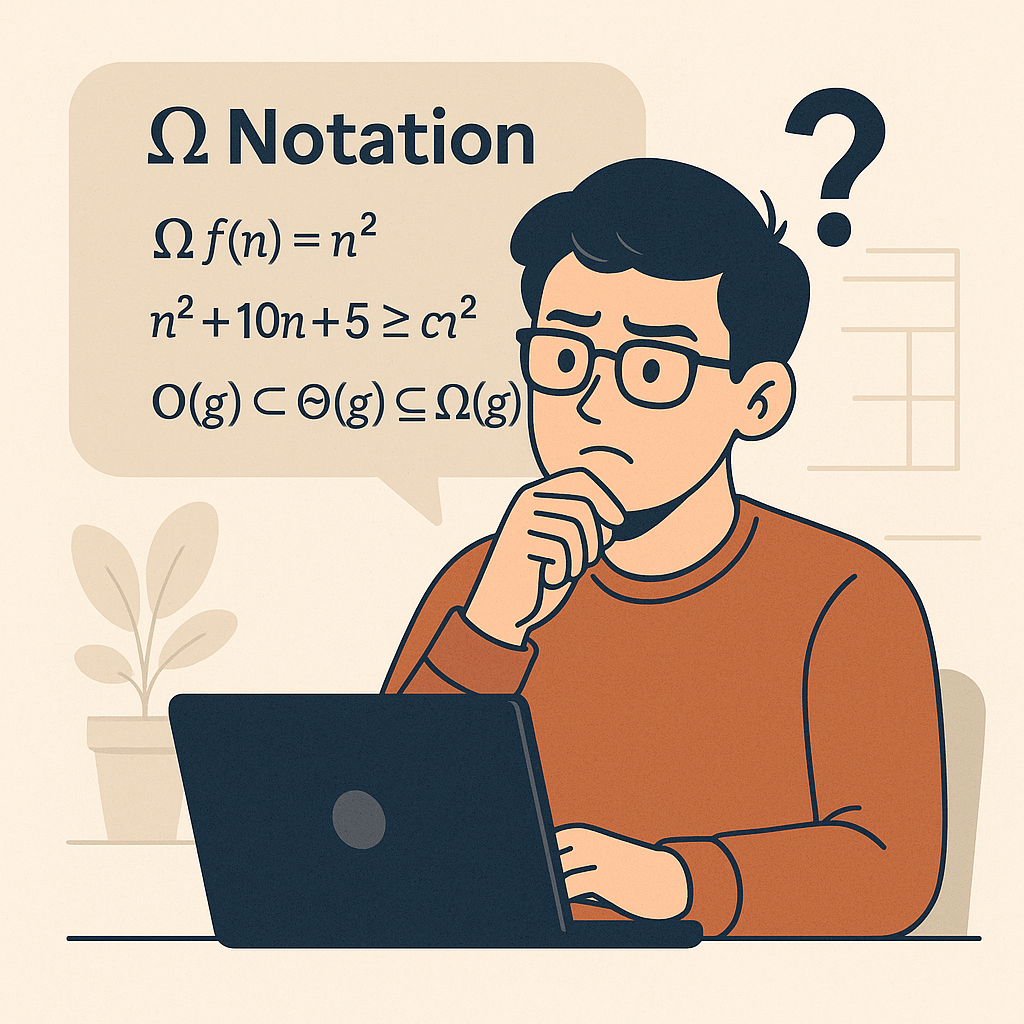
What is Ω-notation?
Ω (Omega) provides a lower bound on algorithm complexity. It tells us the minimum resources (time, comparisons, operations) an algorithm will always need as the input grows.
f(n) ∈ Ω(g(n)) ⇔ ∃ c greater than 0, n₀ ≥ 0 : f(n) ≥ c · g(n), ∀ n ≥ n₀
Why is it important?
- Guarantees performance: tells us the least amount of work required.
- Proves impossibility: For many problems, no algorithm can beat a known lower bound (e.g., comparison sorting is Ω(n log n) → no algorithm can beat it.)
- Supports tight bounds: combine with Big-O to get Θ (tight asymptotics).
How do we use it?
- To prove a minimum baseline cost (e.g., reading input is Ω(n)).
- To establish theoretical limits for problem classes.
- To compare efficiency: if your algorithm is O(n log n) and the problem is Ω(n log n), then your algorithm is optimal.
How do we calculate Ω?
1. Dominant-term method
Keep the leading term of a polynomial.
Example:
4n^3 + 2n^2 + 5 ∈ Ω(n^3)
2. Inequality bounding
Show f(n) ≥ c · g(n) beyond some n₀.
3. Limits
If
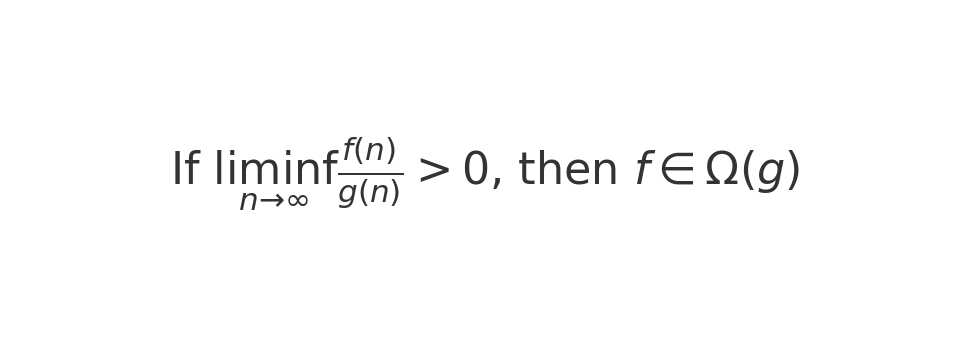
then f ∈ Ω(g).
Step-by-step examples
Example 1: Polynomial
f(n) = 3n^2 + 10n + 5
- For n ≥ 1, 10n + 5 ≥ 0.
- So f(n) ≥ 3n².
- Pick c = 3, n₀ = 1.
Conclusion:
f(n) ∈ Ω(n^2)
Example 2: Code Snippet (Java)
int count = 0;
for (int i = 1; i <= n; i++) {
    for (int j = i; j <= n; j++) {
        count++;
    }
}
- Inner loop runs
(n - i + 1)times.
- Total =
n(n+1)/2.
- ≥
n²/2⇒ Ω(n²).
Relationship with Big-O and Θ
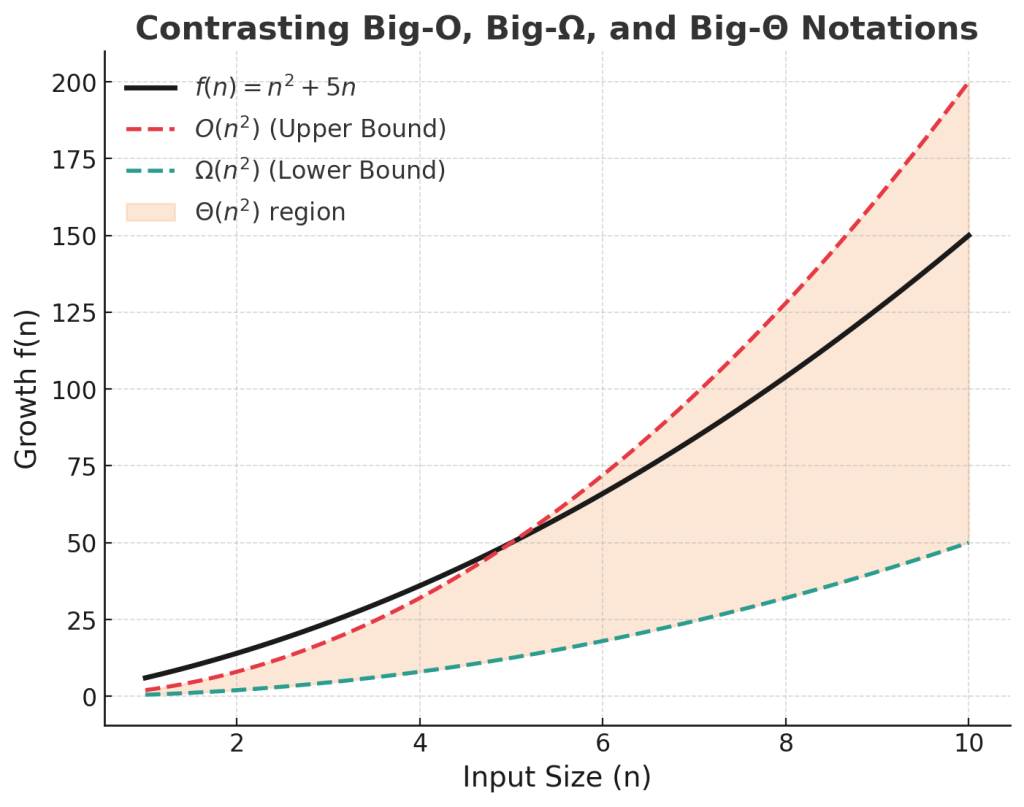
- O(g): upper bound (at most).
- Ω(g): lower bound (at least).
- Θ(g): tight bound (both O and Ω).
Diagram: Contrasting O, Ω, Θ

 Software Engineer's Notes
Recent Comments