Search

Software Engineer's Notes

Tag

Software Development

Understanding Heisenbugs in Software Development

Understanding Heisenbugs

What is a Heisenbug?

A Heisenbug is a type of software bug that seems to disappear or alter its behavior when you attempt to study, debug, or isolate it. In other words, the very act of observing or interacting with the system changes the conditions that make the bug appear.

These bugs are particularly frustrating because they are inconsistent and elusive. Sometimes, they only appear under specific conditions like production workloads, certain timing scenarios, or hardware states. When you add debugging statements, logs, or step through the code, the problem vanishes, leaving you puzzled.

The term is derived from the Heisenberg Uncertainty Principle in quantum physics, which states that you cannot precisely measure both the position and momentum of a particle at the same time. Similarly, a Heisenbug resists measurement or observation.

History of the Term

The term Heisenbug originated in the 1980s among computer scientists and software engineers. It became popular in the field of debugging complex systems, where timing and concurrency played a critical role. The concept was closely tied to emerging issues in multithreading, concurrent programming, and distributed systems, where software behavior could shift when studied.

The word became part of hacker jargon and was documented in The New Hacker’s Dictionary (based on the Jargon File), spreading the concept widely among programmers.

Real-World Examples of Heisenbugs

  1. Multithreading race conditions
    A program that crashes only when two threads access shared data simultaneously. Adding a debug log alters the timing, preventing the crash.
  2. Memory corruption in C/C++
    A program that overwrites memory accidentally may behave unpredictably. When compiled with debug flags, memory layout changes, and the bug disappears.
  3. Network communication issues
    A distributed application that fails when many requests arrive simultaneously, but behaves normally when slowed down during debugging.
  4. UI rendering bugs
    A graphical application where a glitch appears in release mode but never shows up when using a debugger or extra logs.

How Do We Know If We Encounter a Heisenbug?

You may be dealing with a Heisenbug if:

  • The issue disappears when you add logging or debugging code.
  • The bug only shows up in production but not in development or testing.
  • Timing, workload, or environment changes make the bug vanish or behave differently.
  • You cannot consistently reproduce the error under controlled debugging conditions.

Best Practices to Handle Heisenbugs

  1. Use Non-Intrusive Logging
    Instead of adding print statements everywhere, rely on structured logging, performance counters, or telemetry that doesn’t change timing drastically.
  2. Reproduce in Production-like Environments
    Set up staging environments that mirror production workloads, hardware, and configurations as closely as possible.
  3. Automated Stress and Concurrency Testing
    Run automated tests with randomized workloads, race condition detection tools, or fuzzing to expose hidden timing issues.
  4. Version Control Snapshots
    Keep precise build and configuration records. Small environment differences can explain why the bug shows up in one setting but not another.
  5. Use Tools Designed for Concurrency Bugs
    Tools like Valgrind, AddressSanitizer, ThreadSanitizer, or specialized profilers can sometimes catch hidden issues.

How to Debug a Heisenbug

  • Record and Replay: Use software or hardware that captures execution traces so you can replay the exact scenario later.
  • Binary Search Debugging: Narrow down suspicious sections of code by selectively enabling/disabling features.
  • Deterministic Testing Frameworks: Run programs under controlled schedulers that force thread interleavings to be repeatable.
  • Minimize Side Effects of Debugging: Avoid adding too much logging or breakpoints, which may hide the issue.
  • Look for Uninitialized Variables or Race Conditions: These are the most common causes of Heisenbugs.

Suggestions for Developers

  • Accept that Heisenbugs are part of software development, especially in complex or concurrent systems.
  • Invest in robust testing strategies like chaos engineering, stress testing, and fuzzing.
  • Encourage peer code reviews to catch subtle concurrency or memory issues before they make it to production.
  • Document the conditions under which the bug appears so future debugging sessions can be more targeted.

Conclusion

Heisenbugs are some of the most frustrating problems in software development. Like quantum particles, they change when you try to observe them. However, with careful testing, logging strategies, and specialized tools, developers can reduce the impact of these elusive bugs. The key is persistence, systematic debugging, and building resilient systems that account for unpredictability.
State Management in Software Engineering

Learning state management

What Is State Management?

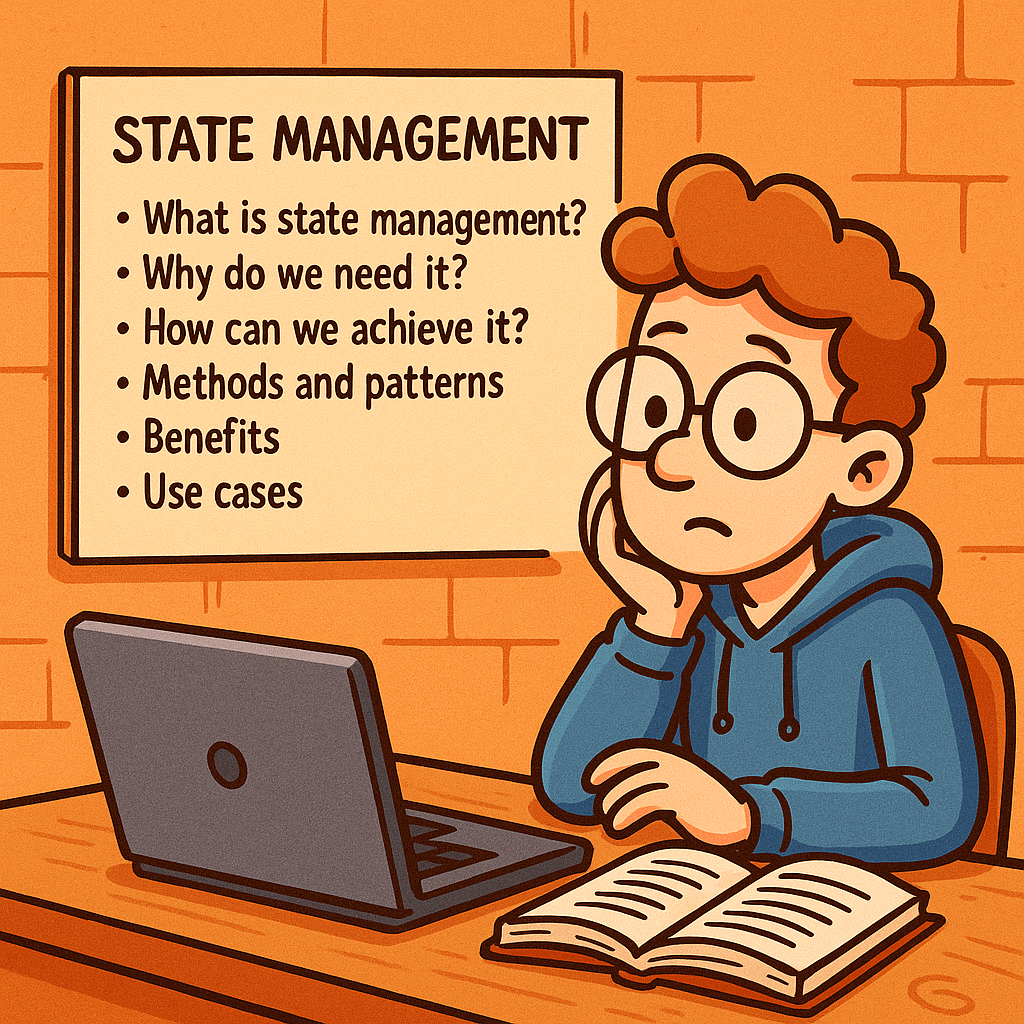
State is the “memory” of a system—the data that captures what has happened so far and what things look like right now.
State management is the set of techniques you use to represent, read, update, persist, share, and synchronize that data across components, services, devices, and time.

Examples of state:

  • A user’s shopping cart
  • The current screen and filters in a UI
  • A microservice’s cache
  • A workflow’s step (“Pending → Approved → Shipped”)
  • A distributed ledger’s account balances

Why Do We Need It?

  • Correctness: Make sure reads/writes follow rules (e.g., no negative inventory).
  • Predictability: Same inputs produce the same outputs; fewer “heisenbugs.”
  • Performance: Cache and memoize expensive work.
  • Scalability: Share and replicate state safely across processes/regions.
  • Resilience: Recover after crashes with snapshots, logs, or replicas.
  • Collaboration: Keep many users and services in sync (conflict handling included).
  • Auditability & Compliance: Track how/when state changed (who did what).

How Can We Achieve It? (Core Approaches)

  1. Local/In-Memory State
    • Kept inside a process (e.g., component state in a UI, service memory cache).
    • Fast, simple; volatile and not shared by default.
  2. Centralized Store
    • A single source of truth (e.g., Redux store, Vuex/Pinia, NgRx).
    • Deterministic updates via actions/reducers; great for complex UIs.
  3. Server-Side Persistence
    • Databases (SQL/NoSQL), key-value stores (Redis), object storage.
    • ACID/transactions for strong consistency; or tunable/BASE for scale.
  4. Event-Driven & Logs
    • Append-only logs (Kafka, Pulsar), pub/sub, event sourcing.
    • Rebuild state from events; great for audit trails and temporal queries.
  5. Finite State Machines/Statecharts
    • Explicit states and transitions (e.g., XState).
    • Eliminates impossible states; ideal for workflows and UI flows.
  6. Actor Model
    • Isolated “actors” own their state and communicate via messages (Akka, Orleans).
    • Avoids shared memory concurrency issues.
  7. Sagas/Process Managers
    • Coordinate multi-service transactions with compensating actions.
    • Essential for long-running, distributed workflows.
  8. Caching & Memoization
    • In-memory, Redis, CDN edge caches; read-through/write-through patterns.
  9. Synchronization & Consensus
    • Leader election and config/state coordination (Raft/etcd, Zookeeper).
    • Used for distributed locks, service discovery, cluster metadata.
  10. Conflict-Friendly Models
    • CRDTs and operational transforms for offline-first and collaborative editing.

Patterns & When To Use Them

  • Repository Pattern: Encapsulate persistence logic behind an interface.
  • Unit of Work: Group changes into atomic commits (helpful with ORMs).
  • CQRS: Separate reads and writes for scale/optimization.
  • Event Sourcing: Store the events; derive current state on demand.
  • Domain-Driven Design (DDD) Aggregates: Keep invariants inside boundaries.
  • Idempotent Commands: Safe retries in distributed environments.
  • Outbox Pattern: Guarantee DB + message bus consistency.
  • Cache-Aside / Read-Through: Balance performance and freshness.
  • Statechart-Driven UIs: Model UI states explicitly to avoid edge cases.

Benefits of Good State Management

  • Fewer bugs & clearer mental model (explicit transitions and invariants)
  • Traceability (who changed what, when, and why)
  • Performance (targeted caching, denormalized read models)
  • Flexibility (swap persistence layers, add features without rewrites)
  • Scalability (independent read/write scaling, sharding)
  • Resilience (snapshots, replays, blue/green rollouts)

Real-World Use Cases

  • E-commerce: Cart, inventory reservations, orders (Sagas + Outbox + CQRS).
  • Banking/FinTech: Double-entry ledgers, idempotent transfers, audit trails (Event Sourcing).
  • Healthcare: Patient workflow states, consent, auditability (Statecharts + DDD aggregates).
  • IoT: Device twins, last-known telemetry, conflict resolution (CRDTs or eventual consistency).
  • Collaboration Apps: Docs/whiteboards with offline editing (CRDTs/OT).
  • Gaming/Realtime: Matchmaking and player sessions (Actor model + in-memory caches).
  • Analytics/ML: Feature stores and slowly changing dimensions (immutable logs + batch/stream views).

Choosing an Approach (Quick Guide)

  • Simple UI component: Local state → lift to a small store if many siblings need it.
  • Complex UI interactions: Statecharts or Redux-style store with middleware.
  • High read throughput: CQRS with optimized read models + cache.
  • Strong auditability: Event sourcing + snapshots + projections.
  • Cross-service transactions: Sagas with idempotent commands + Outbox.
  • Offline/collaborative: CRDTs or OT, background sync, conflict-free merges.
  • Low-latency hot data: In-memory/Redis cache + cache-aside.

How To Use It In Your Software Projects

1) Model the Domain and State

  • Identify entities, value objects, and aggregates.
  • Write down invariants (“inventory ≥ 0”) and state transitions as a state diagram.

2) Define Read vs Write Paths

  • Consider CQRS if reads dominate or need different shapes than writes.
  • Create projections or denormalized views for common queries.

3) Pick Storage & Topology

  • OLTP DB for strong consistency; document/column stores for flexible reads.
  • Redis/memory caches for latency; message bus (Kafka) for event pipelines.
  • Choose consistency model (strong vs eventual) per use case.

4) Orchestrate Changes

  • Commands → validation → domain logic → events → projections.
  • For cross-service flows, implement Sagas with compensations.
  • Ensure idempotency (dedupe keys, conditional updates).

5) Make Failures First-Class

  • Retries with backoff, circuit breakers, timeouts.
  • Outbox for DB-to-bus consistency; dead-letter queues.
  • Snapshots + event replay for recovery.

6) Testing Strategy

  • Unit tests: Reducers/state machines (no I/O).
  • Property-based tests: Invariants always hold.
  • Contract tests: Between services for event/command schemas.
  • Replay tests: Rebuild from events and assert final state.

7) Observability & Ops

  • Emit domain events and metrics on state transitions.
  • Trace IDs through commands, handlers, and projections.
  • Dashboards for lag, cache hit rate, saga success/fail ratios.

8) Security & Compliance

  • AuthN/AuthZ checks at state boundaries.
  • PII encryption, data retention, and audit logging.

Practical Examples

Example A: Shopping Cart (Service + Cache + Events)

  • Write path: AddItemCommand validates stock → updates DB (aggregate) → emits ItemAdded.
  • Read path: Cart view uses a projection kept fresh via events; Redis caches the view.
  • Resilience: Outbox ensures ItemAdded is published even if the service restarts.

Example B: UI Wizard With Statecharts

  • States: Start → PersonalInfo → Shipping → Payment → Review → Complete
  • Guards prevent illegal transitions (e.g., can’t pay before shipping info).
  • Tests assert allowed transitions and side-effects per state.

Example C: Ledger With Event Sourcing

  • Only store TransferInitiated, Debited, Credited, TransferCompleted/Failed.
  • Current balances are projections; rebuilding is deterministic and auditable.

Common Pitfalls (and Fixes)

  • Implicit state in many places: Centralize or document owners; use a store.
  • Mutable shared objects: Prefer immutability; copy-on-write.
  • Missing idempotency: Add request IDs, conditional updates, and dedupe.
  • Tight coupling to DB schema: Use repositories and domain models.
  • Ghost states in UI: Use statecharts or a single source of truth.
  • Cache incoherence: Establish clear cache-aside/invalidations; track TTLs.

Lightweight Checklist

  • Enumerate state, owners, and lifecycle.
  • Decide consistency model per boundary.
  • Choose patterns (CQRS, Sagas, ES, Statecharts) intentionally.
  • Plan storage (DB/log/cache) and schemas/events.
  • Add idempotency and the Outbox pattern where needed.
  • Write reducer/state machine/unit tests.
  • Instrument transitions (metrics, logs, traces).
  • Document invariants and recovery procedures.

Final Thoughts

State management is not one tool—it’s a discipline. Start with your domain’s invariants and consistency needs, then choose patterns and storage that make those invariants easy to uphold. Keep state explicit, observable, and testable. Your systems—and your future self—will thank you.

What is a Modular Monolith?

What is a Modular Monolith?

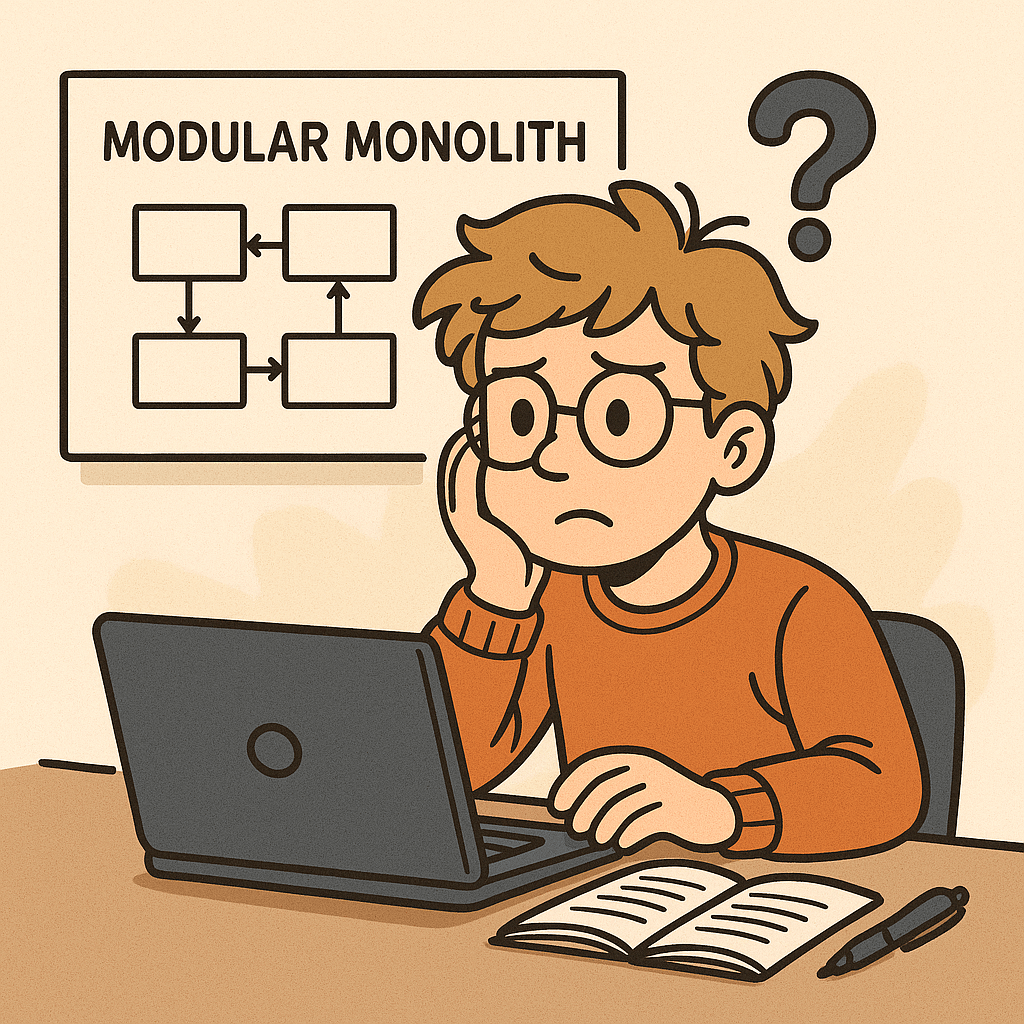
A modular monolith is a software architecture style where an application is built as a single deployable unit (like a traditional monolith), but internally it is organized into well-defined modules. Each module encapsulates specific functionality and communicates with other modules through well-defined interfaces, making the system more maintainable and scalable compared to a classic monolith.

Unlike microservices, where each service is deployed and managed separately, modular monoliths keep deployment simple but enforce modularity within the application.

Main Components and Features of a Modular Monolith

1. Modules

  • Self-contained units with a clear boundary.
  • Each module has its own data structures, business logic, and service layer.
  • Modules communicate through interfaces, not direct database or code access.

2. Shared Kernel or Core

  • Common functionality (like authentication, logging, error handling) that multiple modules use.
  • Helps avoid duplication but must be carefully managed to prevent tight coupling.

3. Interfaces and Contracts

  • Communication between modules is strictly through well-defined APIs or contracts.
  • Prevents “spaghetti code” where modules become tangled.

4. Independent Development and Testing

  • Modules can be developed, tested, and even versioned separately.
  • Still compiled and deployed together, but modularity speeds up development cycles.

5. Single Deployment Unit

  • Unlike microservices, deployment remains simple (a single application package).
  • Easier to manage operationally while still benefiting from modularity.

Benefits of a Modular Monolith

1. Improved Maintainability

  • Clear separation of concerns makes the codebase easier to navigate and modify.
  • Developers can work within modules without breaking unrelated parts.

2. Easier Transition to Microservices

  • A modular monolith can serve as a stepping stone toward microservices.
  • Well-designed modules can later be extracted into independent services.

3. Reduced Complexity in Deployment

  • Single deployment unit avoids the operational complexity of managing multiple microservices.
  • No need to handle distributed systems challenges like service discovery or network latency.

4. Better Scalability Than a Classic Monolith

  • Teams can scale development efforts by working on separate modules independently.
  • Logical boundaries support parallel development.

5. Faster Onboarding

  • New developers can focus on one module at a time instead of the entire system.

Advantages and Disadvantages

Advantages

  • Simpler deployment compared to microservices.
  • Strong modular boundaries improve maintainability.
  • Lower infrastructure costs since everything runs in one unit.
  • Clear path to microservices if needed in the future.

Disadvantages

  • Scaling limits: the whole application still scales as one unit.
  • Tight coupling risk: if boundaries are not enforced, modules can become tangled.
  • Database challenges: teams must resist the temptation of a single shared database without proper separation.
  • Not as resilient: a failure in one module can still crash the entire system.

Real-World Use Cases and Examples

  1. E-commerce Platforms
    • Modules like “Product Catalog,” “Shopping Cart,” “Payments,” and “User Management” are separate but deployed together.
  2. Banking Systems
    • Modules for “Accounts,” “Transactions,” “Loans,” and “Reporting” allow different teams to work independently.
  3. Healthcare Applications
    • Modules like “Patient Records,” “Appointments,” “Billing,” and “Analytics” benefit from modular monolith design before moving to microservices.
  4. Enterprise Resource Planning (ERP)
    • HR, Finance, and Inventory modules can live in a single deployment but still be logically separated.

How to Integrate Modular Monolith into Your Software Development Process

  1. Define Clear Module Boundaries
    • Start by identifying core domains and subdomains (Domain-Driven Design can help).
  2. Establish Communication Rules
    • Only allow interaction through interfaces or APIs, not direct database or code references.
  3. Use Layered Architecture Within Modules
    • Separate each module into layers: presentation, application logic, and domain logic.
  4. Implement Independent Testing for Modules
    • Write unit and integration tests per module.
  5. Adopt Incremental Refactoring
    • If you have a classic monolith, refactor gradually into modules.
  6. Prepare for Future Growth
    • Design modules so they can be extracted as microservices when scaling demands it.

Conclusion

A modular monolith strikes a balance between the simplicity of a traditional monolith and the flexibility of microservices. By creating strong modular boundaries, teams can achieve better maintainability, parallel development, and scalability while avoiding the operational overhead of distributed systems.

It’s a great fit for teams who want to start simple but keep the door open for future microservices adoption.

Minimum Viable Product (MVP) in Software Development

Learning minimum viable product

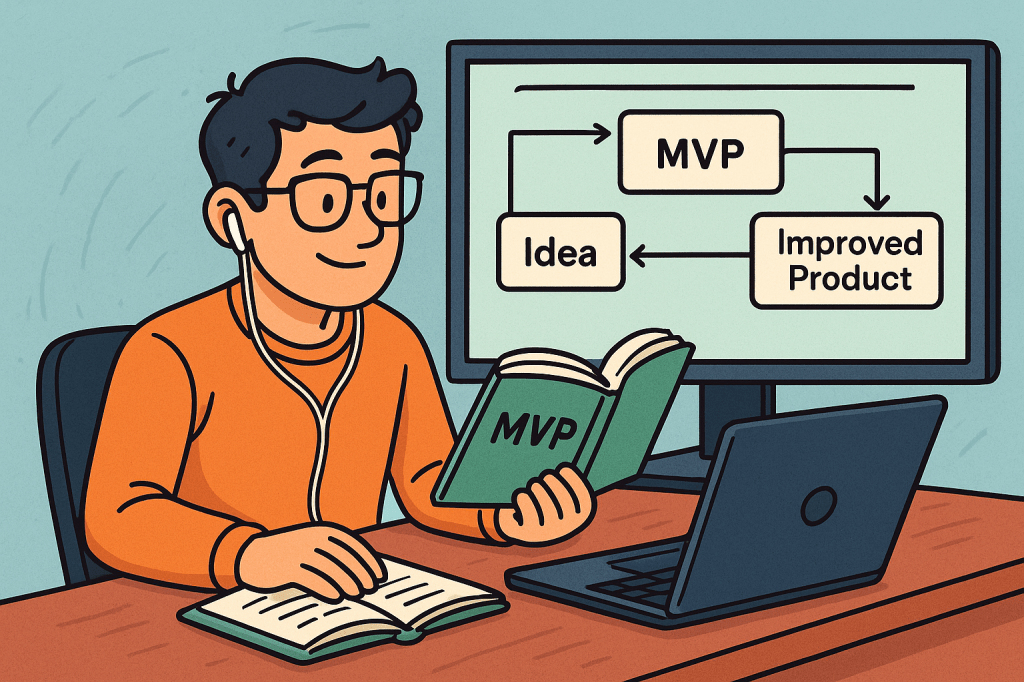
When developing a new product, one of the most effective strategies is to start small, test your ideas, and grow based on real feedback. This approach is called creating a Minimum Viable Product (MVP).

What is a Minimum Viable Product?

A Minimum Viable Product (MVP) is the most basic version of a product that still delivers value to users. It is not a full-fledged product with every feature imagined, but a simplified version that solves the core problem and allows you to test your concept in the real world.

The MVP focuses on answering one important question: Does this product solve a real problem for users?

Key Features of an MVP

  1. Core Functionality Only
    An MVP should focus on the most essential features that directly address the problem. Extra features can be added later once feedback is collected.
  2. Usability
    Even though it is minimal, the product must be usable. Users should be able to complete the core task smoothly without confusion.
  3. Scalability Consideration
    While it starts small, the design should not block future growth. The MVP should be a foundation for future improvements.
  4. Fast to Build
    The MVP must be developed quickly so that testing and feedback cycles can begin early. Speed is one of its key strengths.
  5. Feedback-Driven
    The MVP should make it easy to collect feedback from users, whether through analytics, surveys, or usage data.

Purpose of an MVP

The main purpose of an MVP is validation. Before investing large amounts of time and resources, companies want to know if their idea will actually succeed.

  • It allows testing assumptions with real users.
  • It helps confirm whether the problem you are solving is truly important.
  • It prevents wasting resources on features or ideas that don’t matter to customers.
  • It provides early market entry and brand visibility.

In short, the purpose of an MVP is to reduce risk while maximizing learning.

Benefits of an MVP

  1. Cost Efficiency
    Instead of spending a large budget on full development, an MVP helps you invest small and learn quickly.
  2. Faster Time to Market
    You can launch quickly, test your idea, and make improvements while competitors are still planning.
  3. Real User Feedback
    MVP development lets you learn directly from your audience instead of guessing what they want.
  4. Reduced Risk
    By validating assumptions early, you avoid investing in products that may not succeed.
  5. Investor Confidence
    If your MVP shows traction, it becomes easier to attract investors and funding.

Real-World Example of an MVP

One famous example is Dropbox. Before building the full product, Dropbox created a simple video demonstrating how their file-sharing system would work. The video attracted thousands of sign-ups from people who wanted the product, proving the idea had strong demand. Based on this validation, Dropbox built and released the full product, which later became a global success.

How to Use an MVP in Software Development

  1. Identify the Core Problem
    Focus on the exact problem your software aims to solve.
  2. Select Key Features Only
    Build only the features necessary to address the core problem.
  3. Develop Quickly
    Keep development short and simple. The goal is learning, not perfection.
  4. Release to a Small Audience
    Test with early adopters who are willing to give feedback.
  5. Collect Feedback and Iterate
    Use customer feedback to improve the product step by step.
  6. Scale Gradually
    Once validated, add new features and expand your product.

By adopting the MVP approach, software teams can innovate faster, reduce risk, and build products that truly meet customer needs.

Separation of Concerns (SoC) in Software Engineering

Learning Separation of Concerns

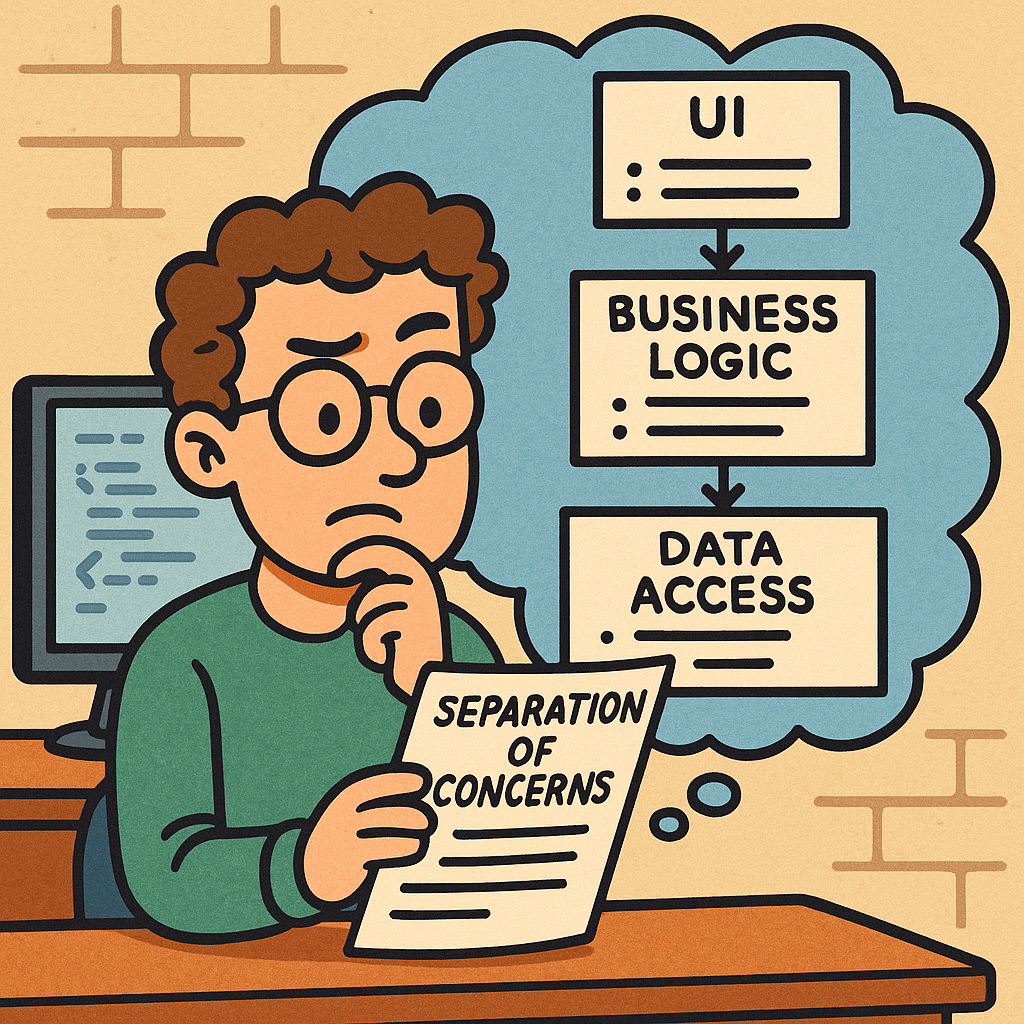
Separation of Concerns (SoC) is a foundational design principle: split your system into parts, where each part focuses on a single, well-defined responsibility. Done well, SoC makes code easier to understand, test, change, scale, and secure.

What is Separation of Concerns?

SoC means organizing software so that each module addresses one concern (a responsibility or “reason to change”) and hides the details of that concern behind clear interfaces.

  • Concern = a cohesive responsibility: UI rendering, data access, domain rules, logging, authentication, caching, configuration, etc.
  • Separation = boundaries (files, classes, packages, services) that prevent concerns from leaking into each other.

Related but different concepts

  • Single Responsibility Principle (SRP): applies at the class/function level. SoC applies at system/module scale.
  • Modularity: a property of structure; SoC is the guiding principle that tells you how to modularize.
  • Encapsulation: the technique that makes separation effective (hide internals, expose minimal interfaces).

How SoC Works

  1. Identify Axes of Change
    Ask: If this changes, what else would need to change? Group code so that each axis of change is isolated (e.g., UI design changes vs. database vendor changes vs. business rules changes).
  2. Define Explicit Boundaries
    • Use layers (Presentation → Application/Service → Domain → Infrastructure/DB).
    • Or vertical slices (Feature A, Feature B), each containing its own UI, logic, and data adapters.
    • Or services (Auth, Catalog, Orders) with network boundaries.
  3. Establish Contracts
    • Interfaces/DTOs so layers talk in clear, stable shapes.
    • APIs so services communicate without sharing internals.
    • Events so features integrate without tight coupling.
  4. Enforce Directional Dependencies
    • High-level policy (domain rules) should not depend on low-level details (database, frameworks).
    • In code, point dependencies inward to abstractions (ports), and keep details behind adapters.
  5. Extract Cross-Cutting Concerns
    • Logging, metrics, auth, validation, caching → implement via middleware, decorators, AOP, or interceptors, not scattered everywhere.
  6. Automate Guardrails
    • Lint rules and architecture tests (e.g., “controllers must not import repositories directly”).
    • Package visibility (e.g., Java package-private), access modifiers, and module boundaries.

Benefits of SoC

  • Change isolation: Modify one concern without ripple effects (e.g., swap PostgreSQL for MySQL by changing only the DB adapter).
  • Testability: Unit tests target a single concern; integration tests verify boundaries; fewer mocks in the wrong places.
  • Reusability: A cleanly separated module (e.g., a pricing engine) can be reused in multiple apps.
  • Parallel development: Teams own concerns or slices without stepping on each other.
  • Scalability & performance: Scale just the hot path (e.g., cache layer or read model) instead of the whole system.
  • Security & compliance: Centralize auth, input validation, and auditing, reducing duplicate risky code.
  • Maintainability: Clear mental model; easier onboarding and refactoring.
  • Observability: Centralized logging/metrics make behavior consistent and debuggable.

Real-World Examples

Web Application (Layered)

  • Presentation: Controllers/Views (HTTP/JSON rendering)
  • Application/Service: Use cases, orchestration
  • Domain: Business rules, entities, value objects
  • Infrastructure: Repositories, messaging, external APIs

Result: Changing UI styling, a pricing rule, or a database index touches different isolated areas.

Front-End (HTML/CSS/JS + State)

  • Structure (HTML/Components) separated from Style (CSS) and Behavior (JS/state).
  • State management (e.g., Redux/Pinia) isolates data flow from view rendering.

Microservices

  • Auth, Catalog, Orders, Billing → each is a concern with its own storage and API.
  • Cross-cutters (logging, tracing, authN/Z) handled via API gateway or shared middleware.

Data Pipelines

  • Ingestion, Normalization, Enrichment, Storage, Serving/BI → separate stages with contracts (schemas).
  • You can replace enrichment logic without touching ingestion.

Cross-Cutting via Middleware

  • Input validation, rate limiting, and structured logging implemented as filters or middleware so business code stays clean.

How to Use SoC in Your Projects

Step-by-Step

  1. Map your concerns
    List core domains (billing, content, search), technical details (DB, cache), and cross-cutters (logging, auth).
  2. Choose a structuring strategy
    • Layers for monoliths and small/medium teams.
    • Vertical feature slices to reduce coordination overhead.
    • Services for independently deployable boundaries (start small—modular monolith first).
  3. Define contracts and boundaries
    • Create interfaces/ports for infrastructure.
    • Use DTOs/events to decouple modules.
    • For services, design versioned APIs.
  4. Refactor incrementally
    • Extract cross-cutters into middleware or decorators.
    • Move data access behind repositories or gateways.
    • Pull business rules into the domain layer.
  5. Add guardrails
    • Architecture tests (e.g., ArchUnit for Java) to forbid forbidden imports.
    • CI checks for dependency direction and circular references.
  6. Document & communicate
    • One diagram per feature or layer (C4 model is a good fit).
    • Ownership map: who maintains which concern.
  7. Continuously review
    • Add “Does this leak a concern?” to PR checklists.
    • Track coupling metrics (instability, afferent/efferent coupling).

Mini Refactor Example (Backend)

Before:
OrderController -> directly talks to JPA Repository
                 -> logs with System.out
                 -> performs validation inline

After:
OrderController -> OrderService (use case)
OrderService -> OrderRepository (interface)
              -> ValidationService (cross-cutter)
              -> Logger (injected)
JpaOrderRepository implements OrderRepository
Logging via middleware/interceptor

Result: You can swap JPA for another store by changing only JpaOrderRepository. Validation and logging are reusable elsewhere.

Patterns That Support SoC

  • MVC/MVP/MVVM: separates UI concerns (view) from presentation and domain logic.
  • Clean/Hexagonal (Ports & Adapters): isolates domain from frameworks and IO.
  • CQRS: separate reads and writes when their concerns diverge (performance, scaling).
  • Event-Driven: decouple features with async events.
  • Dependency Injection: wire implementations to interfaces at the edges.
  • Middleware/Interceptors/Filters: centralize cross-cutting concerns.

Practical, Real-World Examples

  • Feature flags as a concern: toggle new rules in the app layer; domain remains untouched.
  • Search adapters: your app depends on a SearchPort; switch from Elasticsearch to OpenSearch without changing business logic.
  • Payments: domain emits PaymentRequested; payment service handles gateways and retries—domain doesn’t know vendor details.
  • Mobile app MVVM: ViewModel holds state/logic; Views remain dumb; repositories handle data sources.

Common Mistakes (and Fixes)

  • Over-separation (micro-everything): too many tiny modules → slow delivery.
    • Fix: start with a modular monolith, extract services only for hot spots.
  • Leaky boundaries: UI reaches into repositories, or domain knows HTTP.
    • Fix: enforce through interfaces and architecture tests.
  • Cross-cutters sprinkled everywhere: copy-paste validation/logging.
    • Fix: move to middleware/decorators/aspects.
  • God objects/modules: a “Utils” that handles everything.
    • Fix: split by concern; create dedicated packages.

Quick Checklist

  • Does each module have one primary reason to change?
  • Are dependencies pointing inward toward abstractions?
  • Are cross-cutting concerns centralized?
  • Can I swap an implementation (DB, API, style) by touching one area?
  • Do tests cover each concern in isolation?
  • Are there docs/diagrams showing boundaries and contracts?

How to Start Using SoC This Week

  • Create a dependency graph of your project (most IDEs or linters can help).
  • Pick one hot spot (e.g., payment, auth, reporting) and extract its interfaces/adapters.
  • Introduce a middleware layer for logging/validation/auth.
  • Write one architecture test that forbids controllers from importing repositories.
  • Document one boundary with a simple diagram and ownership.

FAQ

Is SoC the same as microservices?
No. Microservices are one way to enforce separation at runtime. You can achieve strong SoC inside a monolith.

How small should a concern be?
A concern should map to a cohesive responsibility and an axis of change. If changes to it often require touching multiple modules, your boundary is probably wrong.

Is duplication ever okay?
Yes, small local duplication can be cheaper than a shared module that couples unrelated features. Optimize for change cost, not just DRY.

Final Thoughts

Separation of Concerns is about clarity and change-friendliness. Start by identifying responsibilities, draw clean boundaries, enforce them with code and tests, and evolve your structure as the product grows. Your future self (and your teammates) will thank you.

Code Review in Software Development

Learning code review

What is a Code Review?

A code review is the process of systematically examining source code written by a developer to identify mistakes, improve quality, and ensure adherence to coding standards. It is a peer-based activity where one or more team members review the code before it is merged into the main codebase.

History of Code Review

The concept of code review dates back to the early days of software engineering in the 1970s, when formal inspections were introduced by Michael Fagan at IBM. These inspections were strict, document-driven, and involved structured meetings. Over time, the practice evolved into more lightweight and flexible processes, especially with the rise of Agile and open-source development, where code review became a standard part of daily workflows.

Importance of Code Review

Code reviews are critical in modern software development. They:

  • Improve code quality and maintainability
  • Detect bugs early in the development cycle
  • Facilitate knowledge sharing among developers
  • Encourage collaboration and collective ownership of the code
  • Enforce coding standards and best practices

Components of a Code Review

A successful code review process usually involves:

  • Author: The developer who wrote the code.
  • Reviewers: Team members who evaluate the code.
  • Tools: Platforms such as GitHub, GitLab, Bitbucket, or specialized review tools.
  • Guidelines: Coding standards, project-specific conventions, and review checklists.
  • Feedback: Constructive comments, suggestions, and clarifications.

How to Perform a Code Review

  • Start by understanding the purpose of the code changes.
  • Review smaller code changes instead of very large pull requests.
  • Check for correctness, readability, performance, and security.
  • Ensure the code follows style guides and project conventions.
  • Provide clear, respectful, and actionable feedback.
  • Encourage discussion instead of one-sided judgment.

Is There a Formal Process?

Yes, organizations often define formal processes for code reviews. A typical process may include:

  1. Developer submits code changes (pull request or merge request).
  2. Automated tests and linters run first.
  3. One or more reviewers analyze the code and leave comments.
  4. The author addresses feedback and makes changes.
  5. Reviewers approve the changes.
  6. Code is merged into the main branch.

Some teams also use pair programming or walkthroughs as part of the process.

Important Details to Pay Attention To

Reviewers should pay attention to:

  • Logic and correctness of the code
  • Security vulnerabilities
  • Performance implications
  • Readability and maintainability
  • Compliance with coding standards
  • Proper documentation and comments

While it’s important to catch issues, reviewers should avoid nitpicking too much on trivial details unless they affect the project long-term.

How Much Time Should We Spend?

Research suggests that effective code reviews should be 30 to 60 minutes per session, focusing on chunks of code not exceeding 400 lines at a time. Longer reviews often reduce effectiveness due to reviewer fatigue. The key is consistency—review regularly, not occasionally.

Applying Code Review in Current Projects

To integrate code reviews into your development process:

  • Use pull requests as the entry point for reviews.
  • Automate tests to catch basic issues before review.
  • Define clear review guidelines for your team.
  • Encourage collaborative discussions.
  • Use tools like GitHub, GitLab, or Bitbucket that integrate seamlessly with workflows.
  • Monitor review metrics (time spent, defects found, review coverage) to improve efficiency.

Understanding MVC Frameworks in Software Development

Understanding MVC Frameworks

What is an MVC Framework?

What is an MVC Framework?

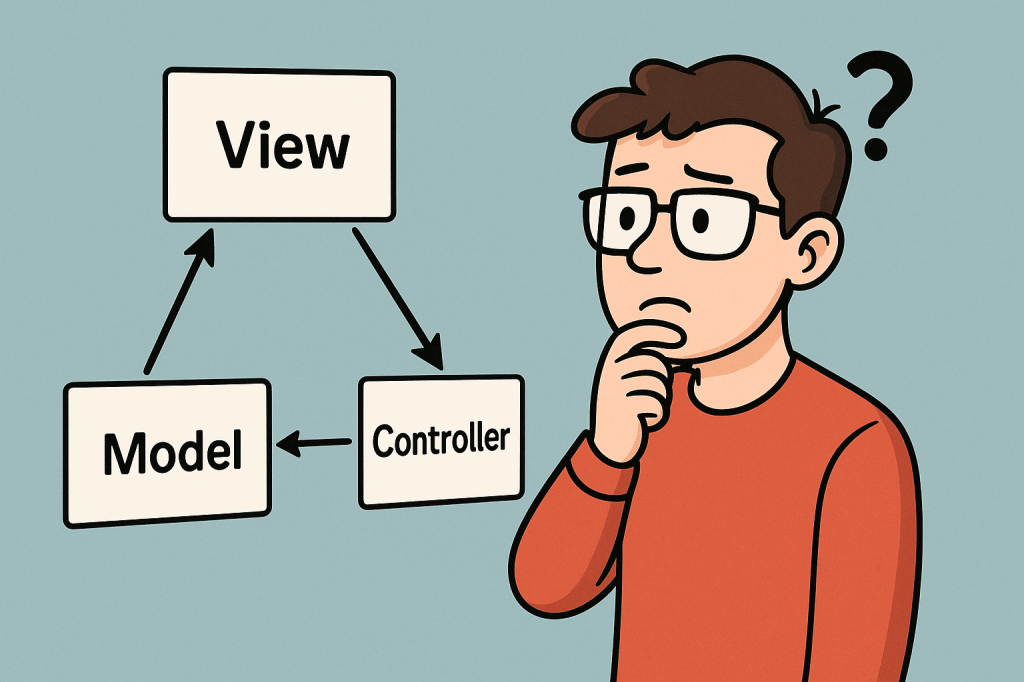
MVC stands for Model–View–Controller, a popular architectural pattern used in software engineering. An MVC framework provides a structured way to separate concerns in an application, making development, testing, and maintenance more manageable. Instead of mixing data, logic, and presentation in one place, MVC enforces a separation that leads to cleaner and more scalable applications.

A Brief History of MVC

The concept of MVC was introduced in the late 1970s by Trygve Reenskaug while working on Smalltalk at Xerox PARC. It was designed as a way to build graphical user interfaces (GUIs) where data and display could be managed independently. Over the years, MVC gained traction in desktop applications and later became one of the dominant architectural patterns for web development frameworks like Ruby on Rails, Django, Angular (early versions), and ASP.NET MVC.

Principles and Components of MVC

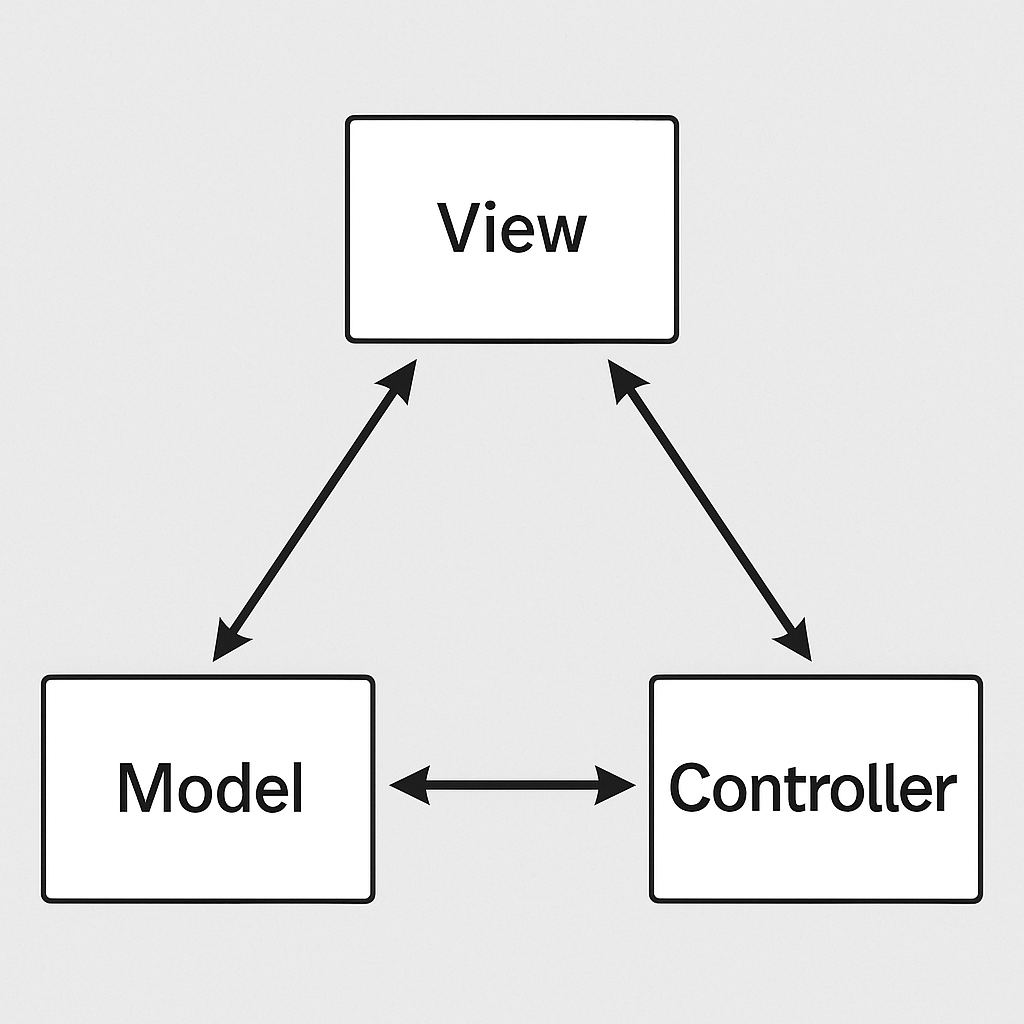
The MVC pattern is based on the principle of separation of concerns, ensuring that each part of the application has a distinct role. It consists of three main components:

1. Model

  • Represents the data and the business logic of the application.
  • It is responsible for retrieving, storing, and updating information (often interacting with a database).
  • Example: In a blog system, the Post model defines the structure of a blog post and manages operations like saving or fetching posts.

2. View

  • Handles the presentation layer.
  • Responsible for displaying the data from the model in a user-friendly way (HTML, JSON, templates, etc.).
  • Example: A web page showing a list of blog posts retrieved by the model.

3. Controller

  • Acts as the middle layer between the Model and View.
  • Receives input from the user, processes it, communicates with the model, and selects the appropriate view for the response.
  • Example: When a user clicks “Create Post,” the controller processes the request, updates the model, and sends the user to a confirmation view.

Advantages of MVC Frameworks

  • Separation of concerns: Each component handles a specific responsibility, reducing code complexity.
  • Maintainability: Easier to update or modify individual parts without affecting the entire system.
  • Testability: Each component can be tested independently, leading to more reliable applications.
  • Reusability: Models, views, or controllers can be reused across different parts of the application.
  • Collaboration: Teams can work on different parts (UI, backend, logic) simultaneously without conflicts.

Benefits for Today’s Software Development

In today’s world of fast-paced, large-scale software development, MVC frameworks provide a foundation for:

  • Scalability: Applications can grow in features and users while remaining stable.
  • Agility: Easier to adopt Agile and DevOps practices, since MVC frameworks often integrate well with CI/CD pipelines.
  • Cross-platform use: MVC works for both web and mobile applications, making it versatile.
  • Community and support: Many popular frameworks (Spring MVC, Laravel, Rails, Django) are built on MVC principles, offering strong ecosystems and libraries.

Why Do People Prefer to Use MVC?

  • Familiarity: MVC is widely taught and used, so developers are comfortable with it.
  • Productivity: Built-in structures and conventions reduce the need to “reinvent the wheel.”
  • Efficiency: Development is faster because teams can work in parallel on models, views, and controllers.
  • Integration: Works well with modern tools, cloud services, and databases.

How to Integrate MVC into Your Software Development Process

  1. Choose a framework: Pick one suited to your programming language (e.g., Spring MVC for Java, Laravel for PHP, Django for Python).
  2. Define models: Identify your application’s data structures and business rules.
  3. Design views: Create templates or interfaces to present data clearly to users.
  4. Implement controllers: Connect user actions to business logic and select views for responses.
  5. Test each layer: Write unit tests for models, functional tests for controllers, and UI tests for views.
  6. Iterate and refine: Continuously improve your architecture as your project grows.

Understanding the Waterfall Model in Software Development

Learning waterfall model

What is the Waterfall Model?

What is the Waterfall Model?

The Waterfall Model is one of the earliest and most traditional approaches to software development. It follows a linear and sequential design process, where each phase must be completed before moving on to the next. Much like water flowing down a series of steps, the process moves forward without going back.

A Brief History of the Waterfall Model

The concept of the Waterfall Model was first introduced in 1970 by Dr. Winston W. Royce in his paper “Managing the Development of Large Software Systems”. While Royce actually presented it as an example of a flawed model (because of its rigidity), the structure was later adapted and formalized. Since then, it became widely used in the 1970s and 1980s, especially for large government and defense projects, where strict documentation and approvals were necessary.

Principles of the Waterfall Model

The Waterfall Model is based on a few guiding principles that define its step-by-step structure:

  1. Sequential Progression
    Development flows in one direction — from requirements to design, implementation, testing, deployment, and maintenance.
  2. Phase Dependency
    Each phase must be fully completed before moving to the next. No overlapping or revisiting of previous phases is expected.
  3. Documentation Driven
    Every stage produces detailed documentation, ensuring clarity and consistency throughout the project lifecycle.
  4. Predictability and Control
    With well-defined phases and deliverables, project timelines and costs can be estimated more accurately.
  5. Customer Sign-off at Each Stage
    Stakeholders approve requirements and designs at early stages, reducing the chances of late surprises.

Why Should We Use the Waterfall Model?

The Waterfall Model provides a clear structure and is easy to understand. It is especially useful for teams that need:

  • A predictable and straightforward process.
  • Detailed documentation and traceability.
  • Strict compliance with external regulations.

Advantages of the Waterfall Model

  • Simple and easy to manage.
  • Well-defined stages with clear milestones.
  • Detailed documentation helps with knowledge transfer.
  • Suitable for projects with stable and well-understood requirements.
  • Easier to measure progress against the plan.

Disadvantages of the Waterfall Model

  • Very rigid and inflexible.
  • Difficult to adapt to changing requirements.
  • Testing comes late in the process, which may delay bug detection.
  • Not ideal for projects with high uncertainty or evolving needs.
  • Can lead to wasted effort if requirements change after early stages.

When Should We Use the Waterfall Model?

The Waterfall Model is best suited for:

  • Projects with clear, fixed requirements that are unlikely to change.
  • Systems requiring strict compliance, such as healthcare, defense, or government projects.
  • Projects where documentation and approvals are critical.
  • Smaller projects where the scope is well understood from the start.

It is less suitable for agile environments or modern software systems that require rapid iterations and frequent feedback.

Applying the Waterfall Model in Software Development

To apply the Waterfall Model in your process:

  1. Gather Requirements – Collect all functional and non-functional requirements from stakeholders.
  2. Design the System – Create detailed system and software designs, including architecture and data models.
  3. Implement the Code – Develop the system according to the approved design.
  4. Test the System – Perform unit, integration, and system testing to verify functionality.
  5. Deploy the Product – Deliver the software to the end users.
  6. Maintain the System – Provide updates, bug fixes, and support over time.

By following these phases strictly in sequence, you can ensure a predictable outcome — though at the cost of flexibility.

Code Refactoring: A Complete Guide for Software Developers

Code refactoring

What is Code Refactoring?

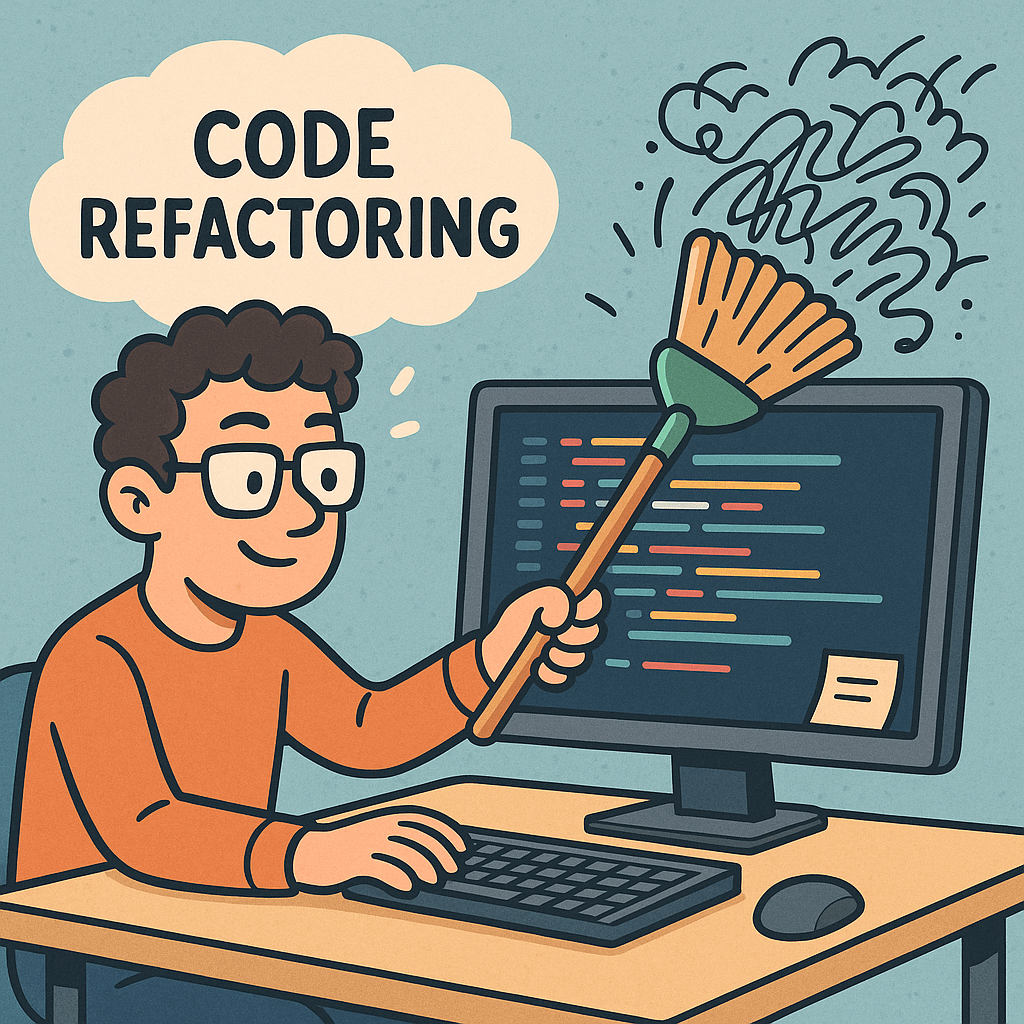
Code refactoring is the process of restructuring existing computer code without changing its external behavior. The main purpose is to improve the internal structure of the code—making it cleaner, easier to read, and more maintainable—without introducing new features or fixing bugs.

In simple terms, think of it as “tidying up” your code to make it better organized and easier to work with.

Why Do We Need Code Refactoring?

Over time, software projects grow and evolve. As new features are added quickly, the codebase may become cluttered, repetitive, or difficult to maintain. Refactoring helps:

  • Reduce technical debt.
  • Improve code readability for current and future developers.
  • Enhance maintainability and reduce the risk of bugs.
  • Support scalability as the project grows.
  • Improve performance in some cases.

Main Concepts of Code Refactoring

When refactoring, developers usually follow some guiding concepts:

  1. Clean Code – Code should be easy to read, simple, and expressive.
  2. DRY (Don’t Repeat Yourself) – Remove code duplication.
  3. KISS (Keep It Simple, Stupid) – Avoid overcomplicated solutions.
  4. Single Responsibility Principle (SRP) – Each class, method, or function should do one thing well.
  5. YAGNI (You Aren’t Gonna Need It) – Avoid adding unnecessary functionality before it’s required.

Best Practices for Code Refactoring

To refactor successfully, follow these best practices:

  • Write tests before refactoring: Ensure that the code’s behavior remains the same after changes.
  • Small steps, frequent commits: Don’t attempt massive refactoring in one go; take incremental steps.
  • Automated tools: Use IDE features like “extract method,” “rename,” or linters to catch issues.
  • Code reviews: Have peers review refactored code for better quality.
  • Refactor regularly: Make it part of your development cycle instead of waiting until the code becomes unmanageable.

How Should We Use Refactoring in Our Projects?

  • Integrate refactoring into Agile sprints while working on new features.
  • Refactor during bug fixing when messy code makes issues hard to track.
  • Apply the “Boy Scout Rule”: Always leave the code cleaner than you found it.
  • Use CI/CD pipelines to run tests automatically after refactoring.

Benefits of Code Refactoring

  • Improved readability → Easier onboarding of new team members.
  • Reduced complexity → Simplified logic and structure.
  • Lower maintenance cost → Fewer bugs and easier updates.
  • Increased reusability → Cleaner components can be reused in other parts of the project.
  • Higher development speed → Developers spend less time understanding messy code.

Issues and Challenges of Code Refactoring

Despite its benefits, refactoring can pose challenges:

  • Risk of introducing bugs if tests are not comprehensive.
  • Time constraints in fast-paced projects may limit refactoring opportunities.
  • Lack of tests in legacy systems makes safe refactoring difficult.
  • Resistance from stakeholders who prefer adding new features over code improvements.

Conclusion

Code refactoring is not just a technical activity—it’s an investment in the long-term health of your software project. By applying it consistently with best practices, you ensure that your codebase remains clean, efficient, and adaptable for future growth.

Remember: Refactoring is not a one-time effort but a continuous process that should become part of your development culture.

Blog at WordPress.com.

Up ↑