Search

Software Engineer's Notes

Tag

Software Architecture

ISO/IEC/IEEE 42010: Understanding the Standard for Architecture Descriptions

What is ISO/IEC/IEEE 42010?

What is ISO/IEC/IEEE 42010?

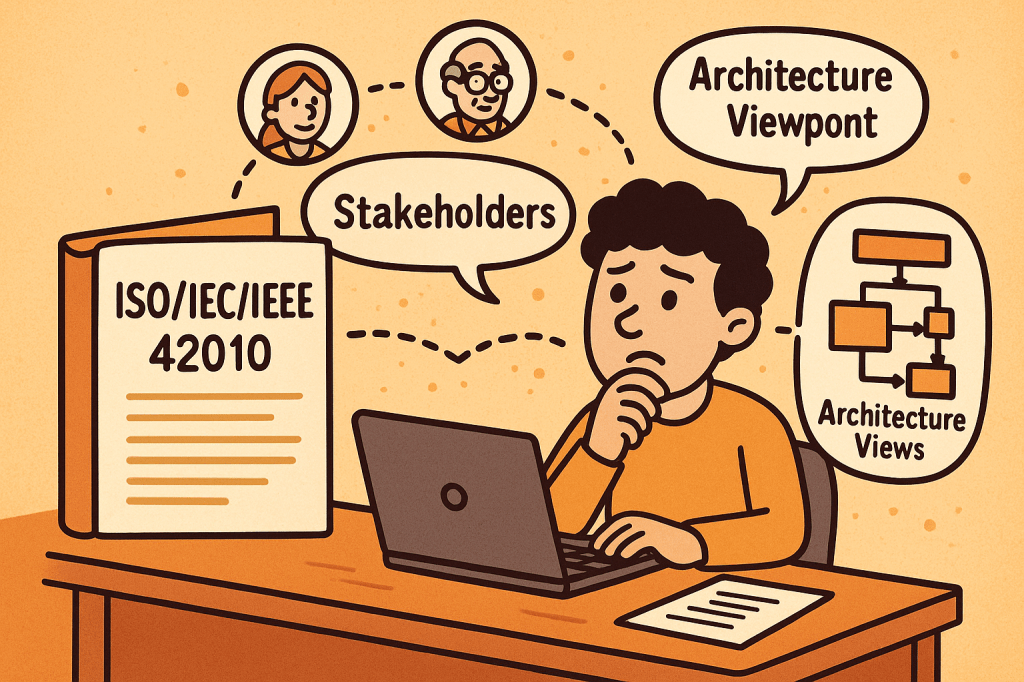
ISO/IEC/IEEE 42010 is an international standard that provides guidance for describing system and software architectures. It ensures that architecture descriptions are consistent, comprehensive, and understandable to all stakeholders.

The standard defines a framework and terminology that helps architects document, communicate, and evaluate software and systems architectures in a standardized and structured way.

At its core, ISO/IEC/IEEE 42010 answers the question: How do we describe architectures so they are meaningful, useful, and comparable?

A Brief History of ISO/IEC/IEEE 42010

The standard evolved to address the increasing complexity of systems and the lack of uniformity in architectural documentation:

  • 1996 – The original version was published as IEEE Std 1471-2000, known as “Recommended Practice for Architectural Description of Software-Intensive Systems.”
  • 2007 – Adopted by ISO and IEC as ISO/IEC 42010:2007, giving it wider international recognition.
  • 2011 – Revised and expanded as ISO/IEC/IEEE 42010:2011, incorporating both system and software architectures, aligning with global best practices, and harmonizing with IEEE.
  • Today – It remains the foundational standard for architecture description, often referenced in model-driven development, enterprise architecture, and systems engineering.

Key Components and Features of ISO/IEC/IEEE 42010

The standard defines several core concepts to ensure architecture descriptions are useful and structured:

1. Stakeholders

  • Individuals, teams, or organizations who have an interest in the system (e.g., developers, users, maintainers, regulators).
  • The standard emphasizes identifying stakeholders and their concerns.

2. Concerns

  • Issues that stakeholders care about, such as performance, security, usability, reliability, scalability, and compliance.
  • Architecture descriptions must explicitly address these concerns.

3. Architecture Views

  • Representations of the system from the perspective of particular concerns.
  • For example:
    • A deployment view shows how software maps to hardware.
    • A security view highlights authentication, authorization, and data protection.

4. Viewpoints

  • Specifications that define how to construct and interpret views.
  • Example: A UML diagram might serve as a viewpoint to express design details.

5. Architecture Description (AD)

  • The complete set of views, viewpoints, and supporting information documenting the architecture of a system.

6. Correspondences and Rationale

  • Explains how different views relate to each other.
  • Provides reasoning for architectural choices, improving traceability.

Why Do We Need ISO/IEC/IEEE 42010?

Architectural documentation often suffers from being inconsistent, incomplete, or too tailored to one stakeholder group. This is where ISO/IEC/IEEE 42010 adds value:

  • Improves communication
    Provides a shared vocabulary and structure for architects, developers, managers, and stakeholders.
  • Ensures completeness
    Encourages documenting all stakeholder concerns, not just technical details.
  • Supports evaluation
    Helps teams assess whether the architecture meets quality attributes like performance, maintainability, and security.
  • Enables consistency
    Standardizes how architectures are described, making them easier to compare, reuse, and evolve.
  • Facilitates governance
    Useful in regulatory or compliance-heavy industries (healthcare, aerospace, finance) where documentation must meet international standards.

What ISO/IEC/IEEE 42010 Does Not Cover

While it provides a strong framework for describing architectures, it does not define or prescribe:

  • Specific architectural methods or processes
    It does not tell you how to design an architecture (e.g., Agile, TOGAF, RUP). Instead, it tells you how to describe the architecture once you’ve designed it.
  • Specific notations or tools
    The standard does not mandate UML, ArchiMate, or SysML. Any notation can be used, as long as it aligns with stakeholder concerns.
  • System or software architecture itself
    It is not a design method, but rather a documentation and description framework.
  • Quality guarantees
    It ensures concerns are addressed and documented but does not guarantee that the system will meet those concerns in practice.

Final Thoughts

ISO/IEC/IEEE 42010 is a cornerstone standard in systems and software engineering. It brings clarity, structure, and rigor to how we document architectures. While it doesn’t dictate how to build systems, it ensures that when systems are built, their architectures are well-communicated, stakeholder-driven, and consistent.

For software teams, enterprise architects, and systems engineers, adopting ISO/IEC/IEEE 42010 can significantly improve communication, reduce misunderstandings, and strengthen architectural governance.
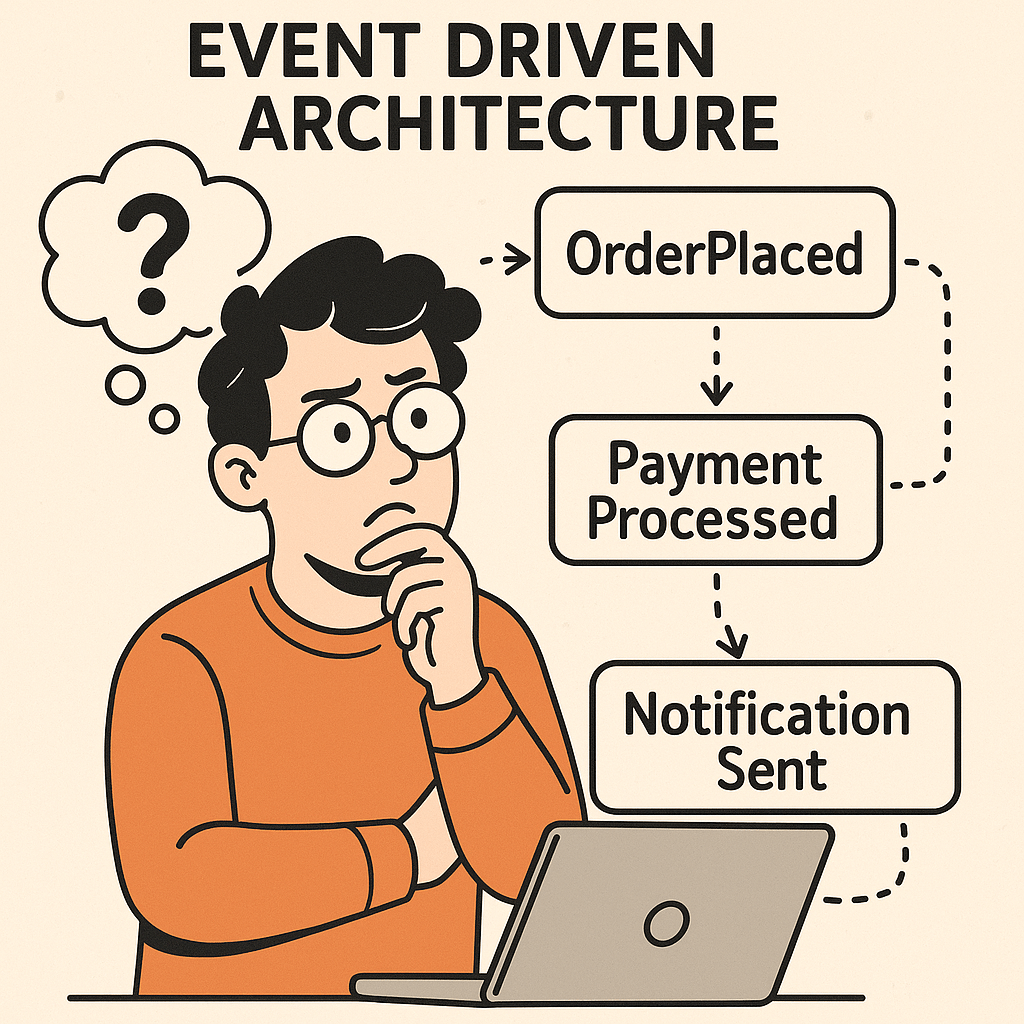
Event Driven Architecture: A Complete Guide

What is event driven architecture?

What is Event Driven Architecture?

Event Driven Architecture (EDA) is a modern software design pattern where systems communicate through events rather than direct calls. Instead of services requesting and waiting for responses, they react to events as they occur.

An event is simply a significant change in state — for example, a user placing an order, a payment being processed, or a sensor detecting a temperature change. In EDA, these events are captured, published, and consumed by other components in real time.

This approach makes systems more scalable, flexible, and responsive to change compared to traditional request/response architectures.

Main Components of Event Driven Architecture

1. Event Producers

These are the sources that generate events. For example, an e-commerce application might generate an event when a customer places an order.

2. Event Routers (Event Brokers)

Routers manage the flow of events. They receive events from producers and deliver them to consumers. Message brokers like Apache Kafka, RabbitMQ, or AWS EventBridge are commonly used here.

3. Event Consumers

These are services or applications that react to events. For instance, an email service may consume an “OrderPlaced” event to send an order confirmation email.

4. Event Channels

These are communication pathways through which events travel. They ensure producers and consumers remain decoupled.

How Does Event Driven Architecture Work?

  1. Event Occurs – Something happens (e.g., a new user signs up).
  2. Event Published – The producer sends this event to the broker.
  3. Event Routed – The broker forwards the event to interested consumers.
  4. Event Consumed – Services subscribed to this event take action (e.g., send a welcome email, update analytics, trigger a workflow).

This process is asynchronous, meaning producers don’t wait for consumers. Events are processed independently, allowing for more efficient, real-time interactions.

Benefits and Advantages of Event Driven Architecture

Scalability

Each service can scale independently based on the number of events it needs to handle.

Flexibility

You can add new consumers without modifying existing producers, making it easier to extend systems.

Real-time Processing

EDA enables near real-time responses, perfect for financial transactions, IoT, and user notifications.

Loose Coupling

Producers and consumers don’t need to know about each other, reducing dependencies.

Resilience

If one consumer fails, other parts of the system continue working. Events can be replayed or queued until recovery.

Challenges of Event Driven Architecture

Complexity

Designing an event-driven system requires careful planning of event flows and dependencies.

Event Ordering and Idempotency

Events may arrive out of order or be processed multiple times, requiring special handling to avoid duplication.

Monitoring and Debugging

Since interactions are asynchronous and distributed, tracing the flow of events can be harder compared to request/response systems.

Data Consistency

Maintaining strong consistency across distributed services is difficult. Often, EDA relies on eventual consistency, which may not fit all use cases.

Operational Overhead

Operating brokers like Kafka or RabbitMQ adds infrastructure complexity and requires proper monitoring and scaling strategies.

When and How Can We Use Event Driven Architecture?

EDA is most effective when:

  • The system requires real-time responses (e.g., fraud detection).
  • The system must handle high scalability (e.g., millions of user interactions).
  • You need decoupled services that can evolve independently.
  • Multiple consumers need to react differently to the same event.

It may not be ideal for small applications where synchronous request/response is simpler.

Real World Examples of Event Driven Architecture

E-Commerce

  • Event: Customer places an order.
  • Consumers:
    • Payment service processes the payment.
    • Inventory service updates stock.
    • Notification service sends confirmation.
    • Shipping service prepares delivery.

All of these happen asynchronously, improving performance and user experience.

Banking and Finance

  • Event: A suspicious transaction occurs.
  • Consumers:
    • Fraud detection system analyzes it.
    • Notification system alerts the user.
    • Compliance system records it.

This allows banks to react to fraud in real-time.

IoT Applications

  • Event: Smart thermostat detects high temperature.
  • Consumers:
    • Air conditioning system turns on.
    • Notification sent to homeowner.
    • Analytics system logs energy usage.

Social Media

  • Event: A user posts a photo.
  • Consumers:
    • Notification service alerts friends.
    • Analytics system tracks engagement.
    • Recommendation system updates feeds.

Conclusion

Event Driven Architecture provides a powerful way to build scalable, flexible, and real-time systems. While it introduces challenges like debugging and data consistency, its benefits make it an essential pattern for modern applications — from e-commerce to IoT to financial systems.

When designed and implemented carefully, EDA can transform how software responds to change, making systems more resilient and user-friendly.

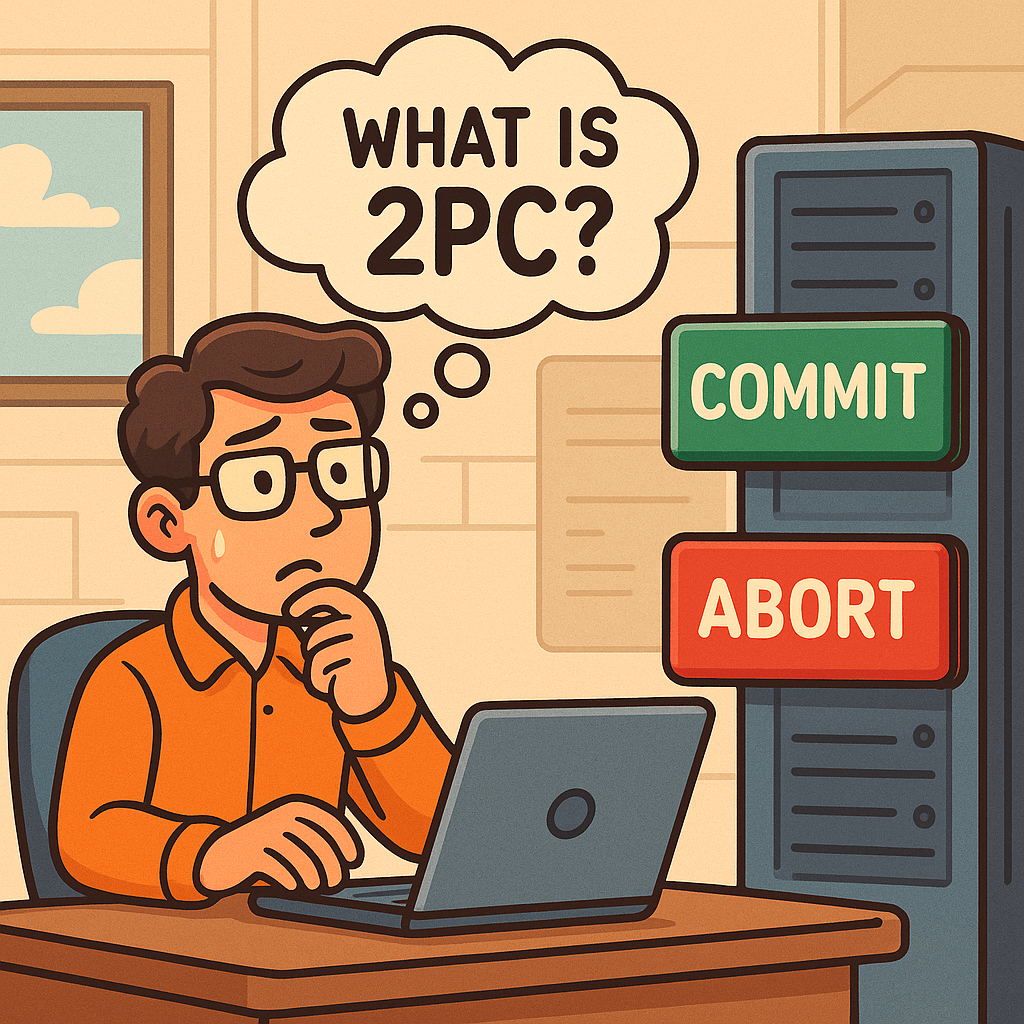
Two-Phase Commit (2PC) in Computer Science: A Complete Guide

What is 2PC?

When we build distributed systems, one of the biggest challenges is ensuring consistency across multiple systems or databases. This is where the Two-Phase Commit (2PC) protocol comes into play. It is a classic algorithm used in distributed computing to ensure that a transaction is either committed everywhere or rolled back everywhere, guaranteeing data consistency.

What is 2PC in Computer Science?

Two-Phase Commit (2PC) is a distributed transaction protocol that ensures all participants in a transaction either commit or abort changes in a coordinated way.
It is widely used in databases, distributed systems, and microservices architectures where data is spread across multiple nodes or systems.

In simple terms, 2PC makes sure that all systems involved in a transaction agree on the outcome—either everyone saves the changes, or no one does.

How Does 2PC Work?

As its name suggests, 2PC works in two phases:

1. Prepare Phase (Voting Phase)

  • The coordinator (a central transaction manager) asks all participants (databases, services, etc.) if they can commit the transaction.
  • Each participant performs local checks and responds with:
    • Yes (Vote to Commit) if it can successfully commit.
    • No (Vote to Abort) if it cannot commit due to conflicts, errors, or failures.

2. Commit Phase (Decision Phase)

  • If all participants vote Yes, the coordinator sends a commit command to everyone.
  • If any participant votes No, the coordinator sends a rollback command to all participants.

This ensures that either all participants commit or none of them do, avoiding partial updates.

Real-World Use Cases of 2PC

1. Banking Systems

When transferring money between two accounts in different banks, both banks must either commit the transaction or roll it back. Without 2PC, one bank might deduct money while the other fails to add it, leading to inconsistency.

2. E-Commerce Order Processing

In an online shopping system:

  • One service decreases stock from inventory.
  • Another service charges the customer’s credit card.
  • Another service updates shipping details.
    Using 2PC, these operations are treated as a single transaction—either all succeed, or all fail.

3. Distributed Databases

In systems like PostgreSQL, Oracle, or MySQL clusters, 2PC is used to ensure that a transaction spanning multiple databases remains consistent.

Issues and Disadvantages of 2PC

While 2PC is reliable, it comes with challenges:

  • Blocking Problem: If the coordinator fails during the commit phase, participants may remain locked waiting for instructions, which can halt the system.
  • Performance Overhead: 2PC introduces extra communication steps, leading to slower performance compared to local transactions.
  • Single Point of Failure: The coordinator is critical. If it crashes, recovery is complex.
  • Not Fault-Tolerant Enough: In real distributed systems, network failures and node crashes are common, and 2PC struggles in such cases.

These issues have led to the development of more advanced protocols like Three-Phase Commit (3PC) or Saga pattern in microservices.

When and How Should We Use 2PC?

2PC is best used when:

  • Strong consistency is critical.
  • The system requires atomic transactions across multiple services or databases.
  • Downtime or data corruption is unacceptable.

However, it should be avoided in systems that require high availability and fault tolerance, where alternatives like eventual consistency or Saga pattern may be more suitable.

Integrating 2PC into Your Software Development Process

Here are practical ways to apply 2PC:

  1. Distributed Databases: Many enterprise database systems (Oracle, PostgreSQL, MySQL with XA transactions) already support 2PC. You can enable it when working with transactions across multiple nodes.
  2. Transaction Managers: Middleware solutions (like Java Transaction API – JTA, or Spring’s transaction management with XA) provide 2PC integration for enterprise applications.
  3. Microservices: If your microservices architecture requires strict ACID guarantees, you can implement a 2PC coordinator service. However, for scalability, you might also consider Saga as a more modern alternative.
  4. Testing and Monitoring: Ensure you have proper logging, failure recovery, and monitoring in place, as 2PC can lead to system lockups if the coordinator fails.

Conclusion

Two-Phase Commit (2PC) is a cornerstone protocol for ensuring atomicity and consistency in distributed systems. While it is not perfect and comes with disadvantages like blocking and performance costs, it remains highly valuable in scenarios where consistency is more important than availability.

By understanding its use cases, challenges, and integration strategies, software engineers can decide whether 2PC is the right fit—or if newer alternatives should be considered.

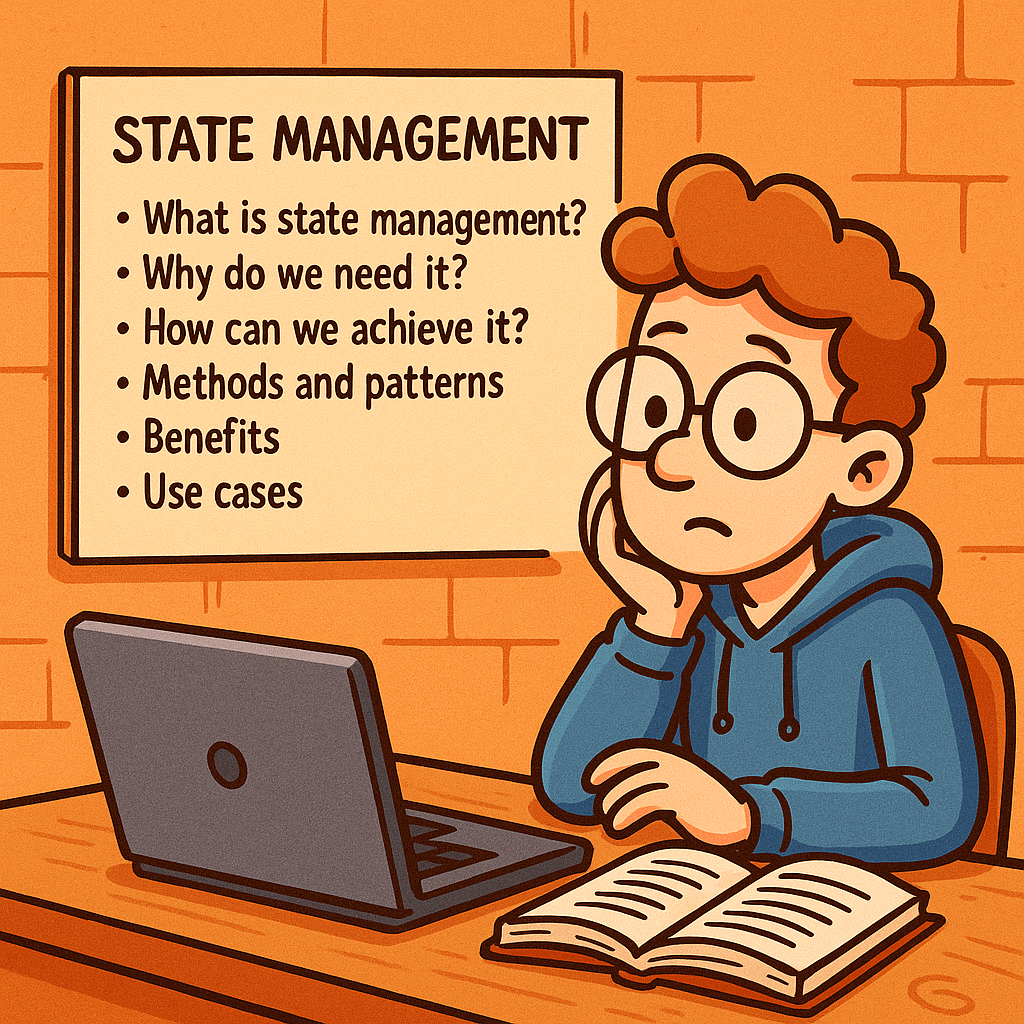
State Management in Software Engineering

Learning state management

What Is State Management?

State is the “memory” of a system—the data that captures what has happened so far and what things look like right now.
State management is the set of techniques you use to represent, read, update, persist, share, and synchronize that data across components, services, devices, and time.

Examples of state:

  • A user’s shopping cart
  • The current screen and filters in a UI
  • A microservice’s cache
  • A workflow’s step (“Pending → Approved → Shipped”)
  • A distributed ledger’s account balances

Why Do We Need It?

  • Correctness: Make sure reads/writes follow rules (e.g., no negative inventory).
  • Predictability: Same inputs produce the same outputs; fewer “heisenbugs.”
  • Performance: Cache and memoize expensive work.
  • Scalability: Share and replicate state safely across processes/regions.
  • Resilience: Recover after crashes with snapshots, logs, or replicas.
  • Collaboration: Keep many users and services in sync (conflict handling included).
  • Auditability & Compliance: Track how/when state changed (who did what).

How Can We Achieve It? (Core Approaches)

  1. Local/In-Memory State
    • Kept inside a process (e.g., component state in a UI, service memory cache).
    • Fast, simple; volatile and not shared by default.
  2. Centralized Store
    • A single source of truth (e.g., Redux store, Vuex/Pinia, NgRx).
    • Deterministic updates via actions/reducers; great for complex UIs.
  3. Server-Side Persistence
    • Databases (SQL/NoSQL), key-value stores (Redis), object storage.
    • ACID/transactions for strong consistency; or tunable/BASE for scale.
  4. Event-Driven & Logs
    • Append-only logs (Kafka, Pulsar), pub/sub, event sourcing.
    • Rebuild state from events; great for audit trails and temporal queries.
  5. Finite State Machines/Statecharts
    • Explicit states and transitions (e.g., XState).
    • Eliminates impossible states; ideal for workflows and UI flows.
  6. Actor Model
    • Isolated “actors” own their state and communicate via messages (Akka, Orleans).
    • Avoids shared memory concurrency issues.
  7. Sagas/Process Managers
    • Coordinate multi-service transactions with compensating actions.
    • Essential for long-running, distributed workflows.
  8. Caching & Memoization
    • In-memory, Redis, CDN edge caches; read-through/write-through patterns.
  9. Synchronization & Consensus
    • Leader election and config/state coordination (Raft/etcd, Zookeeper).
    • Used for distributed locks, service discovery, cluster metadata.
  10. Conflict-Friendly Models
    • CRDTs and operational transforms for offline-first and collaborative editing.

Patterns & When To Use Them

  • Repository Pattern: Encapsulate persistence logic behind an interface.
  • Unit of Work: Group changes into atomic commits (helpful with ORMs).
  • CQRS: Separate reads and writes for scale/optimization.
  • Event Sourcing: Store the events; derive current state on demand.
  • Domain-Driven Design (DDD) Aggregates: Keep invariants inside boundaries.
  • Idempotent Commands: Safe retries in distributed environments.
  • Outbox Pattern: Guarantee DB + message bus consistency.
  • Cache-Aside / Read-Through: Balance performance and freshness.
  • Statechart-Driven UIs: Model UI states explicitly to avoid edge cases.

Benefits of Good State Management

  • Fewer bugs & clearer mental model (explicit transitions and invariants)
  • Traceability (who changed what, when, and why)
  • Performance (targeted caching, denormalized read models)
  • Flexibility (swap persistence layers, add features without rewrites)
  • Scalability (independent read/write scaling, sharding)
  • Resilience (snapshots, replays, blue/green rollouts)

Real-World Use Cases

  • E-commerce: Cart, inventory reservations, orders (Sagas + Outbox + CQRS).
  • Banking/FinTech: Double-entry ledgers, idempotent transfers, audit trails (Event Sourcing).
  • Healthcare: Patient workflow states, consent, auditability (Statecharts + DDD aggregates).
  • IoT: Device twins, last-known telemetry, conflict resolution (CRDTs or eventual consistency).
  • Collaboration Apps: Docs/whiteboards with offline editing (CRDTs/OT).
  • Gaming/Realtime: Matchmaking and player sessions (Actor model + in-memory caches).
  • Analytics/ML: Feature stores and slowly changing dimensions (immutable logs + batch/stream views).

Choosing an Approach (Quick Guide)

  • Simple UI component: Local state → lift to a small store if many siblings need it.
  • Complex UI interactions: Statecharts or Redux-style store with middleware.
  • High read throughput: CQRS with optimized read models + cache.
  • Strong auditability: Event sourcing + snapshots + projections.
  • Cross-service transactions: Sagas with idempotent commands + Outbox.
  • Offline/collaborative: CRDTs or OT, background sync, conflict-free merges.
  • Low-latency hot data: In-memory/Redis cache + cache-aside.

How To Use It In Your Software Projects

1) Model the Domain and State

  • Identify entities, value objects, and aggregates.
  • Write down invariants (“inventory ≥ 0”) and state transitions as a state diagram.

2) Define Read vs Write Paths

  • Consider CQRS if reads dominate or need different shapes than writes.
  • Create projections or denormalized views for common queries.

3) Pick Storage & Topology

  • OLTP DB for strong consistency; document/column stores for flexible reads.
  • Redis/memory caches for latency; message bus (Kafka) for event pipelines.
  • Choose consistency model (strong vs eventual) per use case.

4) Orchestrate Changes

  • Commands → validation → domain logic → events → projections.
  • For cross-service flows, implement Sagas with compensations.
  • Ensure idempotency (dedupe keys, conditional updates).

5) Make Failures First-Class

  • Retries with backoff, circuit breakers, timeouts.
  • Outbox for DB-to-bus consistency; dead-letter queues.
  • Snapshots + event replay for recovery.

6) Testing Strategy

  • Unit tests: Reducers/state machines (no I/O).
  • Property-based tests: Invariants always hold.
  • Contract tests: Between services for event/command schemas.
  • Replay tests: Rebuild from events and assert final state.

7) Observability & Ops

  • Emit domain events and metrics on state transitions.
  • Trace IDs through commands, handlers, and projections.
  • Dashboards for lag, cache hit rate, saga success/fail ratios.

8) Security & Compliance

  • AuthN/AuthZ checks at state boundaries.
  • PII encryption, data retention, and audit logging.

Practical Examples

Example A: Shopping Cart (Service + Cache + Events)

  • Write path: AddItemCommand validates stock → updates DB (aggregate) → emits ItemAdded.
  • Read path: Cart view uses a projection kept fresh via events; Redis caches the view.
  • Resilience: Outbox ensures ItemAdded is published even if the service restarts.

Example B: UI Wizard With Statecharts

  • States: Start → PersonalInfo → Shipping → Payment → Review → Complete
  • Guards prevent illegal transitions (e.g., can’t pay before shipping info).
  • Tests assert allowed transitions and side-effects per state.

Example C: Ledger With Event Sourcing

  • Only store TransferInitiated, Debited, Credited, TransferCompleted/Failed.
  • Current balances are projections; rebuilding is deterministic and auditable.

Common Pitfalls (and Fixes)

  • Implicit state in many places: Centralize or document owners; use a store.
  • Mutable shared objects: Prefer immutability; copy-on-write.
  • Missing idempotency: Add request IDs, conditional updates, and dedupe.
  • Tight coupling to DB schema: Use repositories and domain models.
  • Ghost states in UI: Use statecharts or a single source of truth.
  • Cache incoherence: Establish clear cache-aside/invalidations; track TTLs.

Lightweight Checklist

  • Enumerate state, owners, and lifecycle.
  • Decide consistency model per boundary.
  • Choose patterns (CQRS, Sagas, ES, Statecharts) intentionally.
  • Plan storage (DB/log/cache) and schemas/events.
  • Add idempotency and the Outbox pattern where needed.
  • Write reducer/state machine/unit tests.
  • Instrument transitions (metrics, logs, traces).
  • Document invariants and recovery procedures.

Final Thoughts

State management is not one tool—it’s a discipline. Start with your domain’s invariants and consistency needs, then choose patterns and storage that make those invariants easy to uphold. Keep state explicit, observable, and testable. Your systems—and your future self—will thank you.

What is a Modular Monolith?

What is a Modular Monolith?

A modular monolith is a software architecture style where an application is built as a single deployable unit (like a traditional monolith), but internally it is organized into well-defined modules. Each module encapsulates specific functionality and communicates with other modules through well-defined interfaces, making the system more maintainable and scalable compared to a classic monolith.

Unlike microservices, where each service is deployed and managed separately, modular monoliths keep deployment simple but enforce modularity within the application.

Main Components and Features of a Modular Monolith

1. Modules

  • Self-contained units with a clear boundary.
  • Each module has its own data structures, business logic, and service layer.
  • Modules communicate through interfaces, not direct database or code access.

2. Shared Kernel or Core

  • Common functionality (like authentication, logging, error handling) that multiple modules use.
  • Helps avoid duplication but must be carefully managed to prevent tight coupling.

3. Interfaces and Contracts

  • Communication between modules is strictly through well-defined APIs or contracts.
  • Prevents “spaghetti code” where modules become tangled.

4. Independent Development and Testing

  • Modules can be developed, tested, and even versioned separately.
  • Still compiled and deployed together, but modularity speeds up development cycles.

5. Single Deployment Unit

  • Unlike microservices, deployment remains simple (a single application package).
  • Easier to manage operationally while still benefiting from modularity.

Benefits of a Modular Monolith

1. Improved Maintainability

  • Clear separation of concerns makes the codebase easier to navigate and modify.
  • Developers can work within modules without breaking unrelated parts.

2. Easier Transition to Microservices

  • A modular monolith can serve as a stepping stone toward microservices.
  • Well-designed modules can later be extracted into independent services.

3. Reduced Complexity in Deployment

  • Single deployment unit avoids the operational complexity of managing multiple microservices.
  • No need to handle distributed systems challenges like service discovery or network latency.

4. Better Scalability Than a Classic Monolith

  • Teams can scale development efforts by working on separate modules independently.
  • Logical boundaries support parallel development.

5. Faster Onboarding

  • New developers can focus on one module at a time instead of the entire system.

Advantages and Disadvantages

Advantages

  • Simpler deployment compared to microservices.
  • Strong modular boundaries improve maintainability.
  • Lower infrastructure costs since everything runs in one unit.
  • Clear path to microservices if needed in the future.

Disadvantages

  • Scaling limits: the whole application still scales as one unit.
  • Tight coupling risk: if boundaries are not enforced, modules can become tangled.
  • Database challenges: teams must resist the temptation of a single shared database without proper separation.
  • Not as resilient: a failure in one module can still crash the entire system.

Real-World Use Cases and Examples

  1. E-commerce Platforms
    • Modules like “Product Catalog,” “Shopping Cart,” “Payments,” and “User Management” are separate but deployed together.
  2. Banking Systems
    • Modules for “Accounts,” “Transactions,” “Loans,” and “Reporting” allow different teams to work independently.
  3. Healthcare Applications
    • Modules like “Patient Records,” “Appointments,” “Billing,” and “Analytics” benefit from modular monolith design before moving to microservices.
  4. Enterprise Resource Planning (ERP)
    • HR, Finance, and Inventory modules can live in a single deployment but still be logically separated.

How to Integrate Modular Monolith into Your Software Development Process

  1. Define Clear Module Boundaries
    • Start by identifying core domains and subdomains (Domain-Driven Design can help).
  2. Establish Communication Rules
    • Only allow interaction through interfaces or APIs, not direct database or code references.
  3. Use Layered Architecture Within Modules
    • Separate each module into layers: presentation, application logic, and domain logic.
  4. Implement Independent Testing for Modules
    • Write unit and integration tests per module.
  5. Adopt Incremental Refactoring
    • If you have a classic monolith, refactor gradually into modules.
  6. Prepare for Future Growth
    • Design modules so they can be extracted as microservices when scaling demands it.

Conclusion

A modular monolith strikes a balance between the simplicity of a traditional monolith and the flexibility of microservices. By creating strong modular boundaries, teams can achieve better maintainability, parallel development, and scalability while avoiding the operational overhead of distributed systems.

It’s a great fit for teams who want to start simple but keep the door open for future microservices adoption.

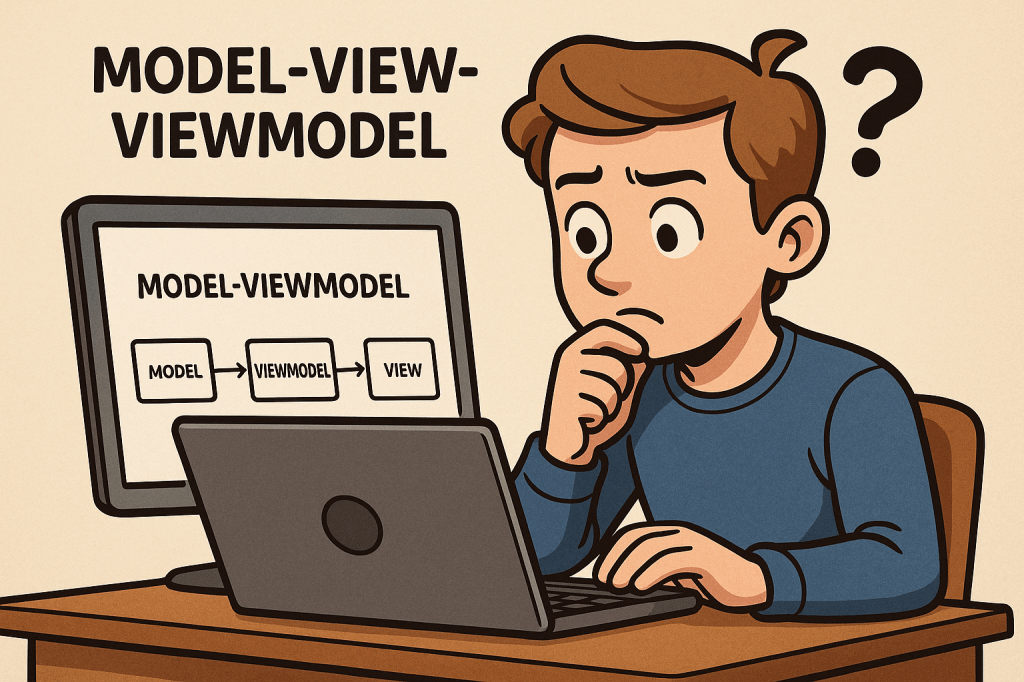
Understanding Model-View-ViewModel (MVVM)

Understanding Model-View-ViewModel

What is MVVM?

What is MVVM?

Model-View-ViewModel (MVVM) is a software architectural pattern that helps organize code by separating the user interface (UI) from the business logic. It acts as an evolution of the Model-View-Controller (MVC) pattern, designed to make applications more testable, maintainable, and scalable. MVVM is particularly popular in applications with complex user interfaces, such as desktop and mobile apps.

A Brief History

MVVM was introduced by Microsoft around 2005 as part of the development of Windows Presentation Foundation (WPF). The goal was to provide a clean separation between the UI and underlying application logic, making it easier for designers and developers to collaborate. Over time, the pattern has spread beyond WPF and is now used in many frameworks and platforms, including Xamarin, Angular, and even some JavaScript libraries.

Main Components of MVVM

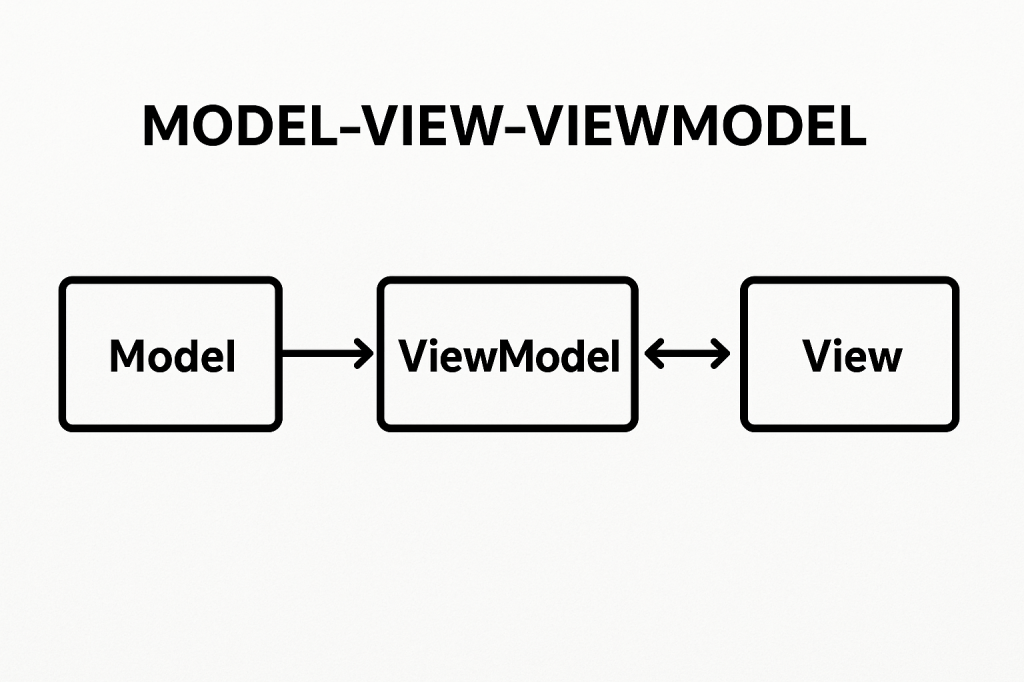
MVVM is built on three main components:

Model

  • Represents the data and business logic of the application.
  • Responsible for managing the application state, retrieving data from databases or APIs, and applying business rules.
  • Example: A Customer class containing fields like Name, Email, and methods for validation.

View

  • Represents the user interface.
  • Displays the data and interacts with the user.
  • Ideally, the view should contain minimal logic and be as declarative as possible.
  • Example: A screen layout in WPF, Android XML, or an HTML template.

ViewModel

  • Acts as a bridge between the Model and the View.
  • Handles UI logic, state management, and provides data in a format the View can easily consume.
  • Exposes commands and properties that the View binds to.
  • Example: A CustomerViewModel exposing properties like FullName or commands like SaveCustomer.

Benefits of MVVM

  • Separation of Concerns: UI code is decoupled from business logic, making the system more maintainable.
  • Improved Testability: Since the ViewModel doesn’t depend on UI elements, it can be easily unit tested.
  • Reusability: The same ViewModel can be used with different Views, increasing flexibility.
  • Collaboration: Designers can work on Views while developers work on ViewModels independently.

Advantages and Disadvantages

Advantages

  • Cleaner and more organized code structure.
  • Reduces duplication of logic across UI components.
  • Makes it easier to scale applications with complex user interfaces.

Disadvantages

  • Can introduce complexity for smaller projects where the overhead is unnecessary.
  • Learning curve for developers new to data binding and command patterns.
  • Requires careful planning to avoid over-engineering.

When Can We Use MVVM?

MVVM is best suited for:

  • Applications with complex or dynamic user interfaces.
  • Projects requiring strong separation of responsibilities.
  • Teams where designers and developers work closely together.
  • Applications needing high test coverage for business and UI logic.

Real World Example

Consider a banking application with a dashboard displaying account balances, recent transactions, and quick actions.

  • Model: Manages account data retrieved from a server.
  • View: The dashboard screen the user interacts with.
  • ViewModel: Provides observable properties like Balance, TransactionList, and commands such as TransferMoney.

This allows changes in the Model (like a new transaction) to automatically update the View without direct coupling.

Integrating MVVM into Our Software Development Process

  1. Identify UI Components: Break down your application into Views and determine the data each needs.
  2. Design ViewModels: Create ViewModels to expose the required data and commands.
  3. Implement Models: Build Models that handle business rules and data access.
  4. Apply Data Binding: Bind Views to ViewModels for real-time updates.
  5. Testing: Write unit tests for ViewModels to ensure correctness without relying on the UI.
  6. Iterate: As requirements change, update ViewModels and Models while keeping the View lightweight.

Blog at WordPress.com.

Up ↑