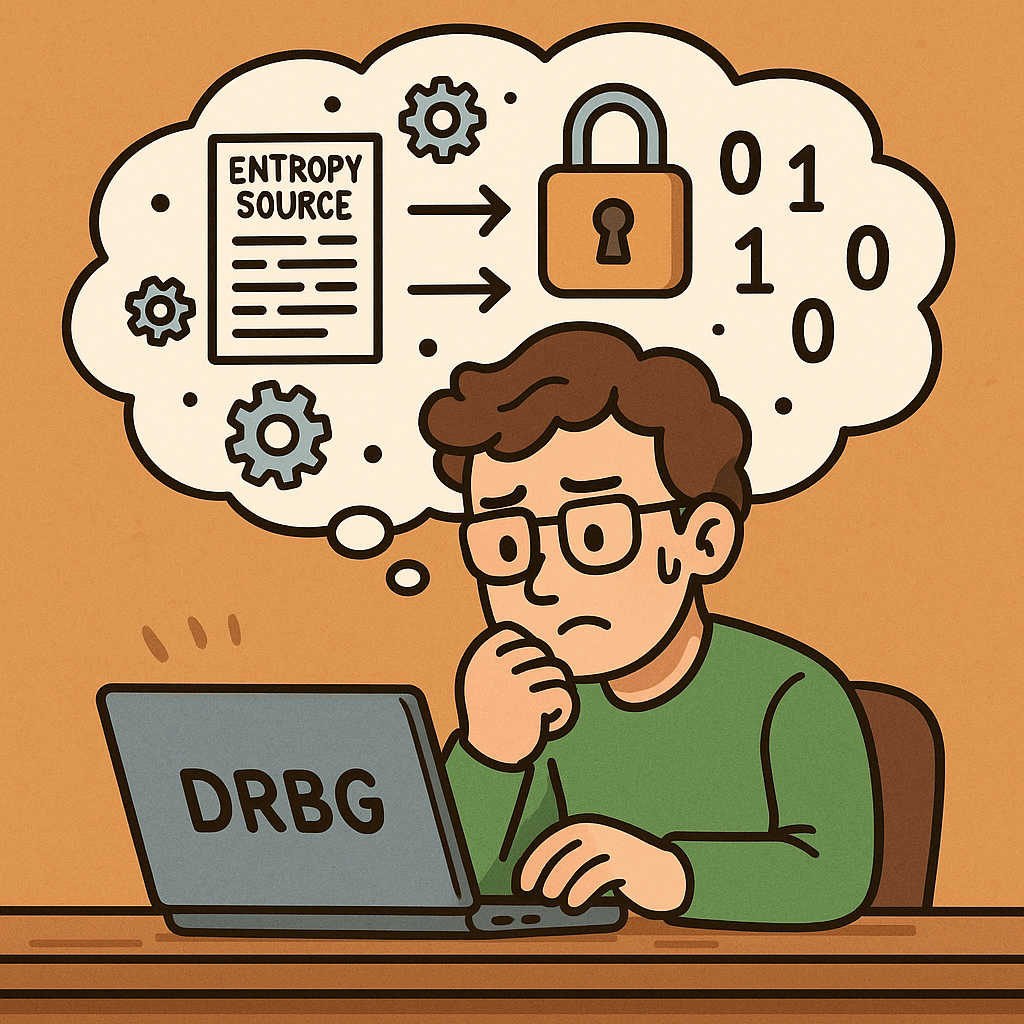
Random number generation is a cornerstone of modern cryptography and secure systems. However, not all random numbers are created equal. To achieve high levels of security, the National Institute of Standards and Technology (NIST) has published recommendations for using Deterministic Random Bit Generators (DRBGs). These guidelines are formalized in the NIST Special Publication 800-90 series and provide a standard framework for generating random bits securely.
In this blog, we will explore what these recommendations are, their historical background, key features, benefits, real-world examples, and how they apply in today’s software development.
What is Recommendation for Random Number Generation Using DRBGs?
The recommendation refers to a set of standards—particularly NIST SP 800-90A, 800-90B, and 800-90C—that define how DRBGs should be designed, implemented, and used in cryptographic applications.
A Deterministic Random Bit Generator (DRBG) is an algorithm that generates a sequence of random-looking bits from a given initial value called a seed. Unlike true random number generators that rely on physical randomness, DRBGs are algorithmic but are designed to be cryptographically secure.
Historical Background
The journey toward secure DRBGs began when the cryptographic community identified weaknesses in naive pseudo-random number generators (PRNGs).
- Early PRNGs (1960s–1990s): Many used simple linear congruential methods, which were fast but not secure for cryptography.
- Rise of Cryptographic Applications (1990s): Secure communications, encryption, and authentication required stronger randomness sources.
- NIST Recommendations (2001 onwards): NIST introduced the SP 800-90 series to formalize standards for DRBGs.
- SP 800-90A (2006, revised 2012): Defined approved DRBG mechanisms based on cryptographic primitives such as hash functions, block ciphers, and HMACs.
- SP 800-90B (2018): Provided guidance for entropy sources to seed DRBGs reliably.
- SP 800-90C (2018): Offered frameworks for combining entropy sources with DRBGs to ensure robustness.
This history reflects the evolution from weak PRNGs to robust, standard-driven DRBGs in critical security infrastructures.
Key Features of DRBG Recommendations
NIST’s recommendations for DRBGs highlight several critical features:
- Cryptographic Strength:
Uses secure primitives (HMAC, SHA-2, AES) to ensure unpredictability of outputs. - Seed and Reseed Mechanisms:
Defines how entropy is collected and used to initialize and refresh the generator. - Backtracking Resistance:
Even if an attacker learns the current internal state, they cannot reconstruct past outputs. - Prediction Resistance:
Future outputs remain secure even if some information about the internal state leaks. - Well-defined Algorithms:
Standardized algorithms include:- Hash_DRBG (based on SHA-256/384/512)
- HMAC_DRBG (based on HMAC with SHA functions)
- CTR_DRBG (based on AES in counter mode)
- Health Tests:
Ensures that entropy sources and generator outputs pass statistical and consistency checks.
Benefits and Advantages
Implementing DRBG recommendations provides several benefits:
- Security Assurance: Compliance with NIST standards ensures robustness against known cryptanalytic attacks.
- Regulatory Compliance: Many industries (finance, government, healthcare) require adherence to NIST guidelines.
- Consistency Across Platforms: Developers can rely on well-defined, interoperable algorithms.
- Scalability: DRBGs are efficient and suitable for large-scale cryptographic systems.
- Forward and Backward Security: Protects past and future randomness even in case of partial
Real-World Examples
- TLS/SSL (Secure Communications):
DRBGs are used to generate session keys in protocols like TLS. Without secure random numbers, encrypted traffic could be decrypted. - Cryptographic Tokens:
Authentication tokens, API keys, and session identifiers often rely on DRBGs for uniqueness and unpredictability. - Digital Signatures:
Secure randomness is required in algorithms like ECDSA or RSA to ensure signatures cannot be forged. - Hardware Security Modules (HSMs):
HSMs use DRBG standards internally to generate keys and nonces in banking and government-grade security applications. - Operating System Randomness APIs:
Functions like/dev/urandom(Linux) orCryptGenRandom(Windows) are based on DRBG-like mechanisms following these recommendations.
How Can We Integrate DRBG Recommendations in Software Development?
- Use Approved Libraries: Always rely on vetted cryptographic libraries (e.g., OpenSSL, BouncyCastle) that implement NIST-approved DRBGs.
- Check Compliance: Ensure your software meets NIST SP 800-90A/B/C requirements if working in regulated industries.
- Seed Properly: Incorporate high-quality entropy sources when initializing DRBGs.
- Regular Reseeding: Implement reseeding policies to maintain long-term security.
- Audit and Testing: Conduct regular security testing, including randomness quality checks.
Conclusion
The NIST recommendations for DRBGs are not just academic—they form the backbone of secure random number generation in modern cryptography. By following these standards, developers and organizations can ensure that their security systems remain resistant to attacks, compliant with regulations, and reliable across applications.

 Software Engineer's Notes
Recent Comments