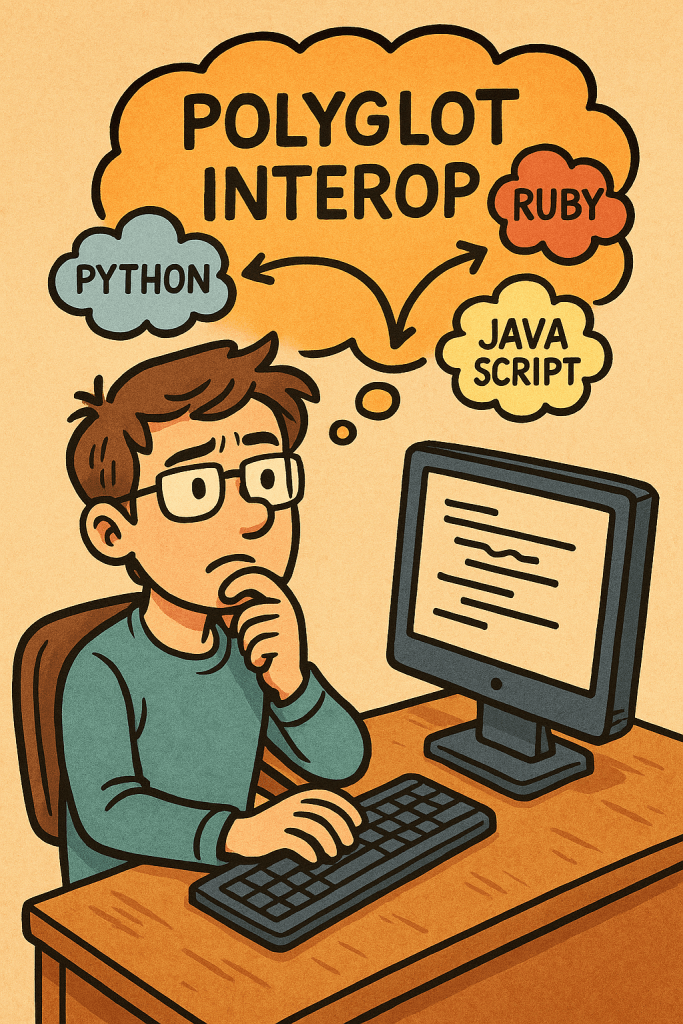
What is Polyglot Interop?
Polyglot interop (polyglot interoperability) refers to the ability of different programming languages to work together within the same system or application. Instead of being confined to a single language, developers can combine multiple languages, libraries, and runtimes to achieve the best possible outcome.
For example, a project might use Python for machine learning, Java for enterprise backends, and JavaScript for frontend interfaces, while still allowing these components to communicate seamlessly.
Main Features and Concepts
- Cross-language communication: Functions and objects written in one language can be invoked by another.
- Shared runtimes: Some platforms (like GraalVM or .NET CLR) allow different languages to run in the same virtual machine.
- Foreign Function Interface (FFI): Mechanisms that allow calling functions written in another language (e.g., C libraries from Python).
- Data marshaling: Conversion of data types between languages so they remain compatible.
- Bridging frameworks: Tools and middleware that act as translators between languages.
How Does Polyglot Interop Work?
Polyglot interop works through a combination of runtime environments, libraries, and APIs:
- Common runtimes: Platforms like GraalVM support multiple languages (Java, JavaScript, Python, R, Ruby, etc.) under one runtime, enabling them to call each other’s functions.
- Bindings and wrappers: Developers create wrappers that expose foreign code to the target language. For example, using SWIG to wrap C++ code for use in Python.
- Remote procedure calls (RPCs): One language can call functions in another language over a protocol like gRPC or Thrift.
- Intermediary formats: JSON, Protocol Buffers, or XML are often used as neutral data formats to allow different languages to communicate.
Benefits and Advantages
- Language flexibility: Use the right tool for the right job.
- Reuse of existing libraries: Avoid rewriting complex libraries by directly using them in another language.
- Performance optimization: Performance-critical parts can be written in a faster language (like C or Rust), while high-level logic stays in Python or JavaScript.
- Improved productivity: Teams can use the languages they are most comfortable with, without limiting the entire project.
- Future-proofing: Systems can evolve without being locked to one language ecosystem.
Main Challenges
- Complexity: Managing multiple languages increases complexity in development and deployment.
- Debugging difficulties: Tracing issues across language boundaries can be hard.
- Performance overhead: Data conversion and bridging may introduce latency.
- Security concerns: Exposing functions across language runtimes can create vulnerabilities if not handled properly.
- Maintenance burden: More languages mean more dependencies, tooling, and long-term upkeep.
How and When Can We Use Polyglot Interop?
Polyglot interop is most useful when:
- You need to leverage specialized libraries in another language.
- You want to combine strengths of multiple ecosystems (e.g., AI in Python, backend in Java).
- You are modernizing legacy systems and need to integrate new languages without rewriting everything.
- You are building platforms or services intended for multiple language communities.
It should be avoided if a single language can efficiently solve the problem, as polyglot interop adds overhead.
Real-World Examples
- Jupyter Notebooks: Allow polyglot programming by mixing Python, R, Julia, and even SQL in one environment.
- GraalVM: A polyglot virtual machine where JavaScript can directly call Java or Python code.
- TensorFlow: Provides APIs in Python, C++, Java, and JavaScript for different use cases.
- .NET platform: Enables multiple languages (C#, F#, VB.NET) to interoperate on the same runtime.
- WebAssembly (Wasm): Enables running code compiled from different languages (Rust, C, Go) in the browser alongside JavaScript.
How to Integrate Polyglot Interop into Software Development
- Identify language strengths: Choose languages based on their ecosystem advantages.
- Adopt polyglot-friendly platforms: Use runtimes like GraalVM, .NET, or WebAssembly for smoother interop.
- Use common data formats: Standardize on formats like JSON or Protobuf to ease communication.
- Set up tooling and CI/CD: Ensure your build, test, and deployment pipelines support multiple languages.
- Educate the team: Train developers on interop concepts to avoid misuse and ensure long-term maintainability.

 Software Engineer's Notes
Recent Comments