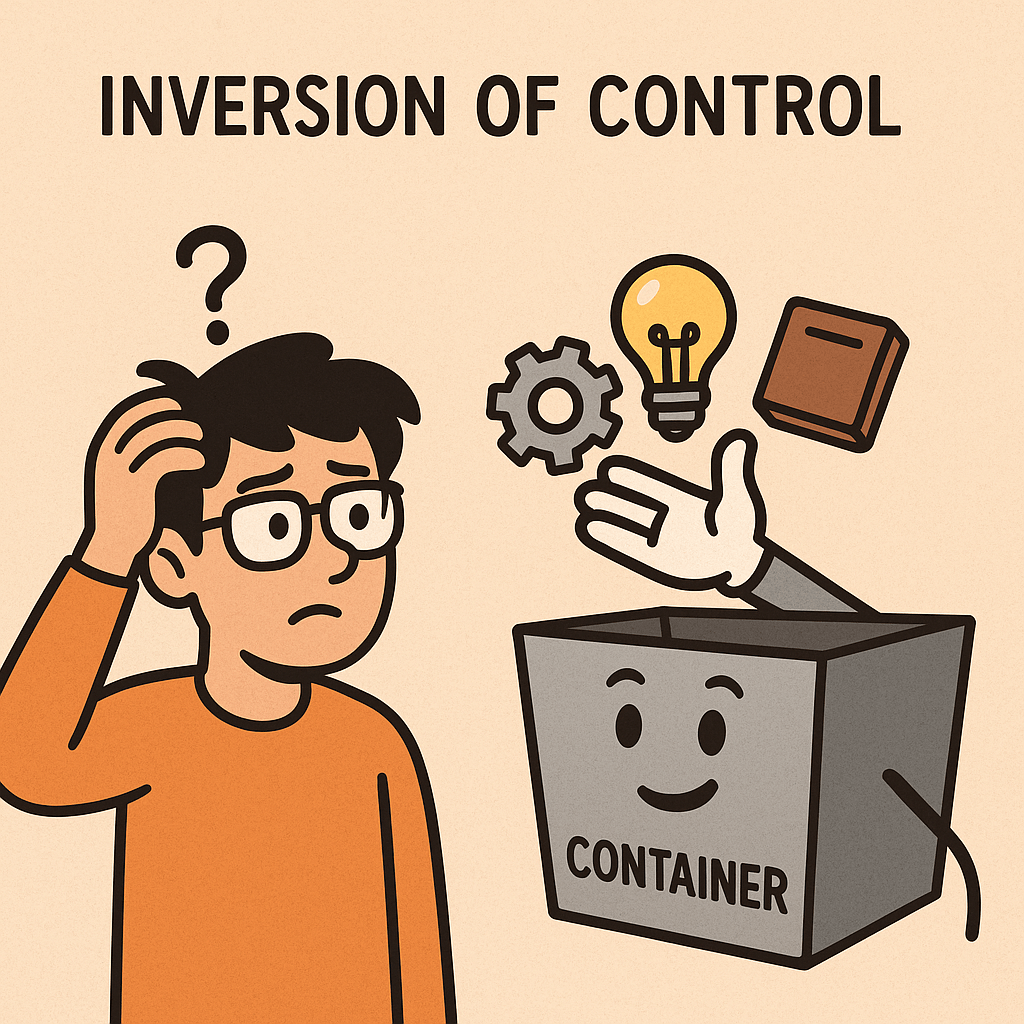
What is Inversion of Control?
Inversion of Control (IoC) is a design principle in software engineering that shifts the responsibility of controlling the flow of a program from the developer’s custom code to a framework or external entity. Instead of your code explicitly creating objects and managing their lifecycles, IoC delegates these responsibilities to a container or framework.
This approach promotes flexibility, reusability, and decoupling of components. IoC is the foundation of many modern frameworks, such as Spring in Java, .NET Core Dependency Injection, and Angular in JavaScript.
A Brief History of Inversion of Control
The concept of IoC emerged in the late 1980s and early 1990s as object-oriented programming matured. Early implementations were seen in frameworks like Smalltalk MVC and later Java Enterprise frameworks.
The term “Inversion of Control” was formally popularized by Michael Mattsson in the late 1990s. Martin Fowler further explained and advocated IoC as a key principle for achieving loose coupling in his widely influential articles and books.
By the 2000s, IoC became mainstream with frameworks such as Spring Framework (2003) introducing dependency injection containers as practical implementations of IoC.
Components of Inversion of Control
Inversion of Control can be implemented in different ways, but the following components are usually involved:
1. IoC Container
A framework or container responsible for managing object creation and lifecycle. Example: Spring IoC Container.
2. Dependencies
The objects or services that a class requires to function.
3. Configuration Metadata
Instructions provided to the IoC container on how to wire dependencies. This can be done using XML, annotations, or code.
4. Dependency Injection (DI)
A specific and most common technique to achieve IoC, where dependencies are provided rather than created inside the class.
5. Event and Callback Mechanisms
Another IoC technique where the flow of execution is controlled by an external framework calling back into the developer’s code when needed.
Benefits of Inversion of Control
1. Loose Coupling
IoC ensures that components are less dependent on each other, making code easier to maintain and extend.
2. Improved Testability
With dependencies injected, mocking and testing become straightforward.
3. Reusability
Since classes do not create their own dependencies, they can be reused in different contexts.
4. Flexibility
Configurations can be changed without altering the core logic of the program.
5. Scalability
IoC helps in scaling applications by simplifying dependency management in large systems.
Why and When Do We Need Inversion of Control?
- When building complex systems with multiple modules requiring interaction.
- When you need flexibility in changing dependencies without modifying code.
- When testing is critical, since IoC makes mocking dependencies easy.
- When aiming for maintainability, as IoC reduces the risk of tight coupling.
IoC is especially useful in enterprise applications, microservices, and modular architectures.
How to Integrate IoC into Our Software Development Process
- Choose a Framework or Container
- For Java: Spring Framework or Jakarta CDI
- For .NET: Built-in DI Container
- For JavaScript: Angular or NestJS
- Identify Dependencies
Review your code and highlight where objects are created and tightly coupled. - Refactor Using DI
Use constructor injection, setter injection, or field injection to provide dependencies instead of creating them inside classes. - Configure Metadata
Define wiring via annotations, configuration files, or code-based approaches. - Adopt IoC Practices Gradually
Start with small modules and expand IoC adoption across your system. - Test and Validate
Use unit tests with mocked dependencies to confirm that IoC is working as intended.
Conclusion
Inversion of Control is a powerful principle that helps developers build flexible, testable, and maintainable applications. By shifting control to frameworks and containers, software becomes more modular and adaptable to change. Integrating IoC into your development process is not only a best practice—it’s a necessity for modern, scalable systems.

 Software Engineer's Notes
Recent Comments