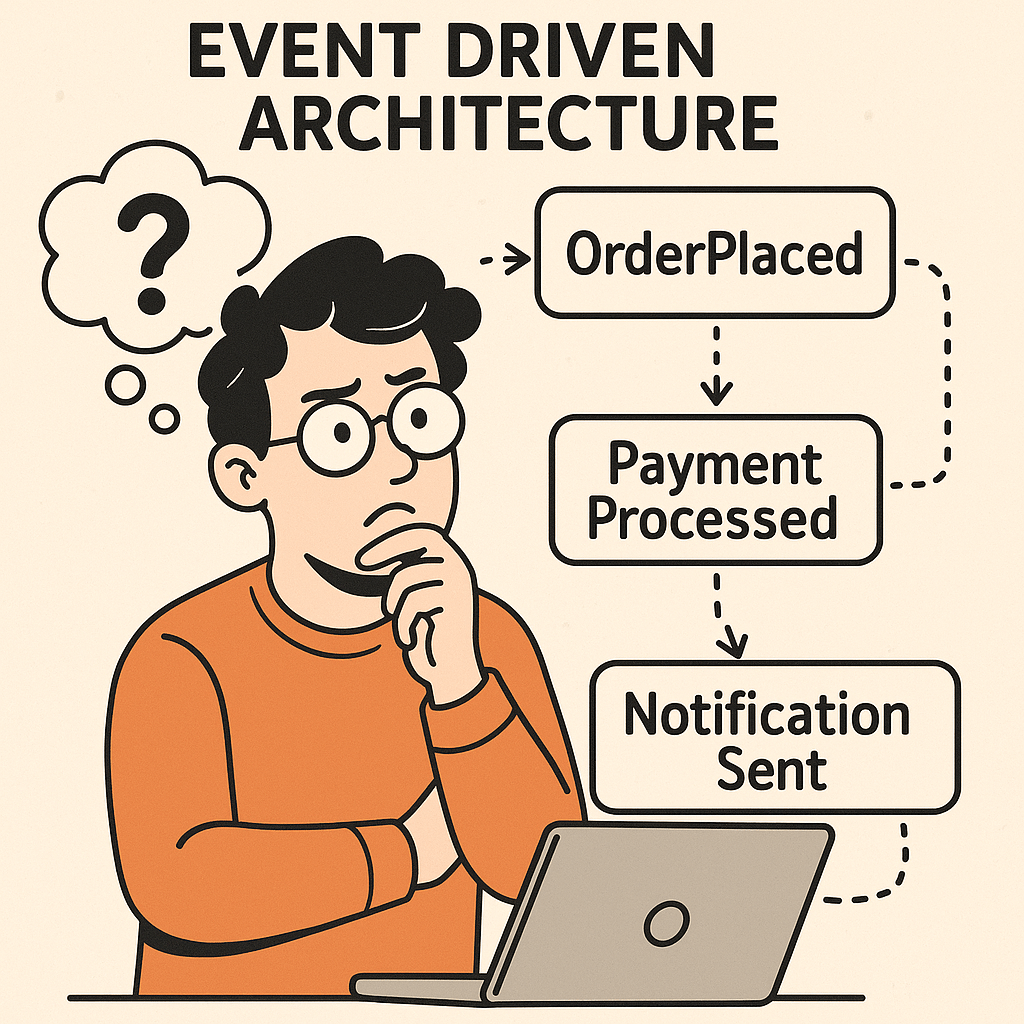
What is Event Driven Architecture?
Event Driven Architecture (EDA) is a modern software design pattern where systems communicate through events rather than direct calls. Instead of services requesting and waiting for responses, they react to events as they occur.
An event is simply a significant change in state — for example, a user placing an order, a payment being processed, or a sensor detecting a temperature change. In EDA, these events are captured, published, and consumed by other components in real time.
This approach makes systems more scalable, flexible, and responsive to change compared to traditional request/response architectures.
Main Components of Event Driven Architecture
1. Event Producers
These are the sources that generate events. For example, an e-commerce application might generate an event when a customer places an order.
2. Event Routers (Event Brokers)
Routers manage the flow of events. They receive events from producers and deliver them to consumers. Message brokers like Apache Kafka, RabbitMQ, or AWS EventBridge are commonly used here.
3. Event Consumers
These are services or applications that react to events. For instance, an email service may consume an “OrderPlaced” event to send an order confirmation email.
4. Event Channels
These are communication pathways through which events travel. They ensure producers and consumers remain decoupled.
How Does Event Driven Architecture Work?
- Event Occurs – Something happens (e.g., a new user signs up).
- Event Published – The producer sends this event to the broker.
- Event Routed – The broker forwards the event to interested consumers.
- Event Consumed – Services subscribed to this event take action (e.g., send a welcome email, update analytics, trigger a workflow).
This process is asynchronous, meaning producers don’t wait for consumers. Events are processed independently, allowing for more efficient, real-time interactions.
Benefits and Advantages of Event Driven Architecture
Scalability
Each service can scale independently based on the number of events it needs to handle.
Flexibility
You can add new consumers without modifying existing producers, making it easier to extend systems.
Real-time Processing
EDA enables near real-time responses, perfect for financial transactions, IoT, and user notifications.
Loose Coupling
Producers and consumers don’t need to know about each other, reducing dependencies.
Resilience
If one consumer fails, other parts of the system continue working. Events can be replayed or queued until recovery.
Challenges of Event Driven Architecture
Complexity
Designing an event-driven system requires careful planning of event flows and dependencies.
Event Ordering and Idempotency
Events may arrive out of order or be processed multiple times, requiring special handling to avoid duplication.
Monitoring and Debugging
Since interactions are asynchronous and distributed, tracing the flow of events can be harder compared to request/response systems.
Data Consistency
Maintaining strong consistency across distributed services is difficult. Often, EDA relies on eventual consistency, which may not fit all use cases.
Operational Overhead
Operating brokers like Kafka or RabbitMQ adds infrastructure complexity and requires proper monitoring and scaling strategies.
When and How Can We Use Event Driven Architecture?
EDA is most effective when:
- The system requires real-time responses (e.g., fraud detection).
- The system must handle high scalability (e.g., millions of user interactions).
- You need decoupled services that can evolve independently.
- Multiple consumers need to react differently to the same event.
It may not be ideal for small applications where synchronous request/response is simpler.
Real World Examples of Event Driven Architecture
E-Commerce
- Event: Customer places an order.
- Consumers:
- Payment service processes the payment.
- Inventory service updates stock.
- Notification service sends confirmation.
- Shipping service prepares delivery.
All of these happen asynchronously, improving performance and user experience.
Banking and Finance
- Event: A suspicious transaction occurs.
- Consumers:
- Fraud detection system analyzes it.
- Notification system alerts the user.
- Compliance system records it.
This allows banks to react to fraud in real-time.
IoT Applications
- Event: Smart thermostat detects high temperature.
- Consumers:
- Air conditioning system turns on.
- Notification sent to homeowner.
- Analytics system logs energy usage.
Social Media
- Event: A user posts a photo.
- Consumers:
- Notification service alerts friends.
- Analytics system tracks engagement.
- Recommendation system updates feeds.
Conclusion
Event Driven Architecture provides a powerful way to build scalable, flexible, and real-time systems. While it introduces challenges like debugging and data consistency, its benefits make it an essential pattern for modern applications — from e-commerce to IoT to financial systems.
When designed and implemented carefully, EDA can transform how software responds to change, making systems more resilient and user-friendly.

 Software Engineer's Notes
Recent Comments