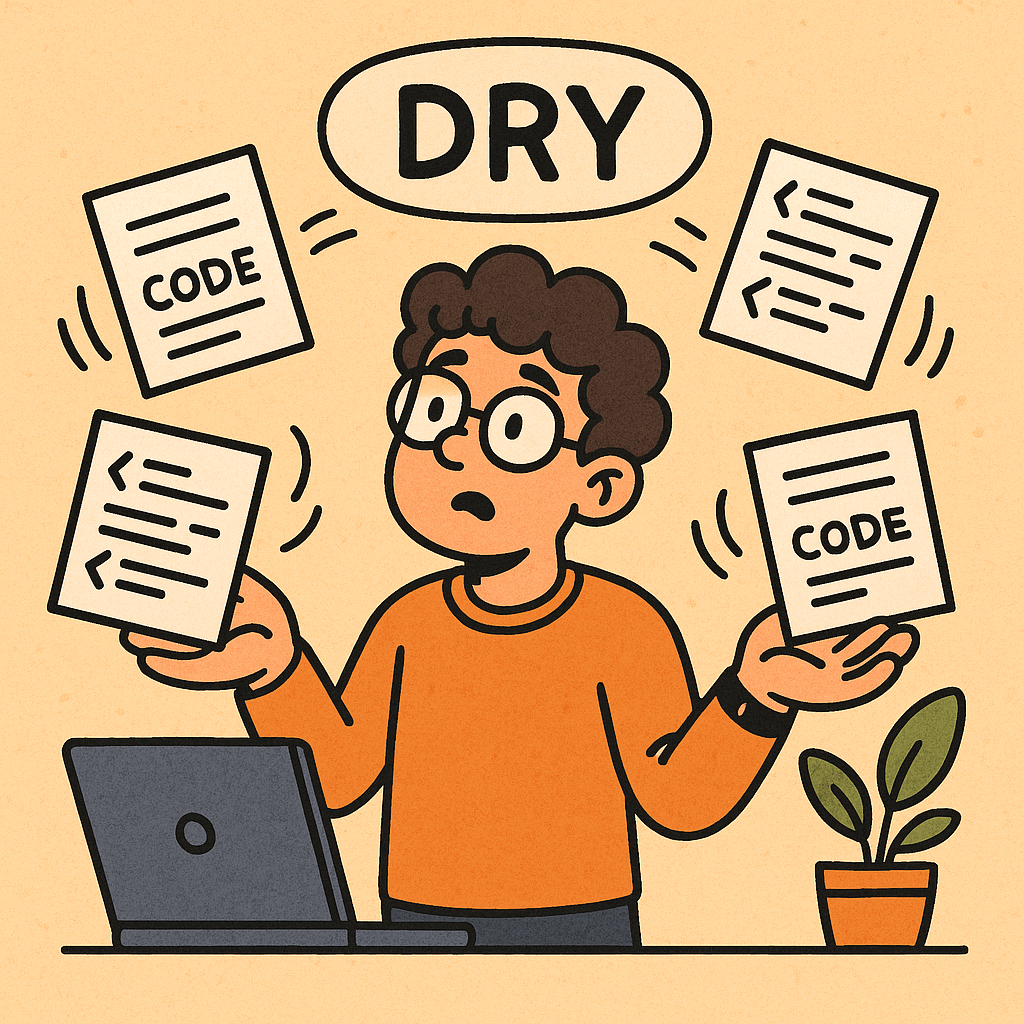
In software engineering, one of the most valuable design principles is the DRY principle. DRY stands for “Don’t Repeat Yourself”, and it is a fundamental guideline that helps developers write cleaner, more maintainable, and efficient code.
What is the DRY Principle?
The DRY principle was first introduced in the book The Pragmatic Programmer by Andy Hunt and Dave Thomas. It emphasizes that every piece of knowledge should have a single, unambiguous, authoritative representation within a system.
In simpler terms, it means avoiding code or logic duplication. When functionality is repeated in multiple places, it increases the risk of errors, makes maintenance harder, and slows down development.
How Do You Apply the DRY Principle?
Applying DRY involves identifying repetition in code, logic, or even processes, and then refactoring them into reusable components. Here are some ways:
- Functions and Methods: If you see the same block of code in multiple places, extract it into a method or function.
- Classes and Inheritance: Use object-oriented design to encapsulate shared behavior.
- Libraries and Modules: Group reusable logic into shared libraries or modules to avoid rewriting the same code.
- Configuration Files: Store common configurations (like database connections or API endpoints) in a single place instead of scattering them across multiple files.
- Database Normalization: Apply DRY at the data level by ensuring information is stored in one place and referenced where needed.
Benefits of the DRY Principle
- Improved Maintainability
When changes are needed, you only update the logic in one place, reducing the chance of introducing bugs. - Reduced Code Size
Less duplication means fewer lines of code, making the codebase easier to read and navigate. - Better Consistency
Logic stays uniform throughout the system since it comes from a single source of truth. - Faster Development
Reusing well-tested components speeds up feature development and reduces time spent debugging.
Main Considerations When Using DRY
While DRY is powerful, it must be applied thoughtfully:
- Over-Abstraction: Extracting too early or without enough context may lead to unnecessary complexity.
- Readability vs. Reuse: Sometimes, duplicating a small piece of code is better than forcing developers to chase references across multiple files.
- Context Awareness: Just because two code blocks look similar doesn’t mean they serve the same purpose. Blindly merging them could create confusion.
Real-World Examples of DRY in Action
- Web Development
Instead of writing the same HTML header and footer on every page, developers use templates or components (e.g., React components, Thymeleaf templates in Spring, or partials in Django). - Database Design
Instead of storing customer address details in multiple tables, create one address table and reference it with foreign keys. This avoids inconsistency. - API Development
Common error handling logic is extracted into a middleware or filter instead of repeating the same try-catch blocks in every endpoint. - Configuration Management
Storing connection strings, API keys, or environment variables in a central config file instead of embedding them across multiple services.
How to Apply DRY in Software Development Projects
- Code Reviews
Encourage teams to identify duplicated code during reviews and suggest refactoring. - Use Frameworks and Libraries
Leverage well-established libraries to handle common tasks (logging, authentication, database access) instead of rewriting them. - Refactor Regularly
As projects grow, revisit the codebase to consolidate repeating logic. - Adopt Best Practices
- Write modular code.
- Follow design patterns (like Singleton, Factory, or Strategy) when applicable.
- Use version control to track refactoring safely.
- Balance DRY with Other Principles
Combine DRY with principles like KISS (Keep It Simple, Stupid) and YAGNI (You Aren’t Gonna Need It) to avoid unnecessary abstractions.
Conclusion
The DRY principle is more than just a coding style rule—it’s a mindset that reduces duplication, improves maintainability, and keeps software consistent. By applying it carefully, balancing reuse with clarity, and leveraging it in real-world contexts, teams can significantly improve the quality and scalability of their projects.

 Software Engineer's Notes
Recent Comments