Search

Software Engineer's Notes

Tag

Distributed Systems

Dead Letter Queues (DLQ): The Complete, Developer-Friendly Guide

What is dead letter queue?

A Dead Letter Queue (DLQ) is a dedicated queue where messages go when your system can’t process them successfully after a defined number of retries or due to validation/format issues. DLQs prevent poison messages from blocking normal traffic, preserve data for diagnostics, and give you a safe workflow to fix and reprocess failures.

What Is a Dead Letter Queue?

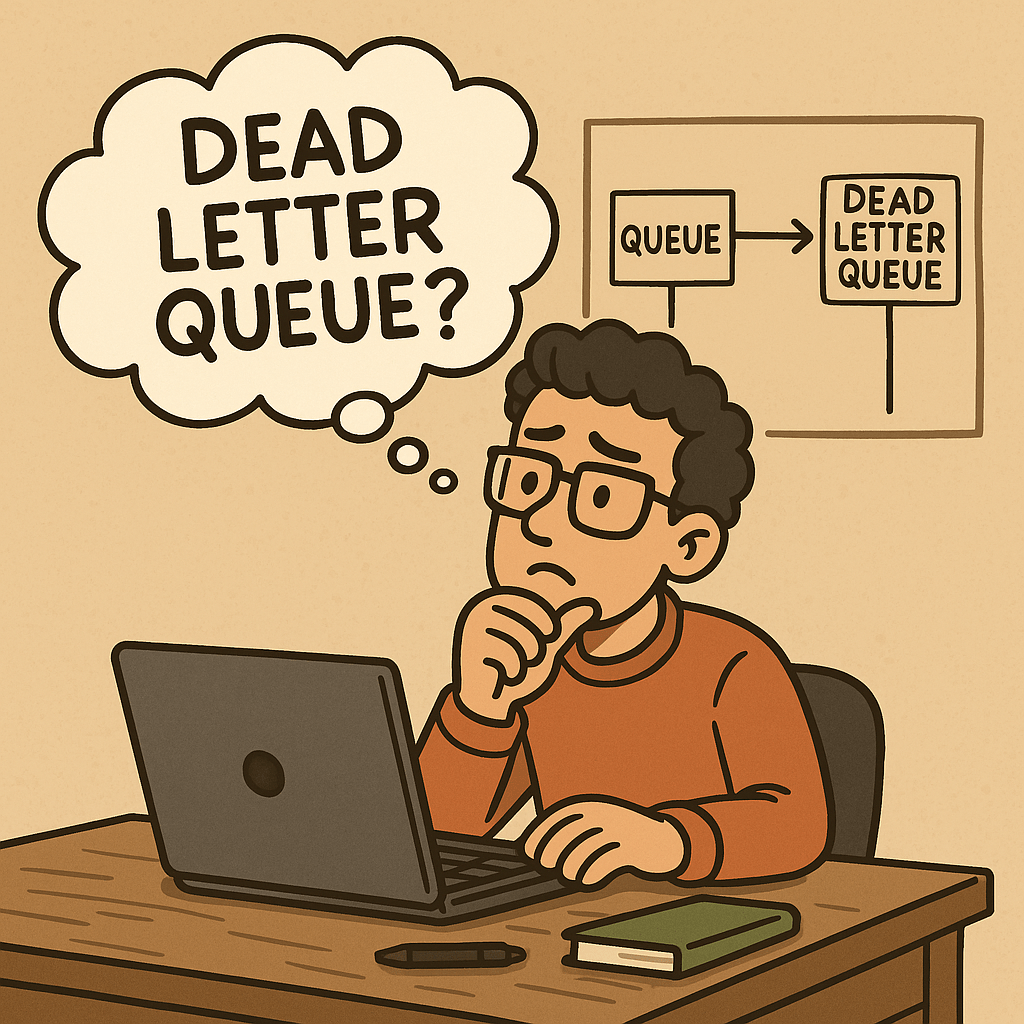
A Dead Letter Queue (DLQ) is a secondary queue linked to a primary “work” queue (or topic subscription). When a message repeatedly fails processing—or violates rules like TTL, size, or schema—it’s moved to the DLQ instead of being retried forever or discarded.

Key idea: separate bad/problematic messages from the healthy stream so the system stays reliable and debuggable.

How Does It Work? (Step by Step)

1) Message arrives

  • Producer publishes a message to the main queue/topic.
  • The message includes metadata (headers) like correlation ID, type, version, and possibly a retry counter.

2) Consumer processes

  • Your worker/service reads the message and attempts business logic.
  • If successful → ACK/NACK appropriately → message is removed.

3) Failure and retries

  • If processing fails (e.g., validation error, missing dependency, transient DB outage), the consumer either NACKs or throws an error.
  • Broker policy or your code triggers a retry (immediate or delayed/exponential backoff).

4) Dead-lettering policy

  • When a threshold is met (e.g., maxReceiveCount = 5, or message TTL exceeded, or explicitly rejected as “unrecoverable”), the broker moves the message to the DLQ.
  • The DLQ carries the original payload plus broker-specific reason codes and delivery attempt metadata.

5) Inspection and reprocessing

  • Operators/engineers inspect DLQ messages, identify root cause, fix code/data/config, and then reprocess messages from the DLQ back into the main flow (or a special “retry” queue).

Benefits & Advantages (Why DLQs Matter)

1) Reliability and throughput protection

  • Poison messages don’t block the main queue, so healthy traffic continues to flow.

2) Observability and forensics

  • You don’t lose failed messages: you can explain failures, reproduce bugs, and perform root-cause analysis.

3) Controlled recovery

  • You can reprocess failed messages in a safe, rate-limited way after fixes, reducing blast radius.

4) Compliance and auditability

  • DLQs preserve evidence of failures (with timestamps and reason codes), useful for audits and postmortems.

5) Cost and performance balance

  • By cutting infinite retries, you reduce wasted compute and noisy logs.

When and How Should We Use a DLQ?

Use a DLQ when…

  • Messages can be malformed, out-of-order, or schema-incompatible.
  • Downstream systems are occasionally unavailable or rate-limited.
  • You operate at scale and need protection from poison messages.
  • You must keep evidence of failures for audit/compliance.

How to configure (common patterns)

  • Set a retry cap: e.g., 3–10 attempts with exponential backoff.
  • Define dead-letter conditions: max attempts, TTL expiry, size limit, explicit rejection.
  • Include reason metadata: error codes, stack traces (trimmed), last-failure timestamp.
  • Create a reprocessing path: tooling or jobs to move messages back after fixes.

Main Challenges (and How to Handle Them)

1) DLQ becoming a “graveyard”

  • Risk: Messages pile up and are never reprocessed.
  • Mitigation: Ownership, SLAs, on-call runbooks, weekly triage, dashboards, and auto-alerts.

2) Distinguishing transient vs. permanent failures

  • Risk: You keep retrying messages that will never succeed.
  • Mitigation: Classify errors (e.g., 5xx transient vs. 4xx permanent), and dead-letter permanent failures early.

3) Message evolution & schema drift

  • Risk: Older messages don’t match new contracts.
  • Mitigation: Use schema versioning, backward-compatible serializers (e.g., Avro/JSON with defaults), and upconverters.

4) Idempotency and duplicates

  • Risk: Reprocessing may double-charge or double-ship.
  • Mitigation: Idempotent handlers keyed by message ID/correlation ID; dedupe storage.

5) Privacy & retention

  • Risk: Sensitive data lingers in DLQ.
  • Mitigation: Redact PII fields, encrypt at rest, set retention policies, purge according to compliance.

6) Operational toil

  • Risk: Manual replays are slow and error-prone.
  • Mitigation: Provide a self-serve DLQ UI/CLI, canned filters, bulk reprocess with rate limits.

Real-World Examples (Deep Dive)

Example 1: E-commerce order workflow (Kafka/RabbitMQ/Azure Service Bus)

  • Scenario: Payment service consumes OrderPlaced events. A small percentage fails due to expired cards or unknown currency.
  • Flow:
    1. Consumer validates schema and payment method.
    2. For transient payment gateway outages → retry with exponential backoff (e.g., 1m, 5m, 15m).
    3. For permanent issues (invalid currency) → send directly to DLQ with reason UNSUPPORTED_CURRENCY.
    4. Weekly DLQ triage: finance reviews messages, fixes catalog currency mappings, then reprocesses only the corrected subset.

Example 2: Logistics tracking updates (AWS SQS)

  • Scenario: IoT devices send GPS updates. Rare firmware bug emits malformed JSON.
  • Flow:
    • SQS main queue with maxReceiveCount=5.
    • Malformed messages fail schema validation 5× → moved to DLQ.
    • An ETL “scrubber” tool attempts to auto-fix known format issues; successful ones are re-queued; truly bad ones are archived and reported.

Example 3: Billing invoice generation (GCP Pub/Sub)

  • Scenario: Monthly invoice generation fan-out; occasionally the customer record is missing tax info.
  • Flow:
    • Pub/Sub subscription push to worker; on 4xx validation error, message is acknowledged to prevent infinite retries and manually published to a DLQ topic with reason MISSING_TAX_PROFILE.
    • Ops runs a batch to fetch missing tax profiles; after remediation, a replay job re-emits those messages to a “retry” topic at a safe rate.

Broker-Specific Notes (Quick Reference)

  • AWS SQS: Configure a redrive policy linking main queue to DLQ with maxReceiveCount. Use CloudWatch metrics/alarms on ApproximateNumberOfMessagesVisible in the DLQ.
  • Amazon SNS → SQS: DLQ typically sits behind the SQS subscription. Each subscription can have its own DLQ.
  • Azure Service Bus: DLQs exist per queue and per subscription. Service Bus auto-dead-letters on TTL, size, or filter issues; you can explicitly dead-letter via SDK.
  • Google Pub/Sub: No first-class DLQ historically; implement via a dedicated “dead-letter topic” plus subscriber logic (Pub/Sub now supports dead letter topics on subscriptions—set deadLetterPolicy with max delivery attempts).
  • RabbitMQ: Use alternate exchange or per-queue dead-letter exchange (DLX) with dead-letter routing keys; create a bound DLQ queue that receives rejected/expired messages.

Integration Guide: Add DLQs to Your Development Process

1) Design a DLQ policy

  • Retry budget: max_attempts = 5, backoff 1m → 5m → 15m → 1h → 6h (example).
  • Classify failures:
    • Transient (timeouts, 5xx): retry up to budget.
    • Permanent (validation, 4xx): dead-letter immediately.
  • Metadata to include: correlation ID, producer service, schema version, last error code/reason, first/last failure timestamps.

2) Implement idempotency

  • Use a processing log keyed by message ID; ignore duplicates.
  • For stateful side effects (e.g., billing), store an idempotency key and status.

3) Add observability

  • Dashboards: DLQ depth, inflow rate, age percentiles (P50/P95), reasons top-N.
  • Alerts: when DLQ depth or age exceeds thresholds; when a single reason spikes.

4) Build safe reprocessing tools

  • Provide a CLI/UI to:
    • Filter by reason code/time window/producer.
    • Bulk requeue with rate limits and circuit breakers.
    • Simulate dry-run processing (validation-only) before replay.

5) Automate triage & ownership

  • Assign service owners for each DLQ.
  • Weekly scheduled triage with an SLA (e.g., “no DLQ message older than 7 days”).
  • Tag JIRA tickets with DLQ reason codes.

6) Security & compliance

  • Redact PII in payloads or keep PII in secure references.
  • Set retention (e.g., 14–30 days) and auto-archive older messages to encrypted object storage.

Practical Config Snippets (Pseudocode)

Retry + Dead-letter decision (consumer)

onMessage(msg):
  try:
    validateSchema(msg)
    processBusinessLogic(msg)
    ack(msg)
  except TransientError as e:
    if msg.attempts < MAX_ATTEMPTS:
      requeueWithDelay(msg, backoffFor(msg.attempts))
    else:
      sendToDLQ(msg, reason="RETRY_BUDGET_EXCEEDED", error=e.summary)
  except PermanentError as e:
    sendToDLQ(msg, reason="PERMANENT_VALIDATION_FAILURE", error=e.summary)

Idempotency guard

if idempotencyStore.exists(msg.id):
  ack(msg)  # already processed
else:
  result = handle(msg)
  idempotencyStore.record(msg.id, result.status)
  ack(msg)

Operational Runbook (What to Do When DLQ Fills Up)

  1. Check dashboards: DLQ depth, top reasons.
  2. Classify spike: deployment-related? upstream schema change? dependency outage?
  3. Fix root cause: roll back, hotfix, or add upconverter/validator.
  4. Sample messages: inspect payloads; verify schema/PII.
  5. Dry-run replay: validate-only path over a small batch.
  6. Controlled replay: requeue with rate limit (e.g., 50 msg/s) and monitor error rate.
  7. Close the loop: add tests, update schemas, document the incident.

Metrics That Matter

  • DLQ Depth (current and trend)
  • Message Age in DLQ (P50/P95/max)
  • DLQ Inflow/Outflow Rate
  • Top Failure Reasons (by count)
  • Replay Success Rate
  • Time-to-Remediate (first seen → replayed)

FAQ

Is a DLQ the same as a retry queue?
No. A retry queue is for delayed retries; a DLQ is for messages that exhausted retry policy or are permanently invalid.

Should every queue have a DLQ?
For critical paths—yes. For low-value or purely ephemeral events, weigh the operational cost vs. benefit.

Can we auto-delete DLQ messages?
You should set retention, but avoid blind deletion. Consider archiving with limited retention to support audits.

Checklist: Fast DLQ Implementation

  • DLQ created and linked to each critical queue/subscription
  • Retry policy set (max attempts + exponential backoff)
  • Error classification (transient vs permanent)
  • Idempotency implemented
  • Dashboards and alerts configured
  • Reprocessing tool with rate limits
  • Ownership & triage cadence defined
  • Retention, redaction, and encryption reviewed

Conclusion

A well-implemented DLQ is your safety net for message-driven systems: it safeguards throughput, preserves evidence, and enables controlled recovery. With clear policies, observability, and a disciplined replay workflow, DLQs transform failures from outages into actionable insights—and keep your pipelines resilient.
Message Brokers in Computer Science — A Practical, Hands-On Guide

What is a message broker?

What Is a Message Broker?

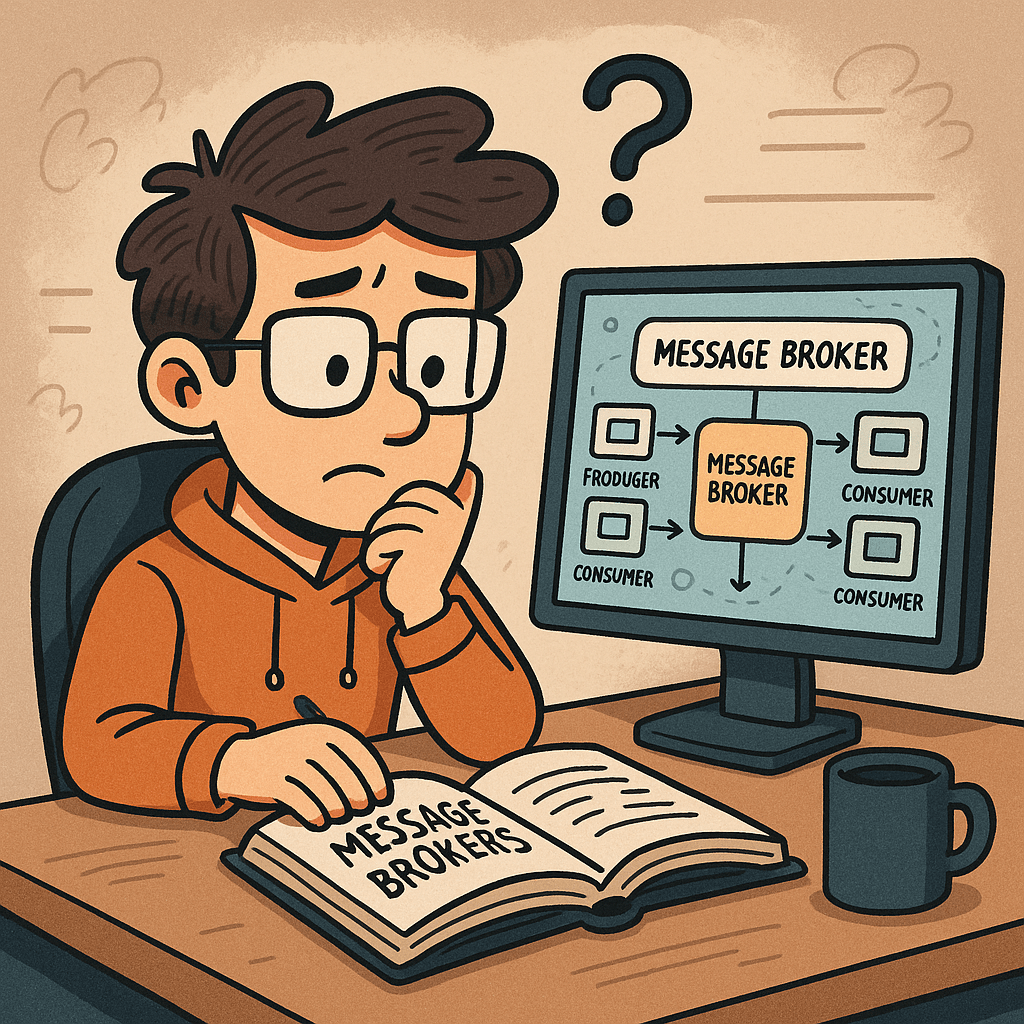
A message broker is middleware that routes, stores, and delivers messages between independent parts of a system (services, apps, devices). Instead of services calling each other directly, they publish messages to the broker, and other services consume them. This creates loose coupling, improves resilience, and enables asynchronous workflows.

At its core, a broker provides:

  • Producers that publish messages.
  • Queues/Topics where messages are held.
  • Consumers that receive messages.
  • Delivery guarantees and routing so the right messages reach the right consumers.

Common brokers: RabbitMQ, Apache Kafka, ActiveMQ/Artemis, NATS, Redis Streams, AWS SQS/SNS, Google Pub/Sub, Azure Service Bus.

A Short History (High-Level Timeline)

  • Mainframe era (1970s–1980s): Early queueing concepts appear in enterprise systems to decouple batch and transactional workloads.
  • Enterprise messaging (1990s): Commercial MQ systems (e.g., IBM MQ, Microsoft MSMQ, TIBCO) popularize durable queues and pub/sub for financial and telecom workloads.
  • Open standards (late 1990s–2000s): Java Message Service (JMS) APIs and AMQP wire protocol encourage vendor neutrality.
  • Distributed streaming (2010s): Kafka and cloud-native services (SQS/SNS, Pub/Sub, Service Bus) emphasize horizontal scalability, event streams, and managed operations.
  • Today: Hybrid models—classic brokers (flexible routing, strong per-message semantics) and log-based streaming (high throughput, replayable events) coexist.

How a Message Broker Works (Under the Hood)

  1. Publish: A producer sends a message with headers and body. Some brokers require a routing key (e.g., “orders.created”).
  2. Route: The broker uses bindings/rules to deliver messages to the right queue(s) or topic partitions.
  3. Persist: Messages are durably stored (disk/replicated) according to retention and durability settings.
  4. Consume: Consumers pull (or receive push-delivered) messages.
  5. Acknowledge & Retry: On success, the consumer acks; on failure, the broker retries with backoff or moves the message to a dead-letter queue (DLQ).
  6. Scale: Consumer groups share work (competing consumers). Partitions (Kafka) or multiple queues (RabbitMQ) enable parallelism and throughput.
  7. Observe & Govern: Metrics (lag, throughput), tracing, and schema/versioning keep systems healthy and evolvable.

Key Features & Characteristics

  • Delivery semantics: at-most-once, at-least-once (most common), sometimes exactly-once (with constraints).
  • Ordering: per-queue or per-partition ordering; global ordering is rare and costly.
  • Durability & retention: in-memory vs disk, replication, time/size-based retention.
  • Routing patterns: direct, topic (wildcards), fan-out/broadcast, headers-based, delayed/priority.
  • Scalability: horizontal scale via partitions/shards, consumer groups.
  • Transactions & idempotency: transactions (broker or app-level), idempotent consumers, deduplication keys.
  • Protocols & APIs: AMQP, MQTT, STOMP, HTTP/REST, gRPC; SDKs for many languages.
  • Security: TLS in transit, server-side encryption, SASL/OAuth/IAM authN/Z, network policies.
  • Observability: consumer lag, DLQ rates, redeliveries, end-to-end tracing.
  • Admin & ops: multi-tenant isolation, quotas, quotas per topic, quotas per consumer, cleanup policies.

Main Benefits

  • Loose coupling: producers and consumers evolve independently.
  • Resilience: retries, DLQs, backpressure protect downstream services.
  • Scalability: natural parallelism via consumer groups/partitions.
  • Smoothing traffic spikes: brokers absorb bursts; consumers process at steady rates.
  • Asynchronous workflows: better UX and throughput (don’t block API calls).
  • Auditability & replay: streaming logs (Kafka-style) enable reprocessing and backfills.
  • Polyglot interop: cross-language, cross-platform integration via shared contracts.

Real-World Use Cases (With Detailed Flows)

  1. Order Processing (e-commerce):
    • Flow: API receives an order → publishes order.created. Payment, inventory, shipping services consume in parallel.
    • Why a broker? Decouples services, enables retries, and supports fan-out to analytics and email notifications.
  2. Event-Driven Microservices:
    • Flow: Services emit domain events (e.g., user.registered). Other services react (e.g., create welcome coupon, sync CRM).
    • Why? Eases cross-team collaboration and reduces synchronous coupling.
  3. Transactional Outbox (reliability bridge):
    • Flow: Service writes business state and an “outbox” row in the same DB transaction → a relay publishes the event to the broker → exactly-once effect at the boundary.
    • Why? Prevents the “saved DB but failed to publish” problem.
  4. IoT Telemetry & Monitoring:
    • Flow: Devices publish telemetry to MQTT/AMQP; backend aggregates, filters, and stores for dashboards & alerts.
    • Why? Handles intermittent connectivity, large fan-in, and variable rates.
  5. Log & Metric Pipelines / Stream Processing:
    • Flow: Applications publish logs/events to a streaming broker; processors compute aggregates and feed real-time dashboards.
    • Why? High throughput, replay for incident analysis, and scalable consumers.
  6. Payment & Fraud Detection:
    • Flow: Payments emit events to fraud detection service; anomalies trigger holds or manual review.
    • Why? Low latency pipelines with backpressure and guaranteed delivery.
  7. Search Indexing / ETL:
    • Flow: Data changes publish “change events” (CDC); consumers update search indexes or data lakes.
    • Why? Near-real-time sync without tight DB coupling.
  8. Notifications & Email/SMS:
    • Flow: App publishes notify.user messages; a notification service renders templates and sends via providers with retry/DLQ.
    • Why? Offloads slow/fragile external calls from critical paths.

Choosing a Broker (Quick Comparison)

BrokerModelStrengthsTypical Fits
RabbitMQQueues + exchanges (AMQP)Flexible routing (topic/direct/fanout), per-message acks, pluginsWork queues, task processing, request/reply, multi-tenant apps
Apache KafkaPartitioned log (topics)Massive throughput, replay, stream processing ecosystemEvent streaming, analytics, CDC, data pipelines
ActiveMQ ArtemisQueues/Topics (AMQP, JMS)Mature JMS support, durable queues, persistenceJava/JMS systems, enterprise integration
NATSLightweight pub/subVery low latency, simple ops, JetStream for persistenceControl planes, lightweight messaging, microservices
Redis StreamsAppend-only streamsSimple ops, consumer groups, good for moderate scaleEvent logs in Redis-centric stacks
AWS SQS/SNSQueue + fan-outFully managed, easy IAM, serverless-readyCloud/serverless integration, decoupled services
GCP Pub/SubTopics/subscriptionsGlobal scale, push/pull, Dataflow tie-insGCP analytics pipelines, microservices
Azure Service BusQueues/TopicsSessions, dead-lettering, rulesAzure microservices, enterprise workflows

Integrating a Message Broker Into Your Software Development Process

1) Design the Events and Contracts

  • Event storming to find domain events (invoice.issued, payment.captured).
  • Define message schema (JSON/Avro/Protobuf) and versioning strategy (backward-compatible changes, default fields).
  • Establish routing conventions (topic names, keys/partitions, headers).
  • Decide on delivery semantics and ordering requirements.

2) Pick the Broker & Topology

  • Match throughput/latency and routing needs to a broker (e.g., Kafka for analytics/replay, RabbitMQ for task queues).
  • Plan partitions/queues, consumer groups, and DLQs.
  • Choose retention: time/size or compaction (Kafka) to support reprocessing.

3) Implement Producers & Consumers

  • Use official clients or proven libs.
  • Add idempotency (keys, dedup cache) and exactly-once effects at the application boundary (often via the outbox pattern).
  • Implement retries with backoff, circuit breakers, and poison-pill handling (DLQ).

4) Security & Compliance

  • Enforce TLS, authN/Z (SASL/OAuth/IAM), least privilege topics/queues.
  • Classify data; avoid PII in payloads unless required; encrypt sensitive fields.

5) Observability & Operations

  • Track consumer lag, throughput, error rates, redeliveries, DLQ depth.
  • Centralize structured logging and traces (correlation IDs).
  • Create runbooks for reprocessing, backfills, and DLQ triage.

6) Testing Strategy

  • Unit tests for message handlers (pure logic).
  • Contract tests to ensure producer/consumer schema compatibility.
  • Integration tests using Testcontainers (spin up Kafka/RabbitMQ in CI).
  • Load tests to validate partitioning, concurrency, and backpressure.

7) Deployment & Infra

  • Provision via IaC (Terraform, Helm).
  • Configure quotas, ACLs, retention, and autoscaling.
  • Use blue/green or canary deploys for consumers to avoid message loss.

8) Governance & Evolution

  • Own each topic/queue (clear team ownership).
  • Document schema evolution rules and deprecation process.
  • Periodically review retention, partitions, and consumer performance.

Minimal Code Samples (Spring Boot, so you can plug in quickly)

Kafka Producer (Spring Boot)

@Service
public class OrderEventProducer {
  private final KafkaTemplate<String, String> kafka;

  public OrderEventProducer(KafkaTemplate<String, String> kafka) {
    this.kafka = kafka;
  }

  public void publishOrderCreated(String orderId, String payloadJson) {
    kafka.send("orders.created", orderId, payloadJson); // use orderId as key for ordering
  }
}

Kafka Consumer

@Component
public class OrderEventConsumer {
  @KafkaListener(topics = "orders.created", groupId = "order-workers")
  public void onMessage(String payloadJson) {
    // TODO: validate schema, handle idempotency via orderId, process safely, log traceId
  }
}

RabbitMQ Consumer (Spring AMQP)

@Component
public class EmailConsumer {
  @RabbitListener(queues = "email.notifications")
  public void handleEmail(String payloadJson) {
    // Render template, call provider with retries; nack to DLQ on poison messages
  }
}

Docker Compose (Local Dev)

services:
  rabbitmq:
    image: rabbitmq:3-management
    ports: ["5672:5672", "15672:15672"]  # UI at :15672
  kafka:
    image: bitnami/kafka:latest
    environment:
      - KAFKA_ENABLE_KRAFT=yes
      - KAFKA_CFG_AUTO_CREATE_TOPICS_ENABLE=true
    ports: ["9092:9092"]

Common Pitfalls (and How to Avoid Them)

  • Treating the broker like a database: keep payloads small, use a real DB for querying and relationships.
  • No schema discipline: enforce contracts; add fields in backward-compatible ways.
  • Ignoring DLQs: monitor and drain with runbooks; fix root causes, don’t just requeue forever.
  • Chatty synchronous RPC over MQ: use proper async patterns; when you must do request-reply, set timeouts and correlation IDs.
  • Hot partitions: choose balanced keys; consider hashing or sharding strategies.

A Quick Integration Checklist

  • Pick broker aligned to throughput/routing needs.
  • Define topic/queue naming, keys, and retention.
  • Establish message schemas + versioning rules.
  • Implement idempotency and the transactional outbox where needed.
  • Add retries, backoff, and DLQ policies.
  • Secure with TLS + auth; restrict ACLs.
  • Instrument lag, errors, DLQ depth, and add tracing.
  • Test with Testcontainers in CI; load test for spikes.
  • Document ownership and runbooks for reprocessing.
  • Review partitions/retention quarterly.

Final Thoughts

Message brokers are a foundational building block for event-driven, resilient, and scalable systems. Start by modeling the events and delivery guarantees you need, then select a broker that fits your routing and throughput profile. With solid schema governance, idempotency, DLQs, and observability, you’ll integrate messaging into your development process confidently—and unlock patterns that are hard to achieve with synchronous APIs alone.

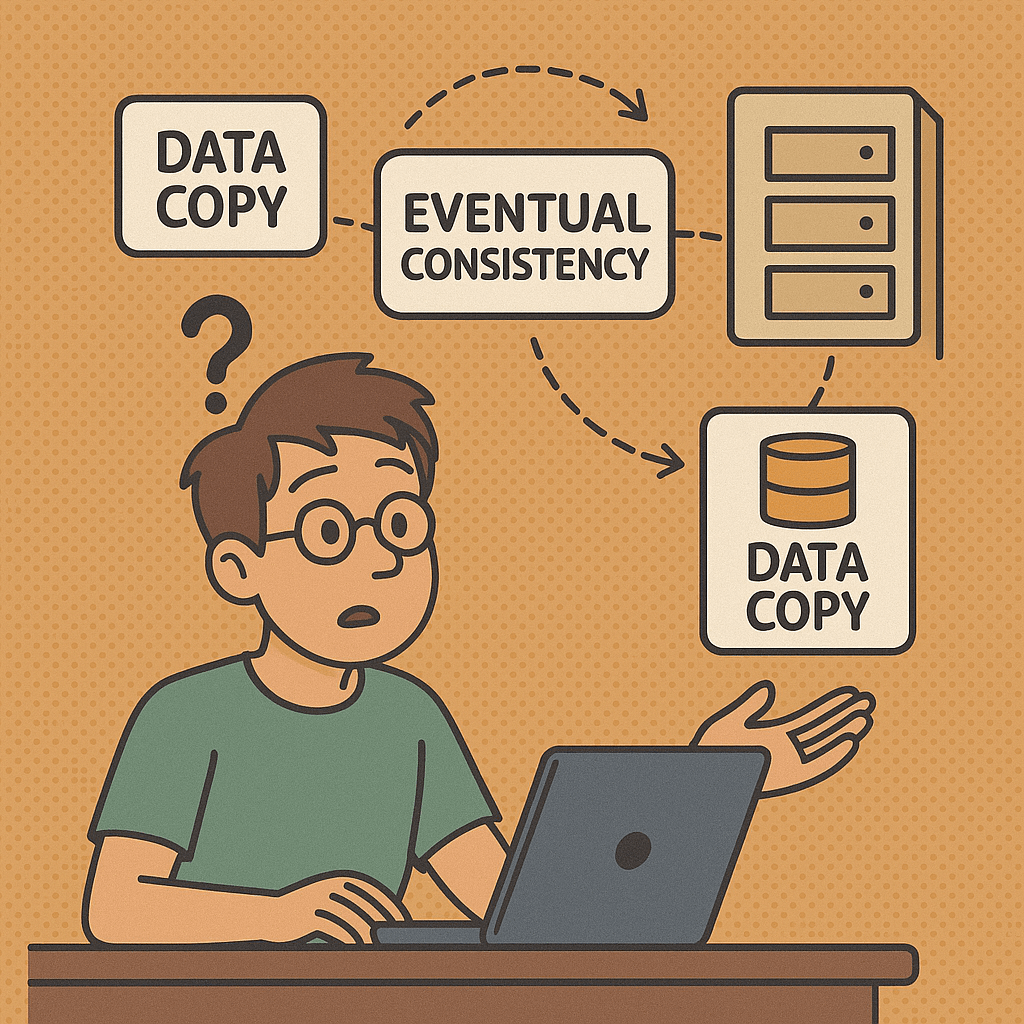
Eventual Consistency in Computer Science

What is eventual consistency?

What is Eventual Consistency?

Eventual consistency is a consistency model used in distributed computing systems. It ensures that, given enough time without new updates, all copies of data across different nodes will converge to the same state. Unlike strong consistency, where every read reflects the latest write immediately, eventual consistency allows temporary differences between nodes but guarantees they will synchronize eventually.

This concept is especially important in large-scale, fault-tolerant, and high-availability systems such as cloud databases, messaging systems, and distributed file stores.

How Does Eventual Consistency Work?

In a distributed system, data is often replicated across multiple nodes for performance and reliability. When a client updates data, the change is applied to one or more nodes and then propagated asynchronously to other replicas. During this propagation, some nodes may have stale or outdated data.

Over time, replication protocols and synchronization processes ensure that all nodes receive the update. The system is considered “eventually consistent” once all replicas reflect the latest state.

Example of the Process:

  1. A user updates their profile picture in a social media application.
  2. The update is saved in one replica immediately.
  3. Other replicas may temporarily show the old picture.
  4. After replication completes, all nodes show the updated picture.

This temporary inconsistency is acceptable in many real-world use cases because the system prioritizes availability and responsiveness over immediate synchronization.

Main Features and Characteristics of Eventual Consistency

  • Asynchronous Replication: Updates propagate to replicas in the background, not immediately.
  • High Availability: The system can continue to operate even if some nodes are temporarily unavailable.
  • Partition Tolerance: Works well in environments where network failures may occur, allowing nodes to re-sync later.
  • Temporary Inconsistency: Different nodes may return different results until synchronization is complete.
  • Convergence Guarantee: Eventually, all replicas will contain the same data once updates are propagated.
  • Performance Benefits: Improves response time since operations do not wait for all replicas to update before confirming success.

Real World Examples of Eventual Consistency

  • Amazon DynamoDB: Uses eventual consistency for distributed data storage to ensure high availability across global regions.
  • Cassandra Database: Employs tunable consistency where eventual consistency is one of the options.
  • DNS (Domain Name System): When a DNS record changes, it takes time for all servers worldwide to update. Eventually, all DNS servers converge on the latest record.
  • Social Media Platforms: Likes, comments, or follower counts may temporarily differ between servers but eventually synchronize.
  • Email Systems: When you send an email, it might appear instantly in one client but take time to sync across devices.

When and How Can We Use Eventual Consistency?

Eventual consistency is most useful in systems where:

  • High availability and responsiveness are more important than immediate accuracy.
  • Applications tolerate temporary inconsistencies (e.g., displaying slightly outdated data for a short period).
  • The system must scale across regions and handle millions of concurrent requests.
  • Network partitions and failures are expected, and the system must remain resilient.

Common scenarios include:

  • Large-scale web applications (social networks, e-commerce platforms).
  • Distributed databases across multiple data centers.
  • Caching systems that prioritize speed.

How to Integrate Eventual Consistency into Our Software Development Process

  1. Identify Use Cases: Determine which parts of your system can tolerate temporary inconsistencies. For example, product catalog browsing may use eventual consistency, while payment transactions require strong consistency.
  2. Choose the Right Tools: Use databases and systems that support eventual consistency, such as Cassandra, DynamoDB, or Cosmos DB.
  3. Design with Convergence in Mind: Ensure data models and replication strategies are designed so that all nodes will eventually agree on the final state.
  4. Implement Conflict Resolution: Handle scenarios where concurrent updates occur, using techniques like last-write-wins, version vectors, or custom merge logic.
  5. Monitor and Test: Continuously test your system under network partitions and high loads to ensure it meets your consistency and availability requirements.
  6. Educate Teams: Ensure developers and stakeholders understand the trade-offs between strong consistency and eventual consistency.

Understanding Three-Phase Commit (3PC) in Computer Science

What is Three-Phase Commit (3PC)?

Distributed systems are everywhere today — from financial transactions to large-scale cloud platforms. To ensure data consistency across multiple nodes, distributed systems use protocols that coordinate between participants. One such protocol is the Three-Phase Commit (3PC), which extends the Two-Phase Commit (2PC) protocol by adding an extra step to improve fault tolerance and avoid certain types of failures.

What is 3PC in Computer Science?

Three-Phase Commit (3PC) is a distributed consensus protocol used to ensure that a transaction across multiple nodes in a distributed system is either committed by all participants or aborted by all participants.

It builds upon the Two-Phase Commit (2PC) protocol, which can get stuck if the coordinator crashes at the wrong time. 3PC introduces an additional phase, making the process non-blocking under most failure conditions.

How Does 3PC Work?

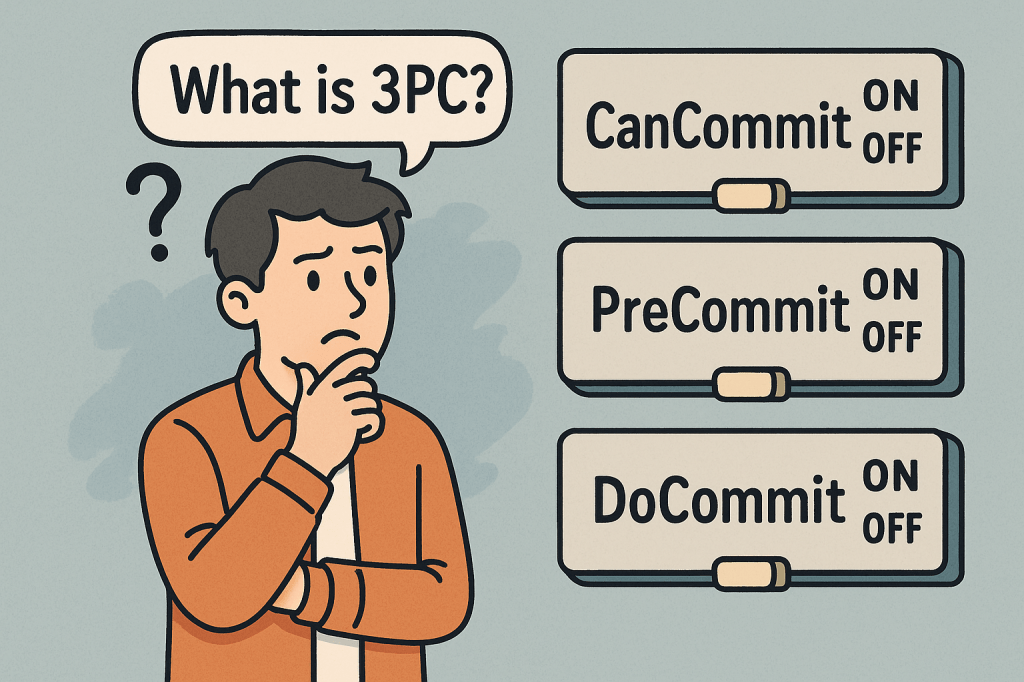
The 3PC protocol has three distinct phases:

1. CanCommit Phase (Voting Request)

  • The coordinator asks all participants if they are able to commit the transaction.
  • Participants check whether they can proceed (resources, constraints, etc.).
  • Each participant replies Yes (vote commit) or No (vote abort).

2. PreCommit Phase (Prepare to Commit)

  • If all participants vote Yes, the coordinator sends a PreCommit message.
  • Participants prepare to commit but do not make changes permanent yet.
  • They acknowledge readiness to commit.
  • If any participant voted No, the coordinator aborts the transaction.

3. DoCommit Phase (Final Commit)

  • After receiving all acknowledgments from PreCommit, the coordinator sends a DoCommit message.
  • Participants finalize the commit and release locks.
  • If any failure occurs before DoCommit, participants can safely roll back without inconsistency.

This three-step approach reduces the chance of deadlocks and ensures that participants have a clear recovery path in case of failures.

Real-World Use Cases of 3PC

1. Banking Transactions

When transferring money between two different banks, both banks’ systems need to either fully complete the transfer or not perform it at all. 3PC ensures that even if the coordinator crashes temporarily, both banks remain consistent.

2. Distributed Databases

Databases like distributed SQL systems or global NoSQL clusters can use 3PC to synchronize data across different data centers. This ensures atomicity when data is replicated globally.

3. E-Commerce Orders

In online shopping, payment, inventory deduction, and order confirmation must all succeed together. 3PC helps reduce inconsistencies such as charging the customer but failing to create the order.

Advantages of 3PC

  • Non-blocking: Unlike 2PC, participants do not remain blocked indefinitely if the coordinator crashes.
  • Improved fault tolerance: Clearer recovery process after failures.
  • Reduced risk of inconsistency: Participants always know the transaction’s current state.
  • Safer in network partitions: Adds a buffer step to prevent premature commits or rollbacks.

Issues and Disadvantages of 3PC

  • Complexity: More phases mean more messages and higher implementation complexity.
  • Performance overhead: Increases latency compared to 2PC since an extra round of communication is required.
  • Still not perfect: In extreme cases (like a complete network partition), inconsistencies may still occur.
  • Less commonly adopted: Many modern systems prefer consensus algorithms like Paxos or Raft instead, which are more robust.

When and How Should We Use 3PC?

3PC is best used when:

  • Systems require high availability and fault tolerance.
  • Consistency is more critical than performance.
  • Network reliability is moderate but not perfect.
  • Transactions involve multiple independent services where rollback can be costly.

For example, financial systems, mission-critical distributed databases, or telecom billing platforms can benefit from 3PC.

Integrating 3PC into Our Software Development Process

  1. Identify Critical Transactions
    Apply 3PC to operations where all-or-nothing consistency is mandatory (e.g., money transfers, distributed order processing).
  2. Use Middleware or Transaction Coordinators
    Implement 3PC using distributed transaction managers, message brokers, or database frameworks that support it.
  3. Combine with Modern Tools
    In microservice architectures, pair 3PC with frameworks like Spring Transaction Manager or distributed orchestrators.
  4. Monitor and Test
    Simulate node failures, crashes, and network delays to ensure the system recovers gracefully under 3PC.

Conclusion

The Three-Phase Commit protocol offers a more fault-tolerant approach to distributed transactions compared to 2PC. While it comes with additional complexity and latency, it is a valuable technique for systems where consistency and reliability outweigh performance costs.

When integrated thoughtfully, 3PC helps ensure that distributed systems maintain data integrity even in the face of crashes or network issues.

Two-Phase Commit (2PC) in Computer Science: A Complete Guide

What is 2PC?

When we build distributed systems, one of the biggest challenges is ensuring consistency across multiple systems or databases. This is where the Two-Phase Commit (2PC) protocol comes into play. It is a classic algorithm used in distributed computing to ensure that a transaction is either committed everywhere or rolled back everywhere, guaranteeing data consistency.

What is 2PC in Computer Science?

Two-Phase Commit (2PC) is a distributed transaction protocol that ensures all participants in a transaction either commit or abort changes in a coordinated way.
It is widely used in databases, distributed systems, and microservices architectures where data is spread across multiple nodes or systems.

In simple terms, 2PC makes sure that all systems involved in a transaction agree on the outcome—either everyone saves the changes, or no one does.

How Does 2PC Work?

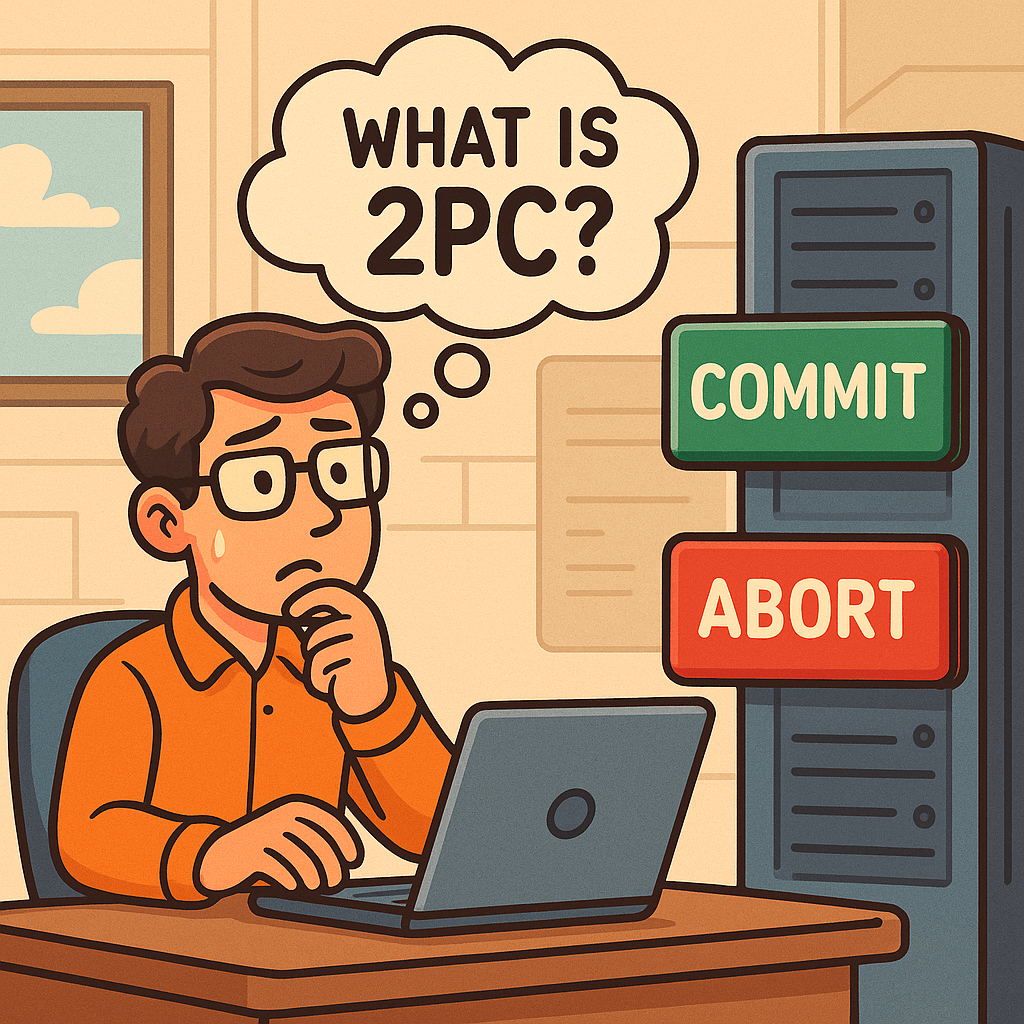
As its name suggests, 2PC works in two phases:

1. Prepare Phase (Voting Phase)

  • The coordinator (a central transaction manager) asks all participants (databases, services, etc.) if they can commit the transaction.
  • Each participant performs local checks and responds with:
    • Yes (Vote to Commit) if it can successfully commit.
    • No (Vote to Abort) if it cannot commit due to conflicts, errors, or failures.

2. Commit Phase (Decision Phase)

  • If all participants vote Yes, the coordinator sends a commit command to everyone.
  • If any participant votes No, the coordinator sends a rollback command to all participants.

This ensures that either all participants commit or none of them do, avoiding partial updates.

Real-World Use Cases of 2PC

1. Banking Systems

When transferring money between two accounts in different banks, both banks must either commit the transaction or roll it back. Without 2PC, one bank might deduct money while the other fails to add it, leading to inconsistency.

2. E-Commerce Order Processing

In an online shopping system:

  • One service decreases stock from inventory.
  • Another service charges the customer’s credit card.
  • Another service updates shipping details.
    Using 2PC, these operations are treated as a single transaction—either all succeed, or all fail.

3. Distributed Databases

In systems like PostgreSQL, Oracle, or MySQL clusters, 2PC is used to ensure that a transaction spanning multiple databases remains consistent.

Issues and Disadvantages of 2PC

While 2PC is reliable, it comes with challenges:

  • Blocking Problem: If the coordinator fails during the commit phase, participants may remain locked waiting for instructions, which can halt the system.
  • Performance Overhead: 2PC introduces extra communication steps, leading to slower performance compared to local transactions.
  • Single Point of Failure: The coordinator is critical. If it crashes, recovery is complex.
  • Not Fault-Tolerant Enough: In real distributed systems, network failures and node crashes are common, and 2PC struggles in such cases.

These issues have led to the development of more advanced protocols like Three-Phase Commit (3PC) or Saga pattern in microservices.

When and How Should We Use 2PC?

2PC is best used when:

  • Strong consistency is critical.
  • The system requires atomic transactions across multiple services or databases.
  • Downtime or data corruption is unacceptable.

However, it should be avoided in systems that require high availability and fault tolerance, where alternatives like eventual consistency or Saga pattern may be more suitable.

Integrating 2PC into Your Software Development Process

Here are practical ways to apply 2PC:

  1. Distributed Databases: Many enterprise database systems (Oracle, PostgreSQL, MySQL with XA transactions) already support 2PC. You can enable it when working with transactions across multiple nodes.
  2. Transaction Managers: Middleware solutions (like Java Transaction API – JTA, or Spring’s transaction management with XA) provide 2PC integration for enterprise applications.
  3. Microservices: If your microservices architecture requires strict ACID guarantees, you can implement a 2PC coordinator service. However, for scalability, you might also consider Saga as a more modern alternative.
  4. Testing and Monitoring: Ensure you have proper logging, failure recovery, and monitoring in place, as 2PC can lead to system lockups if the coordinator fails.

Conclusion

Two-Phase Commit (2PC) is a cornerstone protocol for ensuring atomicity and consistency in distributed systems. While it is not perfect and comes with disadvantages like blocking and performance costs, it remains highly valuable in scenarios where consistency is more important than availability.

By understanding its use cases, challenges, and integration strategies, software engineers can decide whether 2PC is the right fit—or if newer alternatives should be considered.

Conflict-free Replicated Data Type (CRDT)

What is Conflict-free Replicated Data Type (CRDT)?

What is a Conflict-free Replicated Data Type?

A Conflict-free Replicated Data Type (CRDT) is a data structure that allows multiple computers or systems to update shared data independently and concurrently without requiring coordination. Even if updates happen in different orders across different replicas, CRDTs guarantee that all copies of the data will eventually converge to the same state.

In simpler terms, CRDTs make it possible to build distributed systems (like collaborative applications) where users can work offline, make changes, and later sync with others without worrying about conflicts.

A Brief History of CRDTs

The concept of CRDTs emerged in the late 2000s when researchers in distributed computing began looking for alternatives to traditional locking and consensus mechanisms. Traditional approaches like Paxos or Raft ensure consistency but often come with performance trade-offs and complex coordination.

CRDTs were formally introduced around 2011 by Marc Shapiro and his team, who proposed them as a solution for eventual consistency in distributed systems. Since then, CRDTs have been widely researched and adopted in real-world applications such as collaborative editors, cloud storage, and messaging systems.

How Do CRDTs Work?

CRDTs are designed around two main principles:

  1. Local Updates Without Coordination
    Each replica of the data can be updated independently, even while offline.
  2. Automatic Conflict Resolution
    Instead of requiring external conflict resolution, CRDTs are mathematically designed so that when updates are merged, the data structure always converges to the same state.

They achieve this by relying on mathematical properties like commutativity (order doesn’t matter) and idempotence (repeating an operation has no negative effect).

Benefits of CRDTs

  • No Conflicts: Updates never conflict; they are automatically merged.
  • Offline Support: Applications can work offline and sync later.
  • High Availability: Since coordination isn’t required for each update, systems remain responsive even in cases of network partitions.
  • Scalability: Suitable for large-scale distributed applications because they reduce synchronization overhead.

Types of CRDTs

CRDTs come in two broad categories: Operation-based and State-based.

1. State-based CRDTs (Convergent Replicated Data Types)

  • Each replica periodically sends its entire state to others.
  • The states are merged using a mathematical function that ensures convergence.
  • Example: G-Counter (Grow-only Counter).

2. Operation-based CRDTs (Commutative Replicated Data Types)

  • Instead of sending full states, replicas send the operations (like “add 1” or “insert character”) to others.
  • Operations are designed so that they commute (order doesn’t matter).
  • Example: PN-Counter (Positive-Negative Counter).

Common CRDT Structures

  1. Counters
    • G-Counter: Only increases. Useful for counting events.
    • PN-Counter: Can increase and decrease.
  2. Registers
    • Stores a single value.
    • Last-Write-Wins Register resolves conflicts by picking the latest update based on timestamps.
  3. Sets
    • G-Set (Grow-only Set): Items can only be added.
    • 2P-Set (Two-Phase Set): Items can be added and removed, but once removed, cannot be re-added.
    • OR-Set (Observed-Removed Set): Allows both adds and removes with better flexibility.
  4. Sequences
    • Used in collaborative text editing where multiple users edit documents simultaneously.
    • Example: RGA (Replicated Growable Array) or LSEQ.
  5. Maps
    • A dictionary-like structure where keys map to CRDT values (counters, sets, etc.).

Real-World Use Cases of CRDTs

  • Collaborative Document Editing: Google Docs, Microsoft Office Online, and other real-time editors use CRDT-like concepts to merge changes from multiple users.
  • Messaging Apps: WhatsApp and Signal use CRDT principles for message synchronization across devices.
  • Distributed Databases: Databases like Riak and Redis (with CRDT extensions) implement them for high availability.
  • Cloud Storage: Systems like Dropbox and OneDrive rely on CRDTs to merge offline file edits.

When and How Should We Use CRDTs?

When to Use

  • Applications that require real-time collaboration (text editors, shared whiteboards).
  • Messaging platforms that need to handle offline delivery and sync.
  • Distributed systems where network failures are common but consistency is still required.
  • IoT systems where devices may work offline but sync data later.

How to Use

  • Choose the right CRDT type (counter, set, register, map, or sequence) depending on your use case.
  • Integrate CRDT libraries available for your programming language (e.g., Automerge in JavaScript, Riak’s CRDT support in Erlang, or Akka Distributed Data in Scala/Java).
  • Design your application around eventual consistency rather than strict, immediate consistency.

Conclusion

Conflict-free Replicated Data Types (CRDTs) are powerful tools for building modern distributed applications that require collaboration, offline support, and high availability. With their mathematically guaranteed conflict resolution, they simplify the complexity of distributed data synchronization.

If you’re building an app where multiple users interact with the same data—whether it’s text editing, messaging, or IoT data collection—CRDTs might be the right solution.

Blog at WordPress.com.

Up ↑