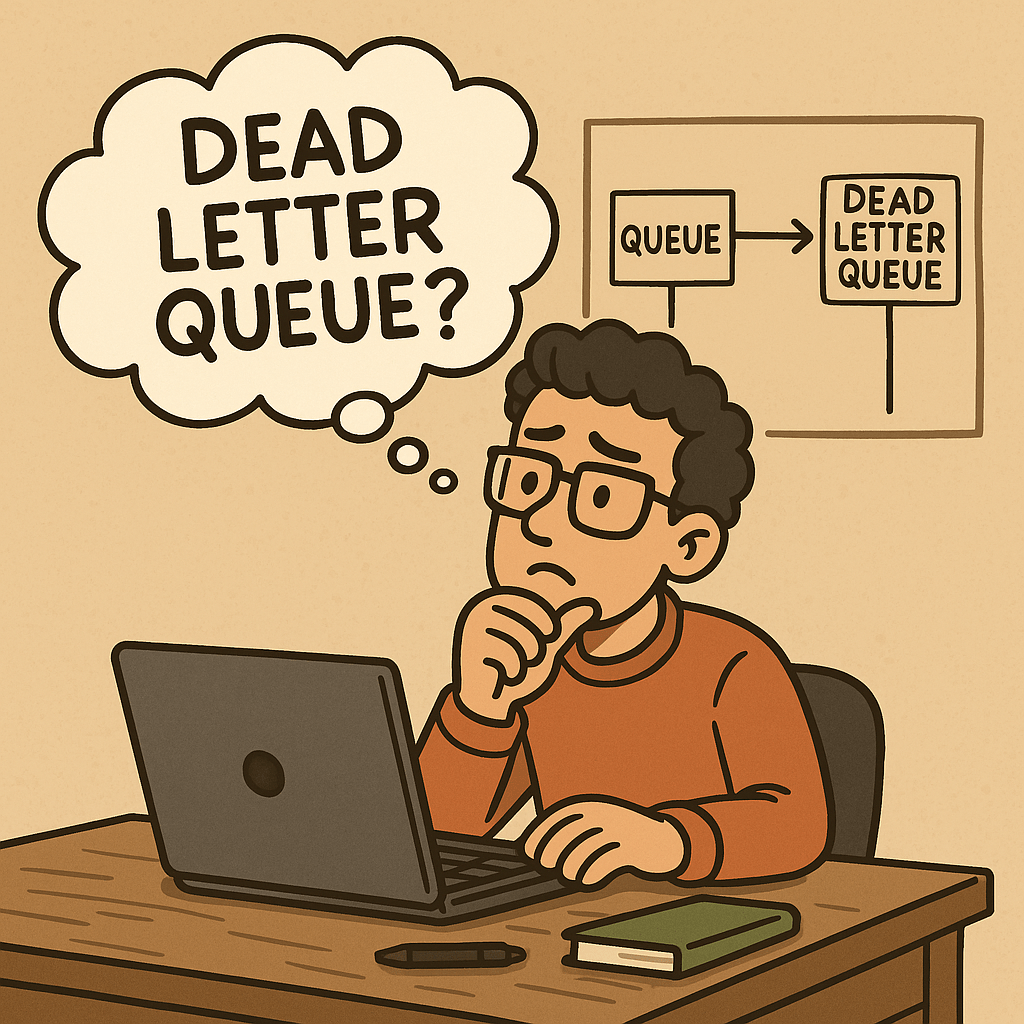
A Dead Letter Queue (DLQ) is a dedicated queue where messages go when your system can’t process them successfully after a defined number of retries or due to validation/format issues. DLQs prevent poison messages from blocking normal traffic, preserve data for diagnostics, and give you a safe workflow to fix and reprocess failures.
What Is a Dead Letter Queue?
A Dead Letter Queue (DLQ) is a secondary queue linked to a primary “work” queue (or topic subscription). When a message repeatedly fails processing—or violates rules like TTL, size, or schema—it’s moved to the DLQ instead of being retried forever or discarded.
Key idea: separate bad/problematic messages from the healthy stream so the system stays reliable and debuggable.
How Does It Work? (Step by Step)
1) Message arrives
- Producer publishes a message to the main queue/topic.
- The message includes metadata (headers) like correlation ID, type, version, and possibly a retry counter.
2) Consumer processes
- Your worker/service reads the message and attempts business logic.
- If successful → ACK/NACK appropriately → message is removed.
3) Failure and retries
- If processing fails (e.g., validation error, missing dependency, transient DB outage), the consumer either NACKs or throws an error.
- Broker policy or your code triggers a retry (immediate or delayed/exponential backoff).
4) Dead-lettering policy
- When a threshold is met (e.g.,
maxReceiveCount = 5, or message TTL exceeded, or explicitly rejected as “unrecoverable”), the broker moves the message to the DLQ. - The DLQ carries the original payload plus broker-specific reason codes and delivery attempt metadata.
5) Inspection and reprocessing
- Operators/engineers inspect DLQ messages, identify root cause, fix code/data/config, and then reprocess messages from the DLQ back into the main flow (or a special “retry” queue).
Benefits & Advantages (Why DLQs Matter)
1) Reliability and throughput protection
- Poison messages don’t block the main queue, so healthy traffic continues to flow.
2) Observability and forensics
- You don’t lose failed messages: you can explain failures, reproduce bugs, and perform root-cause analysis.
3) Controlled recovery
- You can reprocess failed messages in a safe, rate-limited way after fixes, reducing blast radius.
4) Compliance and auditability
- DLQs preserve evidence of failures (with timestamps and reason codes), useful for audits and postmortems.
5) Cost and performance balance
- By cutting infinite retries, you reduce wasted compute and noisy logs.
When and How Should We Use a DLQ?
Use a DLQ when…
- Messages can be malformed, out-of-order, or schema-incompatible.
- Downstream systems are occasionally unavailable or rate-limited.
- You operate at scale and need protection from poison messages.
- You must keep evidence of failures for audit/compliance.
How to configure (common patterns)
- Set a retry cap: e.g., 3–10 attempts with exponential backoff.
- Define dead-letter conditions: max attempts, TTL expiry, size limit, explicit rejection.
- Include reason metadata: error codes, stack traces (trimmed), last-failure timestamp.
- Create a reprocessing path: tooling or jobs to move messages back after fixes.
Main Challenges (and How to Handle Them)
1) DLQ becoming a “graveyard”
- Risk: Messages pile up and are never reprocessed.
- Mitigation: Ownership, SLAs, on-call runbooks, weekly triage, dashboards, and auto-alerts.
2) Distinguishing transient vs. permanent failures
- Risk: You keep retrying messages that will never succeed.
- Mitigation: Classify errors (e.g., 5xx transient vs. 4xx permanent), and dead-letter permanent failures early.
3) Message evolution & schema drift
- Risk: Older messages don’t match new contracts.
- Mitigation: Use schema versioning, backward-compatible serializers (e.g., Avro/JSON with defaults), and upconverters.
4) Idempotency and duplicates
- Risk: Reprocessing may double-charge or double-ship.
- Mitigation: Idempotent handlers keyed by message ID/correlation ID; dedupe storage.
5) Privacy & retention
- Risk: Sensitive data lingers in DLQ.
- Mitigation: Redact PII fields, encrypt at rest, set retention policies, purge according to compliance.
6) Operational toil
- Risk: Manual replays are slow and error-prone.
- Mitigation: Provide a self-serve DLQ UI/CLI, canned filters, bulk reprocess with rate limits.
Real-World Examples (Deep Dive)
Example 1: E-commerce order workflow (Kafka/RabbitMQ/Azure Service Bus)
- Scenario: Payment service consumes
OrderPlacedevents. A small percentage fails due to expired cards or unknown currency. - Flow:
- Consumer validates schema and payment method.
- For transient payment gateway outages → retry with exponential backoff (e.g., 1m, 5m, 15m).
- For permanent issues (invalid currency) → send directly to DLQ with reason
UNSUPPORTED_CURRENCY. - Weekly DLQ triage: finance reviews messages, fixes catalog currency mappings, then reprocesses only the corrected subset.
Example 2: Logistics tracking updates (AWS SQS)
- Scenario: IoT devices send GPS updates. Rare firmware bug emits malformed JSON.
- Flow:
- SQS main queue with
maxReceiveCount=5. - Malformed messages fail schema validation 5× → moved to DLQ.
- An ETL “scrubber” tool attempts to auto-fix known format issues; successful ones are re-queued; truly bad ones are archived and reported.
- SQS main queue with
Example 3: Billing invoice generation (GCP Pub/Sub)
- Scenario: Monthly invoice generation fan-out; occasionally the customer record is missing tax info.
- Flow:
- Pub/Sub subscription push to worker; on 4xx validation error, message is acknowledged to prevent infinite retries and manually published to a DLQ topic with reason
MISSING_TAX_PROFILE. - Ops runs a batch to fetch missing tax profiles; after remediation, a replay job re-emits those messages to a “retry” topic at a safe rate.
- Pub/Sub subscription push to worker; on 4xx validation error, message is acknowledged to prevent infinite retries and manually published to a DLQ topic with reason
Broker-Specific Notes (Quick Reference)
- AWS SQS: Configure a redrive policy linking main queue to DLQ with
maxReceiveCount. Use CloudWatch metrics/alarms onApproximateNumberOfMessagesVisiblein the DLQ. - Amazon SNS → SQS: DLQ typically sits behind the SQS subscription. Each subscription can have its own DLQ.
- Azure Service Bus: DLQs exist per queue and per subscription. Service Bus auto-dead-letters on TTL, size, or filter issues; you can explicitly dead-letter via SDK.
- Google Pub/Sub: No first-class DLQ historically; implement via a dedicated “dead-letter topic” plus subscriber logic (Pub/Sub now supports dead letter topics on subscriptions—set
deadLetterPolicywith max delivery attempts). - RabbitMQ: Use alternate exchange or per-queue dead-letter exchange (DLX) with dead-letter routing keys; create a bound DLQ queue that receives rejected/expired messages.
Integration Guide: Add DLQs to Your Development Process
1) Design a DLQ policy
- Retry budget:
max_attempts = 5, backoff1m → 5m → 15m → 1h → 6h(example). - Classify failures:
- Transient (timeouts, 5xx): retry up to budget.
- Permanent (validation, 4xx): dead-letter immediately.
- Metadata to include: correlation ID, producer service, schema version, last error code/reason, first/last failure timestamps.
2) Implement idempotency
- Use a processing log keyed by message ID; ignore duplicates.
- For stateful side effects (e.g., billing), store an idempotency key and status.
3) Add observability
- Dashboards: DLQ depth, inflow rate, age percentiles (P50/P95), reasons top-N.
- Alerts: when DLQ depth or age exceeds thresholds; when a single reason spikes.
4) Build safe reprocessing tools
- Provide a CLI/UI to:
- Filter by reason code/time window/producer.
- Bulk requeue with rate limits and circuit breakers.
- Simulate dry-run processing (validation-only) before replay.
5) Automate triage & ownership
- Assign service owners for each DLQ.
- Weekly scheduled triage with an SLA (e.g., “no DLQ message older than 7 days”).
- Tag JIRA tickets with DLQ reason codes.
6) Security & compliance
- Redact PII in payloads or keep PII in secure references.
- Set retention (e.g., 14–30 days) and auto-archive older messages to encrypted object storage.
Practical Config Snippets (Pseudocode)
Retry + Dead-letter decision (consumer)
onMessage(msg):
  try:
    validateSchema(msg)
    processBusinessLogic(msg)
    ack(msg)
  except TransientError as e:
    if msg.attempts < MAX_ATTEMPTS:
      requeueWithDelay(msg, backoffFor(msg.attempts))
    else:
      sendToDLQ(msg, reason="RETRY_BUDGET_EXCEEDED", error=e.summary)
  except PermanentError as e:
    sendToDLQ(msg, reason="PERMANENT_VALIDATION_FAILURE", error=e.summary)
Idempotency guard
if idempotencyStore.exists(msg.id):
  ack(msg)  # already processed
else:
  result = handle(msg)
  idempotencyStore.record(msg.id, result.status)
  ack(msg)
Operational Runbook (What to Do When DLQ Fills Up)
- Check dashboards: DLQ depth, top reasons.
- Classify spike: deployment-related? upstream schema change? dependency outage?
- Fix root cause: roll back, hotfix, or add upconverter/validator.
- Sample messages: inspect payloads; verify schema/PII.
- Dry-run replay: validate-only path over a small batch.
- Controlled replay: requeue with rate limit (e.g., 50 msg/s) and monitor error rate.
- Close the loop: add tests, update schemas, document the incident.
Metrics That Matter
- DLQ Depth (current and trend)
- Message Age in DLQ (P50/P95/max)
- DLQ Inflow/Outflow Rate
- Top Failure Reasons (by count)
- Replay Success Rate
- Time-to-Remediate (first seen → replayed)
FAQ
Is a DLQ the same as a retry queue?
No. A retry queue is for delayed retries; a DLQ is for messages that exhausted retry policy or are permanently invalid.
Should every queue have a DLQ?
For critical paths—yes. For low-value or purely ephemeral events, weigh the operational cost vs. benefit.
Can we auto-delete DLQ messages?
You should set retention, but avoid blind deletion. Consider archiving with limited retention to support audits.
Checklist: Fast DLQ Implementation
- DLQ created and linked to each critical queue/subscription
- Retry policy set (max attempts + exponential backoff)
- Error classification (transient vs permanent)
- Idempotency implemented
- Dashboards and alerts configured
- Reprocessing tool with rate limits
- Ownership & triage cadence defined
- Retention, redaction, and encryption reviewed
Conclusion
A well-implemented DLQ is your safety net for message-driven systems: it safeguards throughput, preserves evidence, and enables controlled recovery. With clear policies, observability, and a disciplined replay workflow, DLQs transform failures from outages into actionable insights—and keep your pipelines resilient.

 Software Engineer's Notes
Recent Comments