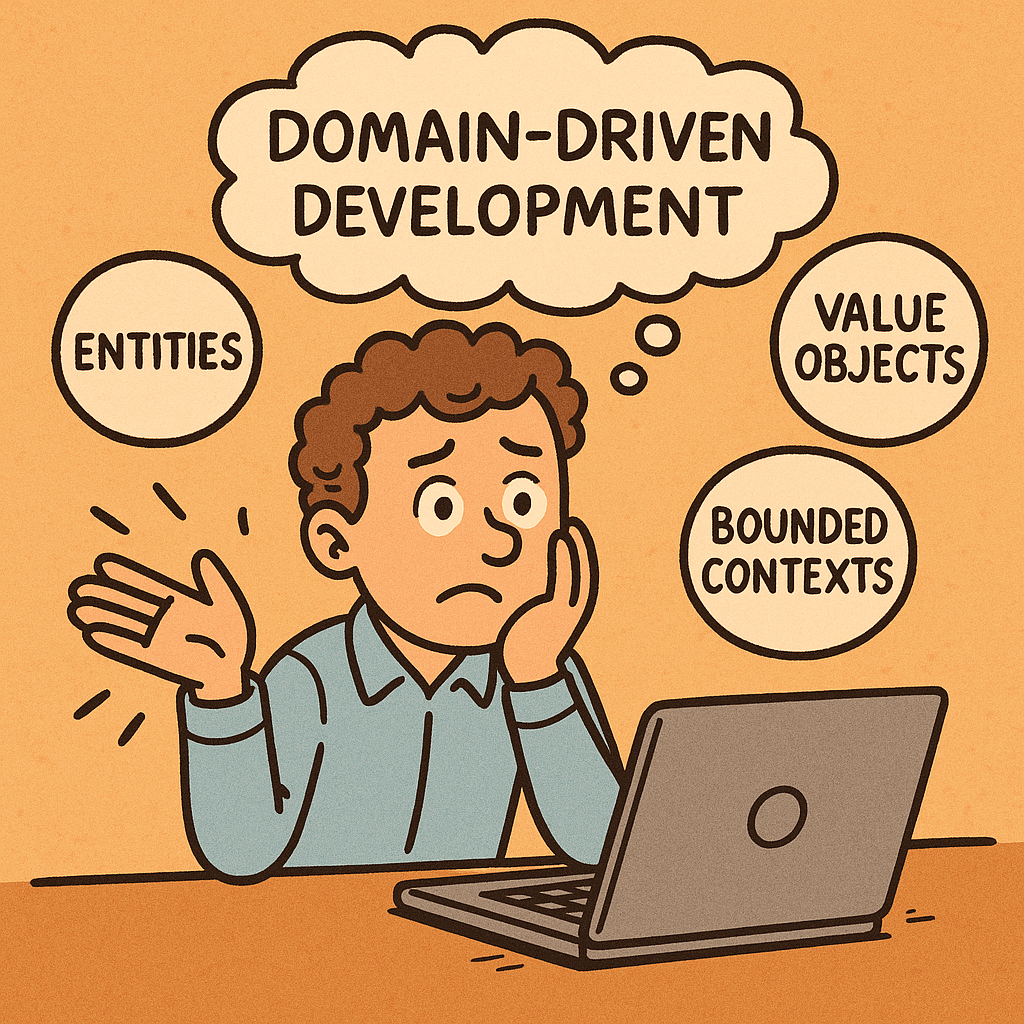
What is Domain-Driven Development?
Domain-Driven Development (DDD) is a software design approach introduced by Eric Evans in his book Domain-Driven Design: Tackling Complexity in the Heart of Software. At its core, DDD emphasizes focusing on the business domain—the real-world problems and processes that software is meant to solve—rather than just the technology or infrastructure.
Instead of forcing business problems to fit around technical choices, DDD places business experts and developers at the center of the design process, ensuring that the resulting software truly reflects the organization’s needs.
The Main Components of Domain-Driven Development
- Domain
The subject area the software is designed to address. For example, healthcare management, e-commerce, or financial trading. - Ubiquitous Language
A shared language between developers and domain experts. This ensures that technical terms and business terms align, preventing miscommunication. - Entities
Objects that have a distinct identity that runs through time, such as Customer or Order. - Value Objects
Immutable objects without identity, defined only by their attributes, such as Money or Address. - Aggregates
Groups of related entities and value objects treated as a single unit, ensuring data consistency. - Repositories
Mechanisms to retrieve and store aggregates while hiding database complexity. - Services
Domain-specific operations that don’t naturally belong to an entity or value object. - Bounded Contexts
Clearly defined boundaries that separate different parts of the domain model, avoiding confusion. For example, “Payments” and “Shipping” may be different bounded contexts in an e-commerce system.
How Does Domain-Driven Development Work?
DDD works by creating a collaborative environment between domain experts and developers. The process generally follows these steps:
- Understand the domain deeply by working with domain experts.
- Create a ubiquitous language to describe concepts, processes, and rules.
- Model the domain using entities, value objects, aggregates, and bounded contexts.
- Implement the design with code that reflects the model.
- Continuously refine the model as the domain and business requirements evolve.
This approach ensures that the codebase remains closely tied to real-world problems and adapts as the business grows.
Benefits and Advantages of DDD
- Closer alignment with business needs: Software reflects real processes and terminology.
- Improved communication: Shared language reduces misunderstandings between developers and stakeholders.
- Better handling of complexity: Bounded contexts and aggregates break down large systems into manageable pieces.
- Flexibility and adaptability: Models evolve with business requirements.
- High-quality, maintainable code: Code mirrors real-world processes, making it easier to understand and extend.
Challenges of Domain-Driven Development
- Steep learning curve
DDD concepts can be difficult for teams unfamiliar with them. - Time investment
Requires significant upfront collaboration between developers and domain experts. - Overengineering risk
In simple projects, applying DDD may add unnecessary complexity. - Requires strong domain knowledge
Without dedicated domain experts, building accurate models becomes very difficult. - Organizational barriers
Some companies may not have the culture or structure to support continuous collaboration between business and technical teams.
When and How Can We Use DDD?
When to use DDD:
- Large, complex business domains.
- Projects with long-term maintenance needs.
- Systems requiring constant adaptation to changing business rules.
- Environments where miscommunication between technical and business teams is common.
When not to use DDD:
- Small, straightforward applications (like a simple CRUD app).
- Projects with very tight deadlines and no access to domain experts.
How to use DDD:
- Start by identifying bounded contexts in your system.
- Build domain models with input from both developers and business experts.
- Use ubiquitous language across documentation, code, and conversations.
- Apply tactical patterns (entities, value objects, repositories, etc.).
- Continuously refine the model through iteration.
Real-World Examples of DDD
- E-Commerce Platform
- Domain: Online shopping.
- Bounded Contexts: Shopping Cart, Payments, Inventory, Shipping.
- Entities: Customer, Order, Product.
- Value Objects: Money, Address.
DDD helps maintain separation so that changes in the “Payments” system don’t affect “Inventory.”
- Healthcare System
- Domain: Patient care management.
- Bounded Contexts: Patient Records, Scheduling, Billing.
- Entities: Patient, Appointment, Doctor.
- Value Objects: Diagnosis, Prescription.
DDD ensures terminology matches medical experts’ language, reducing errors and improving system usability.
- Banking System
- Domain: Financial transactions.
- Bounded Contexts: Accounts, Loans, Risk Management.
- Entities: Account, Transaction, Customer.
- Value Objects: Money, InterestRate.
By modeling aggregates like Account, DDD ensures consistency when handling multiple simultaneous transactions.
Conclusion
Domain-Driven Development is a powerful methodology for tackling complex business domains. By aligning technical implementation with business needs, it creates software that is not only functional but also adaptable and maintainable. While it requires effort and strong collaboration, the benefits far outweigh the challenges for large and evolving systems.

 Software Engineer's Notes
Recent Comments