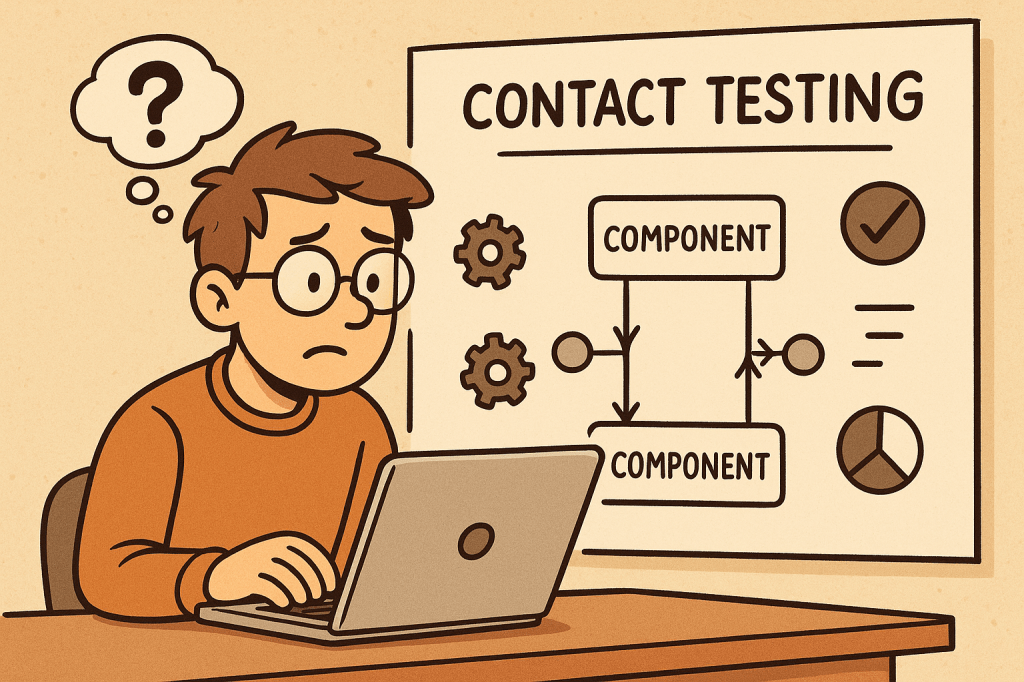
What is Contact Testing?
Contact testing is a software testing approach where different components, services, or systems that “contact” each other are tested to ensure they communicate correctly. It focuses on the integration points between units or modules, rather than testing each component in isolation.
The goal is to verify that the interfaces, data exchanges, and dependencies between components work as expected. While unit tests validate the logic inside a module, contact tests validate the correctness of the connections between modules.
In short: contact testing ensures that pieces of software can talk to each other reliably.
How Does Contact Testing Work?
Contact testing works by simulating real interactions between two or more components in a controlled environment.
- Identify contact points – Determine where modules, APIs, or services interact (e.g., function calls, REST endpoints, message brokers).
- Define contracts and expectations – Define what inputs, outputs, and protocols the interaction should follow.
- Set up a test environment – Create a test harness or mock services to replicate real communication.
- Execute tests – Run tests that validate requests, responses, data formats, error handling, and edge cases.
- Validate results – Ensure both sides of the interaction behave correctly.
Example:
If a front-end application makes a call to a backend API, contact tests check if:
- The request is formatted correctly (headers, payload, authentication).
- The backend responds with the correct status codes and data structures.
- Error scenarios (timeouts, invalid data) are handled properly.
Features and Components of Contact Testing
- Interface Validation
- Ensures APIs, methods, and endpoints conform to expected definitions.
- Data Contract Verification
- Confirms that the structure, types, and formats of exchanged data are correct.
- Dependency Testing
- Validates that dependent services respond as expected.
- Error Handling Checks
- Tests how systems behave under failures (network issues, incorrect inputs).
- Automation Support
- Easily integrated into CI/CD pipelines for continuous validation.
- Environment Simulation
- Uses stubs, mocks, or test doubles to mimic dependencies when the real ones are unavailable.
Advantages and Benefits
- Early Bug Detection
- Detects integration issues before deployment.
- Improved Reliability
- Ensures systems interact smoothly, reducing runtime errors.
- Better Communication Between Teams
- Clearly defined contracts improve collaboration between frontend, backend, and third-party teams.
- Supports Agile and Microservices
- Critical in distributed systems where many services interact.
- Reduced Production Failures
- By validating assumptions early, fewer surprises occur in production.
When and How Should We Use Contact Testing?
- When to Use
- When multiple teams build components independently.
- When integrating third-party APIs or services.
- In microservices architectures with many dependencies.
- Before full end-to-end testing to catch issues early.
- How to Use
- Define contracts (OpenAPI/Swagger for REST APIs, Protobuf for gRPC).
- Create automated tests that verify requests and responses.
- Run tests as part of CI/CD pipelines after unit tests but before full system tests.
- Use tools like Pact, WireMock, or Postman/Newman for contract and contact testing.
Real-World Examples
- E-commerce Platform
- Frontend calls backend to fetch product details. Contact tests verify that product IDs, prices, and stock status are correctly retrieved.
- Payment Gateway Integration
- Contact tests ensure the application sends payment requests correctly and handles responses (success, failure, timeout) as expected.
- Microservices in Banking
- Account service and transaction service communicate via REST APIs. Contact tests validate data formats (account number, balance) and error handling (invalid accounts, insufficient funds).
- Healthcare System
- Contact tests ensure patient records shared between hospital modules follow the correct format and confidentiality rules.
How to Integrate Contact Testing into the Software Development Process
- Define Contracts Early
- Use schemas or interface definitions as a shared agreement between teams.
- Implement Contact Tests Alongside Unit Tests
- Ensure each service’s contact points are tested before integration.
- Automate in CI/CD Pipelines
- Run contact tests automatically on pull requests and deployments.
- Use Mock Servers
- For unavailable or costly dependencies, use mock servers to simulate interactions.
- Continuous Monitoring
- Extend contact testing into production with monitoring tools to detect real-world deviations.
Conclusion
Contact testing is a crucial step between unit testing and full system testing. It ensures that modules, services, and APIs can communicate correctly, reducing integration risks. By incorporating contact tests into your development lifecycle, you improve software reliability, minimize production issues, and enable smoother collaboration across teams.
Whether you’re building microservices, APIs, or integrating third-party tools, contact testing helps validate trust at every connection point.

 Software Engineer's Notes
Recent Comments