
When building modern applications and enterprise systems, managing user authentication across multiple services is often a challenge. One solution that has stood the test of time is the Central Authentication Service (CAS) protocol. In this post, we’ll explore what CAS is, its history, how it works, who uses it, and its pros and cons.
What is CAS?
The Central Authentication Service (CAS) is an open-source, single sign-on (SSO) protocol that allows users to access multiple applications with just one set of login credentials. Instead of requiring separate logins for each application, CAS authenticates the user once and then shares that authentication with other trusted systems.
This makes it particularly useful in organizations where users need seamless access to a variety of internal and external services.
A Brief History of CAS
CAS was originally developed at Yale University in 2001 to solve the problem of students and faculty needing multiple logins for different campus systems.
Over the years, CAS has evolved into a widely adopted open standard, supported by the Apereo Foundation (a nonprofit organization that also manages open-source educational software projects). Today, CAS is actively maintained and widely used in higher education, enterprises, and government systems.
How CAS Works: The Protocol
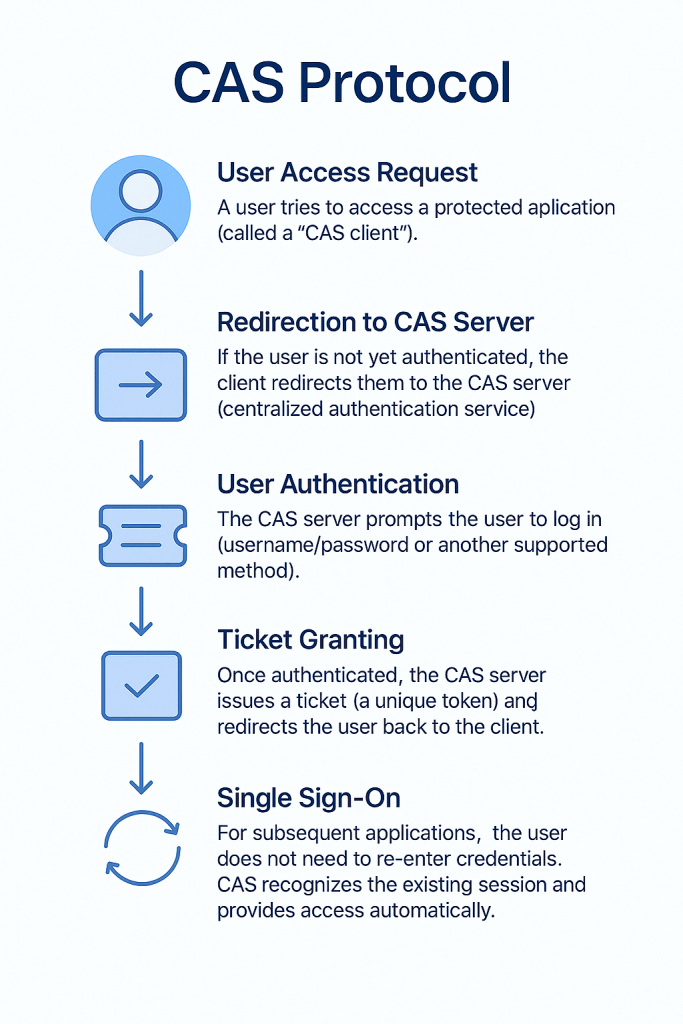
The CAS protocol is based on the principle of single sign-on through ticket validation. Here’s a simplified breakdown of how it works:
- User Access Request
A user tries to access a protected application (called a “CAS client”). - Redirection to CAS Server
If the user is not yet authenticated, the client redirects them to the CAS server (centralized authentication service). - User Authentication
The CAS server prompts the user to log in (username/password or another supported method). - Ticket Granting
Once authenticated, the CAS server issues a ticket (a unique token) and redirects the user back to the client. - Ticket Validation
The client contacts the CAS server to validate the ticket. If valid, the user is granted access. - Single Sign-On
For subsequent applications, the user does not need to re-enter credentials. CAS recognizes the existing session and provides access automatically.
This ticket-based flow ensures security, while the centralized server manages authentication logic.
Who Uses CAS?
CAS is widely adopted across different domains:
- Universities & Colleges → Many higher education institutions rely on CAS to provide seamless login across portals, course systems, and email services.
- Government Agencies → Used to simplify user access across multiple public-facing systems.
- Enterprises → Adopted by businesses for internal systems integration.
- Open-source Projects → Integrated into tools that require centralized authentication.
When to Use CAS?
CAS is a great choice when:
- You have multiple applications that require login.
- You want to reduce password fatigue for users.
- Security and centralized authentication management are critical.
- You prefer an open-source, standards-based protocol with strong community support.
If your system is small or only requires one authentication endpoint, CAS might be overkill.
Advantages of CAS
Single Sign-On (SSO): Users only log in once and gain access to multiple services.
Open-Source & Flexible: Backed by the Apereo community with strong support.
Wide Integration Support: Works with web, desktop, and mobile applications.
Extensible Authentication Methods: Supports username/password, multi-factor authentication, LDAP, OAuth, and more.
Strong Security Model: Ticket validation ensures tokens cannot be reused across systems.
Disadvantages of CAS
Initial Setup Complexity: Requires configuring both CAS server and client applications.
Overhead for Small Systems: If you only have one or two applications, CAS may add unnecessary complexity.
Learning Curve: Developers and administrators need to understand the CAS flow, ticketing, and integration details.
Dependency on CAS Server Availability: If the CAS server goes down, authentication for all connected apps may fail.
Conclusion
The Central Authentication Service (CAS) remains one of the most robust and reliable single sign-on protocols in use today. With its origins in academia and adoption across industries, it has proven to be a secure, scalable solution for organizations that need centralized authentication.
If your system involves multiple applications and user logins, adopting CAS could streamline your authentication strategy, improve user experience, and strengthen overall security.

 Software Engineer's Notes
Recent Comments