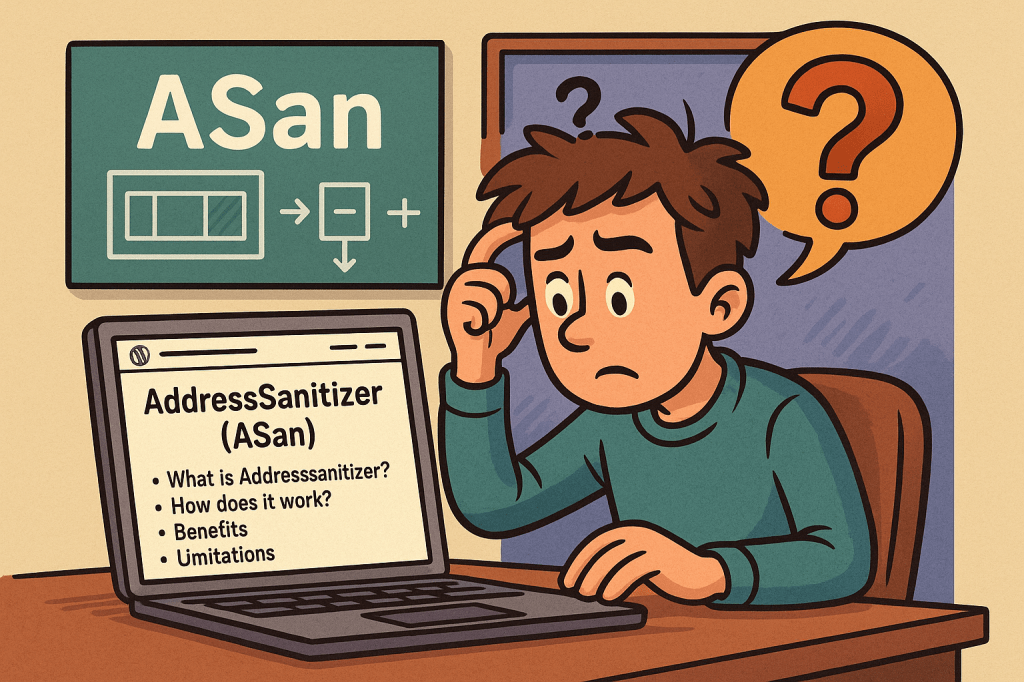
What is AddressSanitizer?
AddressSanitizer (ASan) is a fast memory error detector built into modern compilers (Clang/LLVM and GCC). When you compile your C/C++ (and many C-compatible) programs with ASan, the compiler injects checks that catch hard-to-debug memory bugs at runtime, then prints a readable, symbolized stack trace to help you fix them.
Finds (most common):
- Heap/stack/global buffer overflows & underflows
- Use-after-free and use-after-scope (return)
- Double-free and invalid free
- Memory leaks (via LeakSanitizer integration)
How does ASan work (deep dive)
ASan adds lightweight instrumentation to your binary and links a runtime that monitors memory accesses:
- Shadow Memory:
ASan maintains a “shadow” map where every 8 bytes of application memory correspond to 1 byte in shadow memory. A non-zero shadow byte marks memory as poisoned (invalid); a zero marks it valid. Every load/store checks the shadow first. - Redzones (Poisoned Guards):
Around each allocated object (heap, stack, globals), ASan places redzones—small poisoned regions. If code overreads or overwrites into a redzone, ASan trips immediately with an error report. - Quarantine for Frees:
Freed heap blocks aren’t immediately reused—they go into a quarantine and stay poisoned for a while. Accessing them becomes a use-after-free that ASan can catch reliably. - Stack & Global Instrumentation:
The compiler lays out extra redzones around stack and global objects, poisoning/unpoisoning as scopes begin and end. This helps detect use-after-scope and overflows on local arrays. - Intercepted Library Calls:
Common libc/allocator functions (e.g.,malloc,memcpy) are intercepted so ASan can keep metadata accurate and report clearer diagnostics. - Detailed Reports & Symbolization:
On error, ASan prints the access type/size, the exact location, the allocation site, and a symbolized backtrace (when built with debug info), plus hints (“allocated here”, “freed here”).
Benefits
- High signal, low friction: You recompile with a flag; no code changes needed in most cases.
- Fast enough for day-to-day testing: Typically 1.5–2× CPU overhead—often fine for local runs and CI.
- Readable diagnostics: Clear error type, file/line, and allocation/free stacks dramatically reduce debug time.
- Great with fuzzing & tests: Pair with libFuzzer/AFL/pytest-cpp/etc. to turn latent memory issues into immediate, actionable crashes.
Limitations & Caveats
- Overheads: Extra CPU and memory (often 2–3× RAM). Not ideal for tight-resource or latency-critical production paths.
- Rebuild required: You must compile and link with ASan. Prebuilt third-party libs without ASan may dilute coverage or require special handling.
- Not all bugs:
- Uninitialized reads → use MemorySanitizer (MSan)
- Data races → use ThreadSanitizer (TSan)
- Undefined behavior (e.g., integer overflow UB, misaligned access) → UBSan
- Allocator/custom low-level code: Exotic allocators or inline assembly may need tweaks or suppressions.
- Coverage nuances: Intra-object overflows or certain pointer arithmetic patterns may escape detection.
When should you use it?
- During development & CI for C/C++ services, libraries, and tooling.
- Before releases to smoke-test with integration and end-to-end suites.
- While fuzzing/parsing untrusted data, e.g., file formats, network protocols.
- On crash-heavy modules (parsers, codecs, crypto glue, JNI/FFI boundaries) where memory safety is paramount.
How to enable AddressSanitizer
Quick start (Clang or GCC)
# Build
clang++ -fsanitize=address -fno-omit-frame-pointer -g -O1 -o app_san main.cpp
# or
g++      -fsanitize=address -fno-omit-frame-pointer -g -O1 -o app_san main.cpp

# Run with helpful defaults
ASAN_OPTIONS=halt_on_error=1:strict_string_checks=1:detect_leaks=1 ./app_san
Flags explained
-fsanitize=address— enable ASan-fno-omit-frame-pointer -g— better stack traces-O1(or-O0) — keeps instrumentation simple and easier to map to linesASAN_OPTIONS— runtime tuning (leak detection, halting on first error, etc.)
CMake
# CMakeLists.txt
option(ENABLE_ASAN "Build with AddressSanitizer" ON)

if (ENABLE_ASAN AND CMAKE_CXX_COMPILER_ID MATCHES "Clang|GNU")
  add_compile_options(-fsanitize=address -fno-omit-frame-pointer -g -O1)
  add_link_options(-fsanitize=address)
endif()
Make
CXXFLAGS += -fsanitize=address -fno-omit-frame-pointer -g -O1
LDFLAGS  += -fsanitize=address
Real-World Use Cases (and how ASan helps)
- Image Parser Heap Overflow
- Scenario: A PNG decoder reads width/height from the file, under-validates them, and writes past a heap buffer.
- With ASan: First failing test triggers an out-of-bounds write report with call stacks for both the write and the allocation site. You fix the bounds check and add regression tests.
- Use-After-Free in a Web Server
- Scenario: Request object freed on one path but referenced later by a logger.
- With ASan: The access to the freed pointer immediately faults with a use-after-free report. Quarantine ensures it crashes deterministically instead of “works on my machine.”
- Stack Buffer Overflow in Protocol Handler
- Scenario: A stack array sized on assumptions gets overrun by a longer header.
- With ASan: Redzones around stack objects catch it as soon as the bad write occurs, pointing to the exact function and line.
- Memory Leaks in CLI Tool
- Scenario: Early returns skip frees.
- With ASan + LeakSanitizer: Run tests; at exit, you get a leak summary with allocation stacks. You patch the code and verify the leak disappears.
- Fuzzing Third-Party Libraries
- Scenario: You integrate libFuzzer to stress a JSON library.
- With ASan: Any corruptor input hitting memory issues produces actionable reports, turning “mysterious crashes” into clear bugs.
Integrating ASan into Your Software Development Process
1) Add a dedicated “sanitizer” build
- Create a separate build target/profile (e.g.,
Debug-ASAN). - Compile everything you can with
-fsanitize=address(apps, libs, tests). - Keep symbols:
-g -fno-omit-frame-pointer.
2) Run unit/integration tests under ASan
- In CI, add a job that builds with ASan and runs your full test suite.
- Fail the pipeline on any ASan report (
halt_on_error=1).
3) Use helpful ASAN_OPTIONS (per target or globally)
Common choices:
ASAN_OPTIONS=\
detect_leaks=1:\
halt_on_error=1:\
strict_string_checks=1:\
alloc_dealloc_mismatch=1:\
detect_stack_use_after_return=1
(You can also keep a project-level .asanrc/env file for consistency.)
4) Symbolization & developer ergonomics
- Ensure
llvm-symbolizeris installed (or available in your toolchain). - Keep
-gin your ASan builds; store dSYMs/PDBs where applicable. - Teach the team to read ASan reports—share a short “How to read ASan output” page.
5) Handle third-party and system libraries
- Prefer source builds of dependencies with ASan enabled.
- If you must link against non-ASan binaries, test critical boundaries thoroughly and consider suppressions for known benign issues.
6) Combine with other sanitizers (where applicable)
- UBSan (undefined behavior), TSan (data races), MSan (uninitialized reads).
- Run them in separate builds; mixing TSan with others is generally not recommended.
7) Pre-release and nightly sweeps
- Run heavier test suites (fuzzers, long-running integration tests) nightly under ASan.
- Gate releases on “no sanitizer regressions.”
8) Production strategy
- Typically don’t run ASan in production (overhead + noisy reports).
- If necessary, use shadow deploys or limited canaries with low traffic and aggressive alerting.
Developer Tips & Troubleshooting
- Crashing in malloc/new interceptors? Ensure you link the sanitizer runtime last or use the compiler driver (don’t manually juggle libs).
- False positives from assembly or custom allocators? Add minimal suppressions and comments; also review for real bugs—ASan is usually right.
- Random hangs/timeouts under fuzzing? Start with smaller corpora and lower timeouts; increase gradually.
- Build system gotchas: Ensure both compile and link steps include
-fsanitize=address.
FAQ
Q: Can I use ASan with C only?
Yes. It works great for C and C++ (and many C-compatible FFI layers).
Q: Does ASan slow everything too much?
For local and CI testing, the trade-off is almost always worth it. Typical overhead: ~1.5–2× CPU, ~2–3× RAM.
Q: Do I need to change my code?
Usually no. Compile/link with the flags and run. You might tweak build scripts or add suppressions for a few low-level spots.
A minimal “Starter Checklist”
- Add an ASan build target to your project (CMake/Make/Bazel).
- Ensure -g and -fno-omit-frame-pointer are on.
- Add a CI job that runs tests with
ASAN_OPTIONS=halt_on_error=1:detect_leaks=1. - Document how to read ASan reports and where symbol files live.
- Pair ASan with fuzzing on parsers/protocols.
- Gate releases on sanitizer-clean status.

 Software Engineer's Notes
Recent Comments