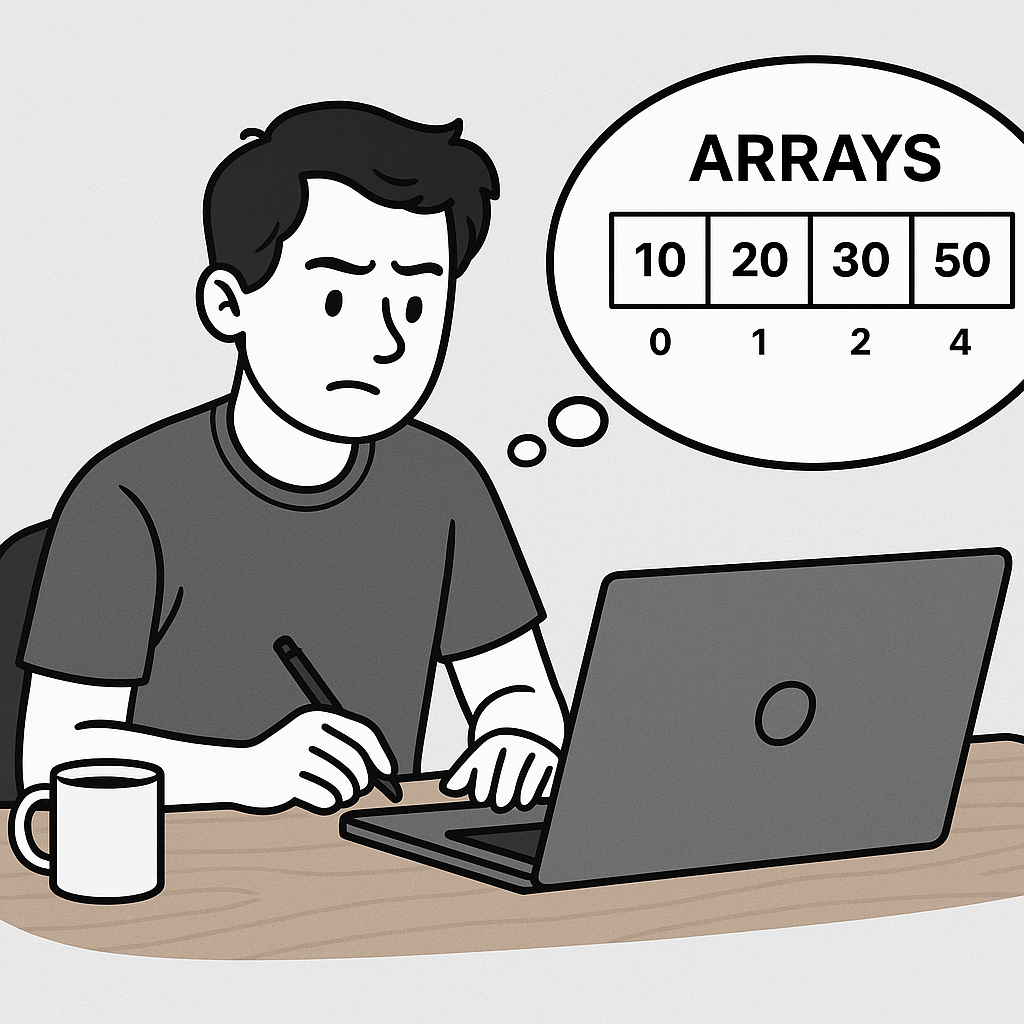
Arrays are one of the most fundamental concepts in computer science and programming. Whether you are working with Java, Python, JavaScript, or PHP, arrays play a critical role in how data is stored and accessed. In this post, we’ll break down what arrays are, why they’re important, when to use them, and even analyze their performance.
What is an Array?
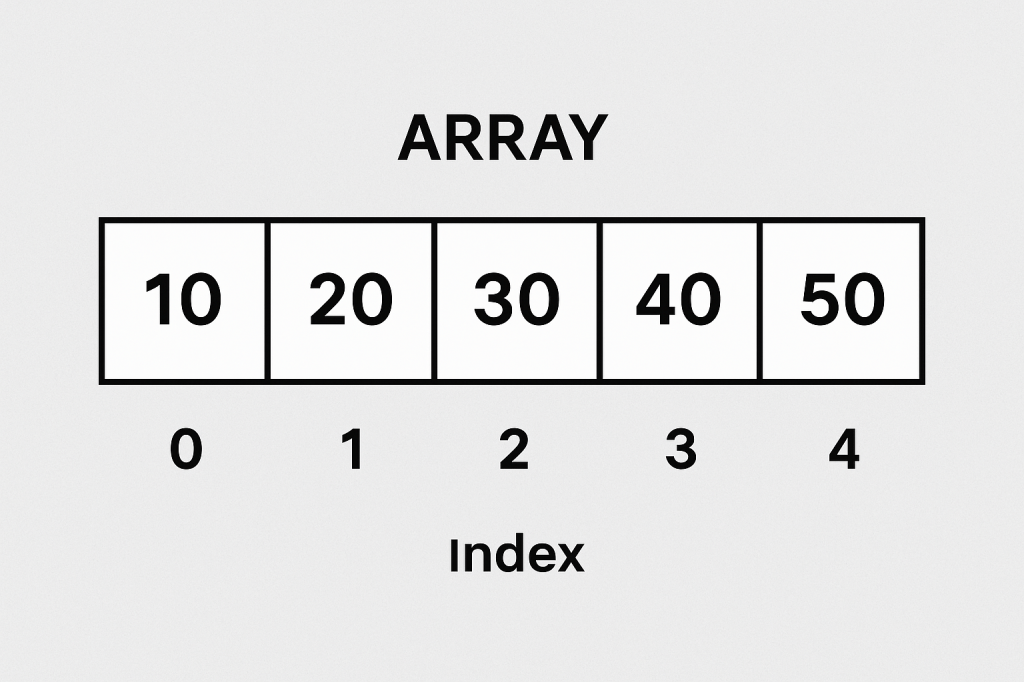
An array is a data structure that stores multiple values of the same type in a single variable. Instead of declaring multiple variables to hold related data, we can store them in an array and access them by their index (position).
Example in Java:
int numbers[] = {10, 20, 30, 40, 50};
System.out.println(numbers[2]); // prints 30
Here, numbers[2] refers to the third element in the array (since arrays are zero-indexed).
Why Do We Need Arrays?
Arrays solve the problem of managing large amounts of data efficiently. Without arrays, we would need to create separate variables for each value, which becomes unmanageable.
- Organized data storage – Store related items together.
- Fast access – Retrieve elements in constant time using an index.
- Efficient looping – Easily iterate over items with
fororwhileloops.
When Should We Use Arrays?
Use arrays when:
- You know the fixed size of data in advance.
- You want fast, random access to elements by index.
- You want to perform repetitive operations on similar data types.
However, if the dataset size changes frequently (lots of insertions/deletions), arrays may not be the best choice. In such cases, dynamic structures like ArrayList in Java or List in Python are preferred.
Real-World Example of Arrays
Imagine a system that stores the grades of students in a class:
grades = [85, 90, 78, 92, 88]

# Find average grade
average = sum(grades) / len(grades)
print("Class Average:", average)
Instead of creating five different variables (grade1, grade2, grade3...), an array helps us store all grades in a single variable and compute results easily.
Time and Memory Complexity
Arrays are efficient but come with tradeoffs. Let’s look at their common operations:
| Operation | Time Complexity | Memory Impact |
|---|---|---|
| Access (arr[i]) | O(1) | No extra memory |
| Update (arr[i] = x) | O(1) | No extra memory |
| Populate (initial fill) | O(n) | O(n) space |
| Insert (middle) | O(n) | May shift elements |
| Insert (end) | O(1) (if space) / O(n) (resize) | Extra memory if resized |
| Delete (middle) | O(n) | Shift elements left |
| Delete (end) | O(1) | No shift |
Key takeaway: Arrays are excellent for fast access but not ideal for frequent insertions or deletions in the middle.
Conclusion
Arrays are the backbone of many algorithms and data structures. They provide an easy way to store, organize, and access data efficiently. While they shine in random access speed, they are less suitable when frequent modifications are needed. Understanding arrays is the first step toward mastering more advanced structures like linked lists, stacks, and queues.

 Software Engineer's Notes
Recent Comments