Search

Software Engineer's Notes

Tag

Agile

Acceptance Testing: A Complete Guide

What is acceptance testing?

What is Acceptance Testing?

Acceptance Testing is a type of software testing conducted to determine whether a system meets business requirements and is ready for deployment. It is the final phase of testing before software is released to production. The primary goal is to validate that the product works as expected for the end users and stakeholders.

Unlike unit or integration testing, which focus on technical correctness, acceptance testing focuses on business functionality and usability.

Main Features and Components of Acceptance Testing

  1. Business Requirement Focus
    • Ensures the product aligns with user needs and business goals.
    • Based on functional and non-functional requirements.
  2. Stakeholder Involvement
    • End users, product owners, or business analysts validate the results.
  3. Predefined Test Cases and Scenarios
    • Tests are derived directly from user stories or requirement documents.
  4. Pass/Fail Criteria
    • Each test has a clear outcome: if all criteria are met, the system is accepted.
  5. Types of Acceptance Testing
    • User Acceptance Testing (UAT): Performed by end users.
    • Operational Acceptance Testing (OAT): Focuses on operational readiness (backup, recovery, performance).
    • Contract Acceptance Testing (CAT): Ensures software meets contractual obligations.
    • Regulation Acceptance Testing (RAT): Ensures compliance with industry standards and regulations.

How Does Acceptance Testing Work?

  1. Requirement Analysis
    • Gather business requirements, user stories, and acceptance criteria.
  2. Test Planning
    • Define objectives, entry/exit criteria, resources, timelines, and tools.
  3. Test Case Design
    • Create test cases that reflect real-world business processes.
  4. Environment Setup
    • Prepare a production-like environment for realistic testing.
  5. Execution
    • Stakeholders or end users execute tests to validate features.
  6. Defect Reporting and Retesting
    • Any issues are reported, fixed, and retested.
  7. Sign-off
    • Once all acceptance criteria are met, the software is approved for release.

Benefits of Acceptance Testing

  • Ensures Business Alignment: Confirms that the software meets real user needs.
  • Improves Quality: Reduces the chance of defects slipping into production.
  • Boosts User Satisfaction: End users are directly involved in validation.
  • Reduces Costs: Catching issues before release is cheaper than fixing post-production bugs.
  • Regulatory Compliance: Ensures systems meet industry or legal standards.

When and How Should We Use Acceptance Testing?

  • When to Use:
    • At the end of the development cycle, after system and integration testing.
    • Before product release or delivery to the customer.
  • How to Use:
    • Involve end users early in test planning.
    • Define clear acceptance criteria at the requirement-gathering stage.
    • Automate repetitive acceptance tests for efficiency (e.g., using Cucumber, FitNesse).

Real-World Use Cases of Acceptance Testing

  1. E-commerce Platforms
    • Testing if users can successfully search, add products to cart, checkout, and receive order confirmations.
  2. Banking Systems
    • Verifying that fund transfers, account balance checks, and statement generations meet regulatory and business expectations.
  3. Healthcare Software
    • Ensuring that patient data is stored securely and workflows comply with HIPAA regulations.
  4. Government Systems
    • Confirming that online tax filing applications meet both citizen needs and legal compliance.

How to Integrate Acceptance Testing into the Software Development Process

  1. Agile & Scrum Integration
    • Define acceptance criteria in each user story.
    • Automate acceptance tests as part of the CI/CD pipeline.
  2. Shift-Left Approach
    • Involve stakeholders early in requirement definition and acceptance test design.
  3. Tool Support
    • Use tools like Cucumber, Behave, Selenium, FitNesse for automation.
    • Integrate with Jenkins, GitLab CI/CD, or Azure DevOps for continuous validation.
  4. Feedback Loops
    • Provide immediate feedback to developers and business owners when acceptance criteria fail.

Conclusion

Acceptance Testing is the bridge between technical correctness and business value. By validating the system against business requirements, organizations ensure higher quality, regulatory compliance, and user satisfaction. When properly integrated into the development process, acceptance testing reduces risks, improves product reliability, and builds stakeholder confidence.


Code Katas: A Practical Guide for Your Everyday Engineering Practice

Learning code kata

What are Code Katas?

Code katas are short, repeatable programming exercises designed to improve specific skills through deliberate practice. Borrowed from martial arts, the term “kata” refers to a structured routine you repeat to refine form, speed, and judgment. In software, that means repeatedly solving small problems with intention—focusing on technique (naming, refactoring, testing, decomposition) rather than “just getting it to work.”

A Brief History

  • Origins of the term: Inspired by martial arts training, the “kata” metaphor entered software craftsmanship to emphasize practice and technique over ad-hoc hacking.
  • Popularization: In the early 2000s, the idea spread through the software craftsmanship movement and communities around Agile, TDD, and clean code. Well-known exercises (e.g., Bowling Game, Roman Numerals, Gilded Rose) became common practice drills in meetups, coding dojos, and workshops.
  • Today: Katas are used by individuals, teams, bootcamps, and user groups to build muscle memory in test-driven development (TDD), refactoring, design, and problem decomposition.

Why We Need Code Katas (Benefits)

  • Deliberate practice: Target a narrow skill (e.g., TDD rhythm, naming, edge-case thinking) and improve it fast.
  • Muscle memory for TDD: Red-Green-Refactor becomes automatic under time pressure.
  • Design intuition: Frequent refactoring grows your “smell” for better abstractions and simpler designs.
  • Safer learning: Fail cheaply in a sandbox instead of production.
  • Team alignment: Shared exercises align standards for testing, style, and architecture.
  • Confidence & speed: Repetition reduces hesitation; you ship with fewer regressions.
  • Interview prep: Katas sharpen fundamentals without “trick” problems.

Main Characteristics (and How to Use Them)

  1. Small Scope
    What it is: A compact problem (30–90 minutes).
    How to use: Choose tasks with clear correctness criteria (e.g., string transforms, calculators, parsers).
  2. Repetition & Variation
    What it is: Solve the same kata multiple times, adding constraints.
    How to use: Repeat weekly; vary approach (different data structures, patterns, or languages).
  3. Time-Boxing
    What it is: Short, focused sessions to keep intensity high.
    How to use: 25–45 minute blocks (Pomodoro); stop when time ends and reflect.
  4. TDD Rhythm
    What it is: Red → Green → Refactor loop.
    How to use: Write the smallest failing test, make it pass, then improve the design. Repeat.
  5. Constraints
    What it is: Self-imposed rules to sharpen technique.
    How to use: Examples: “no if statements,” “immutable data only,” “only functional style,” “one assert per test.”
  6. Frequent Refactoring
    What it is: Continual cleanup to reveal better design.
    How to use: After every green step, improve names, extract methods, remove duplication.
  7. Feedback & Reflection
    What it is: Short retrospective at the end.
    How to use: Capture what slowed you down, smells you saw, patterns you used, and what to try next time.
  8. Social Formats (Dojo/Pair/Mob)
    What it is: Practice together.
    How to use:
    • Pair kata: Driver/Navigator switch every 5–7 minutes.
    • Mob kata: One keyboard; rotate driver; everyone else reviews and guides.
    • Dojo: One person solves while others observe; rotate and discuss.

How to Use Code Katas (Step-by-Step)

  1. Pick one skill to train (e.g., “fewer conditionals,” “clean tests,” “naming”).
  2. Choose a kata that fits the skill and your time (30–60 min).
  3. Set a constraint aligned to your skill (e.g., immutability).
  4. Run TDD cycles with very small steps; keep tests crisp.
  5. Refactor relentlessly; remove duplication, clarify intent.
  6. Stop on time; retrospect (what went well, what to try next).
  7. Repeat the same kata next week with a new constraint or language.

Real-World Kata Examples (with What They Teach)

  • String Calculator
    Teaches: TDD rhythm, incremental parsing, edge cases (empty, delimiters, negatives).
  • Roman Numerals
    Teaches: Mapping tables, greedy algorithms, clear tests, refactoring duplication.
  • Bowling Game Scoring
    Teaches: Complex scoring rules, stepwise design, test coverage for tricky cases.
  • Gilded Rose Refactoring
    Teaches: Working with legacy code, characterization tests, safe refactoring.
  • Mars Rover
    Teaches: Command parsing, state modeling, encapsulation, test doubles.
  • FizzBuzz Variants
    Teaches: Simple loops, branching alternatives (lookup tables, rules engines), constraint-driven creativity.
  • Anagrams / Word Ladder
    Teaches: Data structures, performance trade-offs, readability vs speed.

Sample Kata Plan (30 Days)

  • Week 1 — TDD Basics: String Calculator (x2), Roman Numerals (x2)
  • Week 2 — Refactoring: Gilded Rose (x2), FizzBuzz with constraints (no if)
  • Week 3 — Design: Mars Rover (x2), Bowling Game (x2)
  • Week 4 — Variation: Repeat two favorites in a new language or paradigm (OO → FP)

Tip: Track each session in a short log: date, kata, constraint, what improved, next experiment.

Team Formats You Can Try

  • Lunchtime Dojo (45–60 min): One kata, rotate driver every test.
  • Pair Fridays: Everyone pairs; share takeaways at stand-up.
  • Mob Monday: One computer; rotate every 5–7 minutes; prioritize learning over finishing.
  • Guild Nights: Monthly deep-dives (e.g., legacy refactoring katas).

Common Pitfalls (and Fixes)

  • Rushing to “final code”Fix: Celebrate tiny, green, incremental steps.
  • Over-engineering earlyFix: You Aren’t Gonna Need It” (YAGNI). Refactor after tests pass.
  • Giant testsFix: One behavior per test; clear names; one assert pattern.
  • Skipping retrosFix: Reserve 5 minutes to write notes and choose a new constraint.

Simple Kata Template

Goal: e.g., practice small TDD steps and expressive names
Constraint: e.g., no primitives as method params; use value objects
Time-box: e.g., 35 minutes

Plan:

  1. Write the smallest failing test for the next slice of behavior.
  2. Make it pass as simply as possible.
  3. Refactor names/duplication before the next test.
  4. Repeat until time ends; then write a short retrospective.

Retrospective Notes (5 min):

  • What slowed me down?
  • What code smells did I notice?
  • What pattern/principle helped?
  • What constraint will I try next time?

Example: “String Calculator” (TDD Outline)

  1. Returns 0 for ""
  2. Returns number for single input "7"
  3. Sums two numbers "1,2"3
  4. Handles newlines "1\n2,3"6
  5. Custom delimiter "//;\n1;2"3
  6. Rejects negatives with message
  7. Ignores numbers > 1000
  8. Refactor: extract parser, value object for tokens, clean error handling

When (and When Not) to Use Katas

Use katas when:

  • You want to build fluency in testing, refactoring, or design.
  • Onboarding a team to shared coding standards.
  • Preparing for interviews or new language paradigms.

Avoid katas when:

  • You need domain discovery or system design at scale (do spikes instead).
  • You’re under a hard delivery deadline—practice sessions shouldn’t cannibalize critical delivery time.

Getting Started (Quick Checklist)

  • Pick one kata and one skill to train this week.
  • Book two 30–45 minute time-boxes in your calendar.
  • Choose a constraint aligned with your skill.
  • Practice, then write a short retro.
  • Repeat the same kata next week with a variation.

Pair Programming: Working Together for Better Code

Pair programming

What is Pair Programming?

Pair programming is a software development technique where two programmers work together at one workstation. One developer, called the Driver, writes the code, while the other, the Observer or Navigator, reviews each line of code as it is typed. They frequently switch roles, ensuring both remain engaged and focused.

Why Do We Need Pair Programming?

Software development is complex, and mistakes are easy to make when working alone. Pair programming helps reduce errors, improves code quality, and encourages knowledge sharing between team members. It also fosters collaboration, which is essential in agile teams.

A Brief History of Pair Programming

Pair programming became popular in the late 1990s with the rise of Extreme Programming (XP), an agile software development methodology introduced by Kent Beck. XP emphasized practices that increased communication, feedback, and simplicity—pair programming being one of the core practices. Over time, this approach has been adopted in many agile teams worldwide.

Benefits of Pair Programming

  • Higher Code Quality: Continuous code review reduces bugs and improves design.
  • Faster Knowledge Transfer: Developers learn from each other in real time.
  • Improved Team Communication: Encourages collaboration and trust.
  • Problem Solving: Two minds tackling a problem often find better solutions.
  • Reduced Knowledge Silos: Knowledge of the codebase is spread across the team.

Advantages of Pair Programming

  • Fewer bugs and higher quality code.
  • Enhanced learning opportunities for junior developers.
  • Improved team dynamics and collaboration.
  • Helps maintain coding standards consistently.

Disadvantages of Pair Programming

  • Increased Costs: Two developers working on one task may seem less efficient.
  • Personality Conflicts: Not all developers enjoy working closely with others.
  • Fatigue: Pairing requires constant focus, which can be tiring over time.
  • Not Always Necessary: For simple or repetitive tasks, solo programming might be faster.

Should We Use Pair Programming in Our Projects?

The decision depends on the project and team culture. Pair programming works best when:

  • The project is complex and requires careful design.
  • You have new team members who need to learn quickly.
  • Code quality is critical (e.g., healthcare, finance, security applications).
  • Collaboration and team bonding are important goals.

However, it might not be ideal for short, simple tasks or when deadlines are extremely tight. A hybrid approach, where pair programming is used strategically for complex or high-risk parts of a project, often delivers the best results.

Test Driven Development (TDD): A Complete Guide

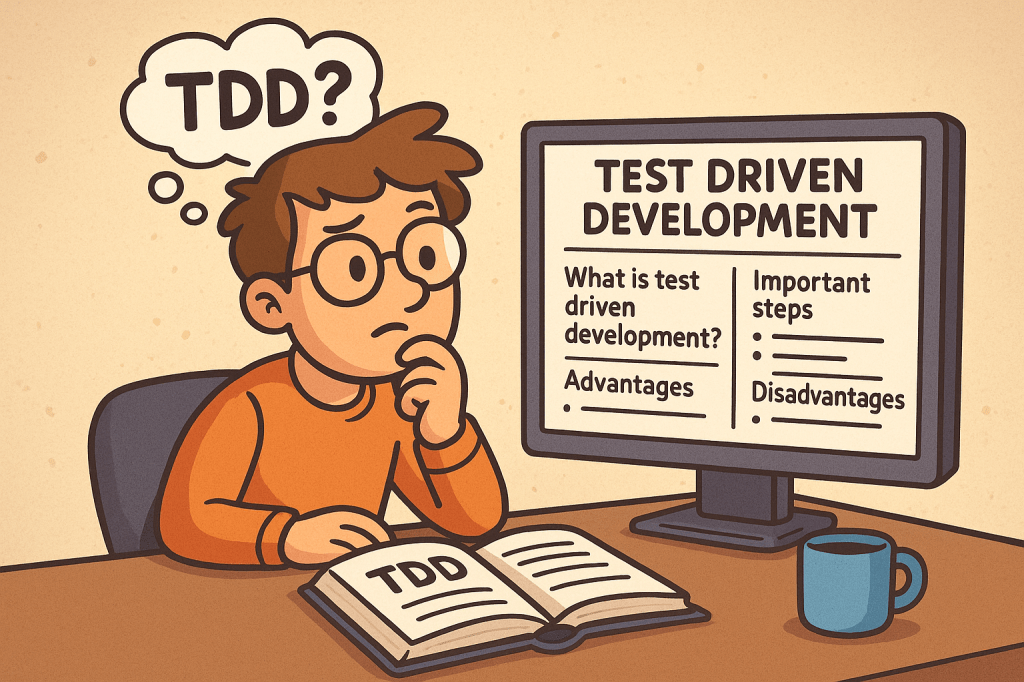
Learning Test Driven Evelopment

What is Test Driven Development?

Test Driven Development (TDD) is a software development practice where tests are written before the actual code. The main idea is simple: first, you write a failing test that defines what the software should do, then you write just enough code to make the test pass, and finally, you improve the code through refactoring.

TDD encourages developers to focus on requirements and expected behavior rather than jumping directly into implementation details.

A Brief History of TDD

TDD is closely tied to Extreme Programming (XP), introduced in the late 1990s by Kent Beck. Beck emphasized automated testing as a way to improve software quality and developer confidence. While unit testing existed earlier, TDD formalized the cycle of writing tests before writing code and popularized it as a disciplined methodology.

How Does TDD Work?

TDD typically follows a simple cycle, often called Red-Green-Refactor:

  1. Red – Write a small test that fails because the functionality does not exist yet.
  2. Green – Write the minimum code required to pass the test.
  3. Refactor – Improve the code structure without changing its behavior, while keeping all tests passing.

This cycle is repeated for each new piece of functionality until the feature is fully developed.

Important Steps in TDD

  • Understand requirements clearly before starting.
  • Write a failing test case for the expected behavior.
  • Implement code to make the test pass.
  • Run all tests to ensure nothing else is broken.
  • Refactor code for clarity, performance, and maintainability.
  • Repeat for each new requirement or functionality.

Advantages of TDD

  • Ensures better code quality and fewer bugs.
  • Encourages modular and clean code design.
  • Provides a safety net for refactoring and adding new features.
  • Reduces debugging time since most errors are caught early.
  • Improves developer confidence and project maintainability.

Disadvantages of TDD

  • Initial learning curve can be steep for teams new to the practice.
  • Writing tests first may feel slower at the beginning.
  • Requires discipline and consistency; skipping steps reduces its effectiveness.
  • Not always practical for UI-heavy applications or experimental projects.

Should We Use TDD in Our Projects?

The decision depends on your project type, deadlines, and team maturity. TDD works best in:

  • Long-term projects that need high maintainability.
  • Systems requiring reliability and accuracy (e.g., finance, healthcare, safety systems).
  • Teams practicing Agile or XP methodologies.

For quick prototypes or proof-of-concepts, TDD might not always be the best choice.

Integrating TDD into the Software Development Cycle

  • Combine TDD with Agile or Scrum for iterative development.
  • Use Continuous Integration (CI) pipelines to automatically run tests on every commit.
  • Pair TDD with code review practices for stronger quality control.
  • Start with unit tests, then expand to integration and system tests.
  • Train your team with small exercises, such as Kata challenges, to build TDD discipline.

Conclusion

Test Driven Development is more than just writing tests; it’s a mindset that prioritizes quality, clarity, and confidence in your code. While it requires discipline and may feel slow at first, TDD pays off in the long run by reducing bugs, improving maintainability, and making your development process more predictable.

If your project values stability, collaboration, and scalability, then TDD is a powerful practice to adopt.

Blog at WordPress.com.

Up ↑