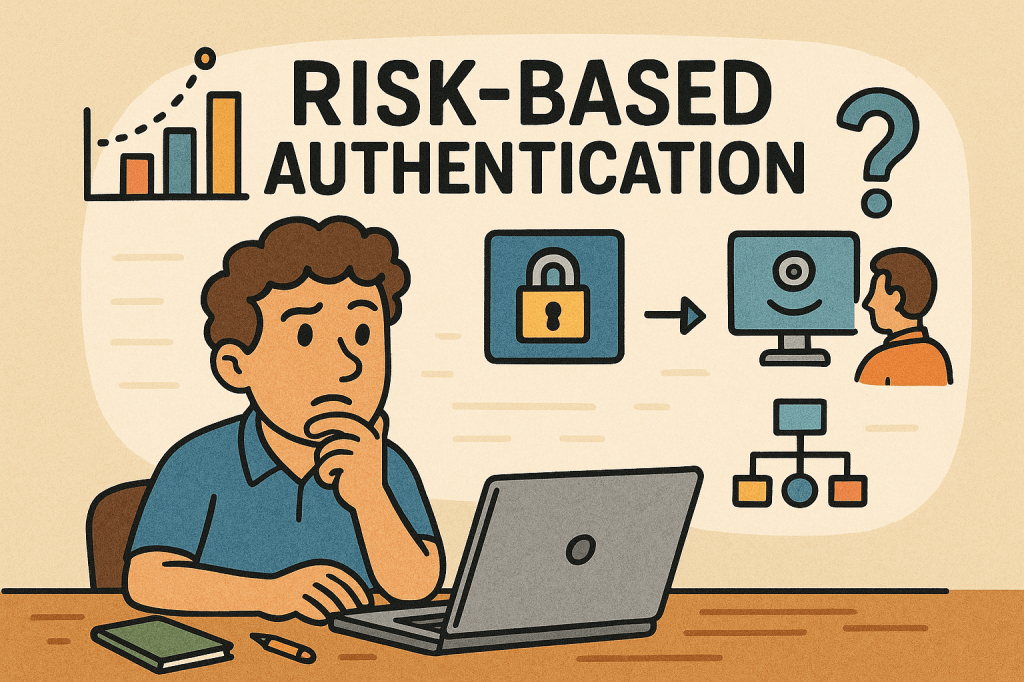
What is Risk-Based Authentication?
Risk-Based Authentication (RBA) is an adaptive security approach that evaluates the risk level of a login attempt and adjusts the authentication requirements accordingly. Instead of always requiring the same credentials (like a password and OTP), RBA looks at context—such as device, location, IP address, and user behavior—and decides whether to grant, challenge, or block access.
This method helps balance security and user experience, ensuring that legitimate users face fewer obstacles while suspicious attempts get stricter checks.
A Brief History of Risk-Based Authentication
The concept of Risk-Based Authentication emerged in the early 2000s as online fraud and phishing attacks grew, especially in banking and financial services. Traditional two-factor authentication (2FA) was widely adopted, but it became clear that requiring extra steps for every login created friction for users.
Banks and e-commerce companies began exploring context-aware security, leveraging early fraud detection models. By the mid-2000s, vendors like RSA and large financial institutions were deploying adaptive authentication tools.
Over the years, with advancements in machine learning, behavioral analytics, and big data, RBA evolved into a more precise and seamless mechanism. Today, it’s a cornerstone of Zero Trust architectures and widely used in industries like finance, healthcare, and enterprise IT.
How Does Risk-Based Authentication Work?
RBA works by assigning a risk score to each login attempt, based on contextual signals. Depending on the score, the system decides the next step:
- Data Collection – Gather information such as:
- Device type and fingerprint
- IP address and geolocation
- Time of access
- User’s typical behavior (keystroke patterns, navigation habits)
- Risk Scoring – Use rules or machine learning to calculate the probability that the login is fraudulent.
- Decision Making – Based on thresholds:
- Low Risk → Allow login with minimal friction.
- Medium Risk → Ask for additional verification (OTP, security questions, push notification).
- High Risk → Block the login or require strong multi-factor authentication.
Main Components of Risk-Based Authentication
- Risk Engine – The core system that analyzes contextual data and assigns risk scores.
- Data Sources – Inputs such as IP reputation, device fingerprints, geolocation, and behavioral biometrics.
- Policy Rules – Configurable logic that defines how the system should respond to different risk levels.
- Adaptive Authentication Methods – Secondary checks like OTPs, SMS codes, biometrics, or security keys triggered only when needed.
- Integration Layer – APIs or SDKs that integrate RBA into applications, identity providers, or single sign-on systems.
Benefits of Risk-Based Authentication
- Improved Security
- Detects abnormal behavior like unusual login locations or impossible travel scenarios.
- Makes it harder for attackers to compromise accounts even with stolen credentials.
- Better User Experience
- Reduces unnecessary friction for trusted users.
- Only challenges users when risk is detected.
- Scalability
- Works dynamically across millions of logins without overwhelming help desks.
- Compliance Support
- Meets security standards (e.g., PSD2, HIPAA, PCI-DSS) by demonstrating adaptive risk mitigation.
Weaknesses of Risk-Based Authentication
While powerful, RBA isn’t flawless:
- False Positives – Legitimate users may be flagged and challenged if they travel often or use different devices.
- Bypass with Sophisticated Attacks – Advanced attackers may mimic device fingerprints or use botnets to appear “low risk.”
- Complex Implementation – Requires integration with multiple data sources, tuning of risk models, and ongoing maintenance.
- Privacy Concerns – Collecting and analyzing user behavior (like keystrokes or device details) may raise regulatory and ethical issues.
When and How to Use Risk-Based Authentication
RBA is best suited for environments where security risk is high but user convenience is critical, such as:
- Online banking and financial services
- E-commerce platforms
- Enterprise single sign-on solutions
- Healthcare portals and government services
- SaaS platforms with global user bases
It’s especially effective when you want to strengthen authentication without forcing MFA on every single login.
Integrating RBA Into Your Software Development Process
To adopt RBA in your applications:
- Assess Security Requirements – Identify which applications and users require adaptive authentication.
- Choose an RBA Provider – Options include identity providers (Okta, Ping Identity, Azure AD, Keycloak with extensions) or building custom engines.
- Integrate via APIs/SDKs – Many RBA providers offer APIs that hook into your login and identity management system.
- Define Risk Policies – Set thresholds for low, medium, and high risk.
- Test and Tune Continuously – Use A/B testing and monitoring to reduce false positives and improve accuracy.
- Ensure Compliance – Review data collection methods to meet GDPR, CCPA, and other privacy laws.
Conclusion
Risk-Based Authentication provides the perfect balance between strong security and seamless usability. By adapting authentication requirements based on real-time context, it reduces friction for genuine users while blocking suspicious activity.
When thoughtfully integrated into software development processes, RBA can help organizations move towards a Zero Trust security model, protect sensitive data, and create a safer digital ecosystem.

 Software Engineer's Notes
Recent Comments