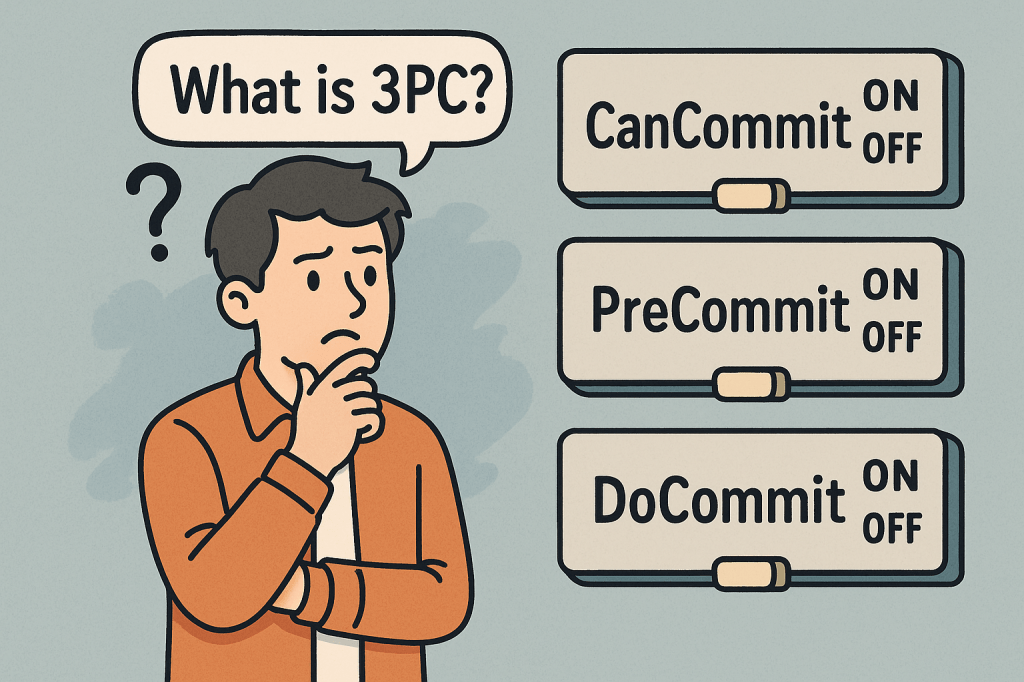
Distributed systems are everywhere today — from financial transactions to large-scale cloud platforms. To ensure data consistency across multiple nodes, distributed systems use protocols that coordinate between participants. One such protocol is the Three-Phase Commit (3PC), which extends the Two-Phase Commit (2PC) protocol by adding an extra step to improve fault tolerance and avoid certain types of failures.
What is 3PC in Computer Science?
Three-Phase Commit (3PC) is a distributed consensus protocol used to ensure that a transaction across multiple nodes in a distributed system is either committed by all participants or aborted by all participants.
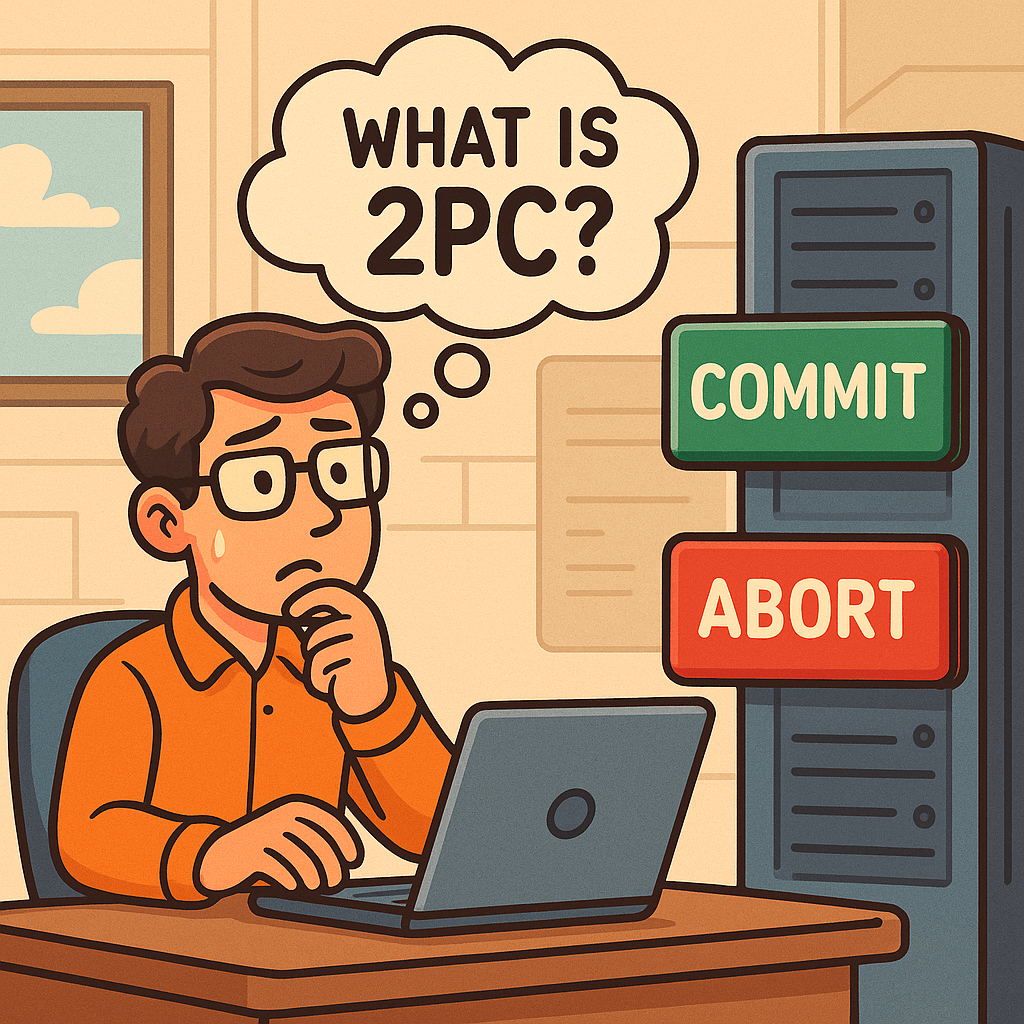
It builds upon the Two-Phase Commit (2PC) protocol, which can get stuck if the coordinator crashes at the wrong time. 3PC introduces an additional phase, making the process non-blocking under most failure conditions.
How Does 3PC Work?
The 3PC protocol has three distinct phases:
1. CanCommit Phase (Voting Request)
- The coordinator asks all participants if they are able to commit the transaction.
- Participants check whether they can proceed (resources, constraints, etc.).
- Each participant replies Yes (vote commit) or No (vote abort).
2. PreCommit Phase (Prepare to Commit)
- If all participants vote Yes, the coordinator sends a PreCommit message.
- Participants prepare to commit but do not make changes permanent yet.
- They acknowledge readiness to commit.
- If any participant voted No, the coordinator aborts the transaction.
3. DoCommit Phase (Final Commit)
- After receiving all acknowledgments from PreCommit, the coordinator sends a DoCommit message.
- Participants finalize the commit and release locks.
- If any failure occurs before DoCommit, participants can safely roll back without inconsistency.
This three-step approach reduces the chance of deadlocks and ensures that participants have a clear recovery path in case of failures.
Real-World Use Cases of 3PC
1. Banking Transactions
When transferring money between two different banks, both banks’ systems need to either fully complete the transfer or not perform it at all. 3PC ensures that even if the coordinator crashes temporarily, both banks remain consistent.
2. Distributed Databases
Databases like distributed SQL systems or global NoSQL clusters can use 3PC to synchronize data across different data centers. This ensures atomicity when data is replicated globally.
3. E-Commerce Orders
In online shopping, payment, inventory deduction, and order confirmation must all succeed together. 3PC helps reduce inconsistencies such as charging the customer but failing to create the order.
Advantages of 3PC
- Non-blocking: Unlike 2PC, participants do not remain blocked indefinitely if the coordinator crashes.
- Improved fault tolerance: Clearer recovery process after failures.
- Reduced risk of inconsistency: Participants always know the transaction’s current state.
- Safer in network partitions: Adds a buffer step to prevent premature commits or rollbacks.
Issues and Disadvantages of 3PC
- Complexity: More phases mean more messages and higher implementation complexity.
- Performance overhead: Increases latency compared to 2PC since an extra round of communication is required.
- Still not perfect: In extreme cases (like a complete network partition), inconsistencies may still occur.
- Less commonly adopted: Many modern systems prefer consensus algorithms like Paxos or Raft instead, which are more robust.
When and How Should We Use 3PC?
3PC is best used when:
- Systems require high availability and fault tolerance.
- Consistency is more critical than performance.
- Network reliability is moderate but not perfect.
- Transactions involve multiple independent services where rollback can be costly.
For example, financial systems, mission-critical distributed databases, or telecom billing platforms can benefit from 3PC.
Integrating 3PC into Our Software Development Process
- Identify Critical Transactions
Apply 3PC to operations where all-or-nothing consistency is mandatory (e.g., money transfers, distributed order processing). - Use Middleware or Transaction Coordinators
Implement 3PC using distributed transaction managers, message brokers, or database frameworks that support it. - Combine with Modern Tools
In microservice architectures, pair 3PC with frameworks like Spring Transaction Manager or distributed orchestrators. - Monitor and Test
Simulate node failures, crashes, and network delays to ensure the system recovers gracefully under 3PC.
Conclusion
The Three-Phase Commit protocol offers a more fault-tolerant approach to distributed transactions compared to 2PC. While it comes with additional complexity and latency, it is a valuable technique for systems where consistency and reliability outweigh performance costs.
When integrated thoughtfully, 3PC helps ensure that distributed systems maintain data integrity even in the face of crashes or network issues.





 Software Engineer's Notes
Recent Comments