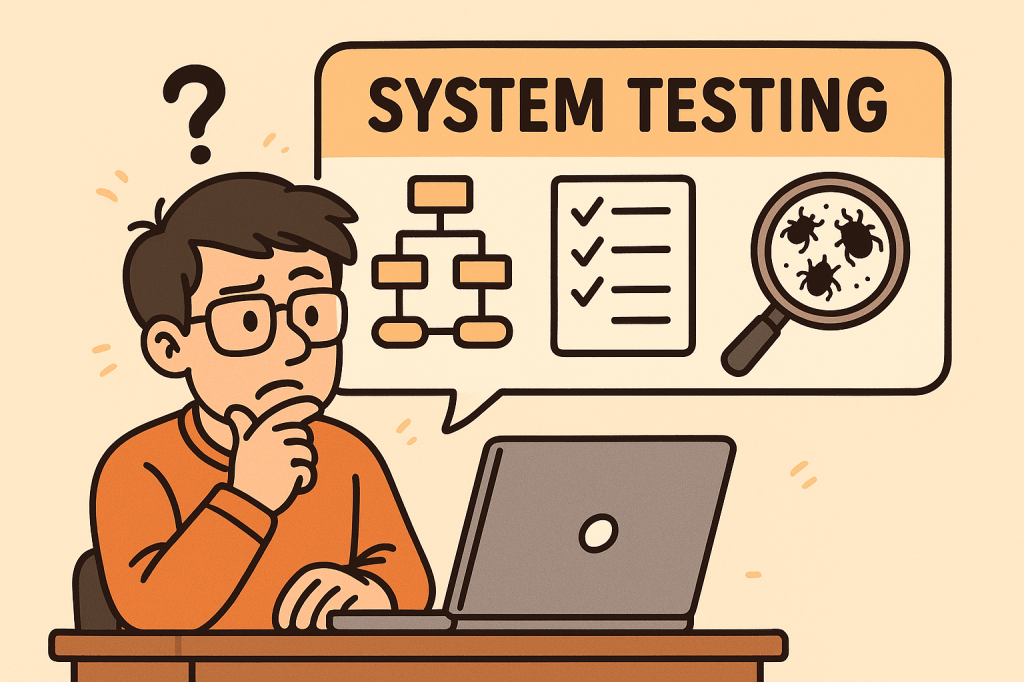
Software development doesn’t end with writing code—it must be tested thoroughly to ensure it works as intended. One of the most comprehensive testing phases is System Testing, where the entire system is evaluated as a whole. This blog will explore what system testing is, its features, how it works, benefits, real-world examples, and how to integrate it into your software development process.
What is System Testing?
System Testing is a type of software testing where the entire integrated system is tested as a whole. Unlike unit testing (which focuses on individual components) or integration testing (which focuses on interactions between modules), system testing validates that the entire software product meets its requirements.
It is typically the final testing stage before user acceptance testing (UAT) and deployment.
Main Features and Components of System Testing
System testing includes several important features and components:
1. End-to-End Testing
Tests the software from start to finish, simulating real user scenarios.
2. Black-Box Testing Approach
Focuses on the software’s functionality rather than its internal code. Testers don’t need knowledge of the source code.
3. Requirement Validation
Ensures that the product meets all functional and non-functional requirements.
4. Comprehensive Coverage
Covers a wide variety of testing types such as:
- Functional testing
- Performance testing
- Security testing
- Usability testing
- Compatibility testing
5. Environment Similarity
Conducted in an environment similar to production to detect environment-related issues.
How Does System Testing Work?
The process of system testing typically follows these steps:
- Requirement Review – Analyze functional and non-functional requirements.
- Test Planning – Define test strategy, scope, resources, and tools.
- Test Case Design – Create detailed test cases simulating user scenarios.
- Test Environment Setup – Configure hardware, software, and databases similar to production.
- Test Execution – Execute test cases and record results.
- Defect Reporting and Tracking – Log issues and track them until resolution.
- Regression Testing – Retest the system after fixes to ensure stability.
- Final Evaluation – Ensure the system is ready for deployment.
Benefits of System Testing
System testing provides multiple advantages:
- Validates Full System Behavior – Ensures all modules and integrations work together.
- Detects Critical Bugs – Finds issues missed during unit or integration testing.
- Improves Quality – Increases confidence that the system meets requirements.
- Reduces Risks – Helps prevent failures in production.
- Ensures Compliance – Confirms the system meets legal, industry, and business standards.
When and How Should We Use System Testing?
When to Use:
- After integration testing is completed.
- Before user acceptance testing (UAT) and deployment.
How to Use:
- Define clear acceptance criteria.
- Automate repetitive system-level test cases where possible.
- Simulate real-world usage scenarios to mimic actual customer behavior.
Real-World Use Cases of System Testing
- E-commerce Website
- Verifying user registration, product search, cart, checkout, and payment workflows.
- Ensuring the system handles high traffic loads during sales events.
- Banking Applications
- Validating transactions, loan applications, and account security.
- Checking compliance with financial regulations.
- Healthcare Systems
- Testing appointment booking, patient data access, and medical records security.
- Ensuring HIPAA compliance and patient safety.
- Mobile Applications
- Confirming compatibility across devices, screen sizes, and operating systems.
- Testing notifications, performance, and offline capabilities.
How to Integrate System Testing into the Software Development Process
- Adopt a Shift-Left Approach – Start planning system tests early in the development lifecycle.
- Use Continuous Integration (CI/CD) – Automate builds and deployments so system testing can be executed frequently.
- Automate Where Possible – Use tools like Selenium, JUnit, or Cypress for functional and regression testing.
- Define Clear Test Environments – Keep staging environments as close as possible to production.
- Collaborate Across Teams – Ensure developers, testers, and business analysts work together.
- Track Metrics – Measure defect density, test coverage, and execution time to improve continuously.
Conclusion
System testing is a critical step in delivering high-quality software. It validates the entire system as a whole, ensuring that all functionalities, integrations, and requirements are working correctly. By integrating system testing into your development process, you can reduce risks, improve reliability, and deliver products that users can trust.

 Software Engineer's Notes
Recent Comments