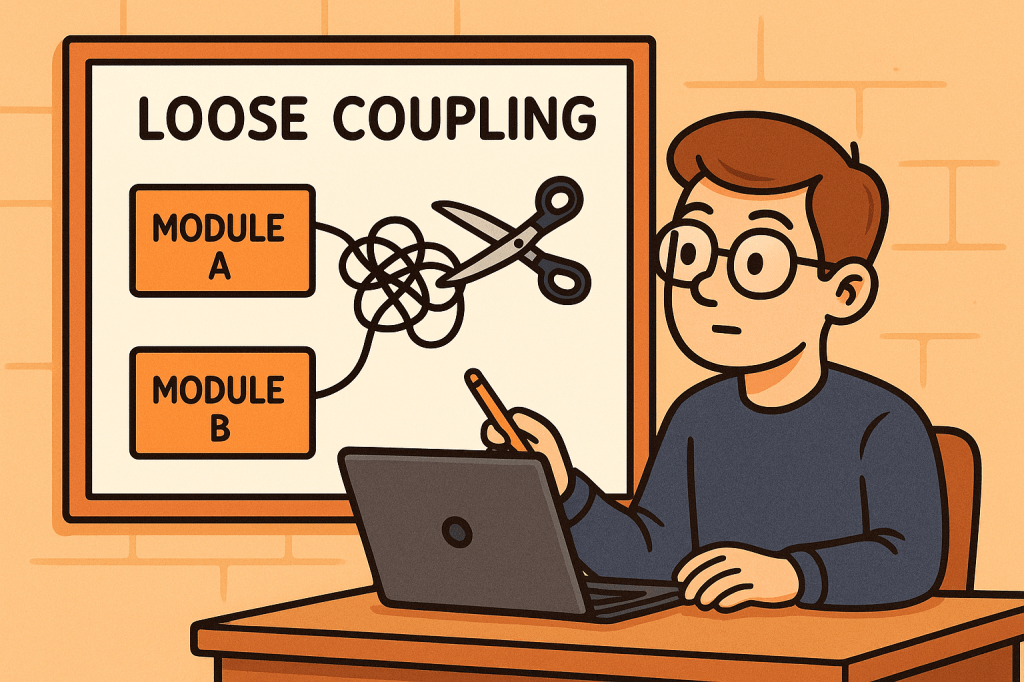
What is Loose Coupling?
Loose coupling is a design principle in software engineering where different components, modules, or services in a system are designed to have minimal dependencies on one another. This means that each component can function independently, with limited knowledge of the internal details of other components.
The opposite of loose coupling is tight coupling, where components are heavily dependent on each other’s internal implementation, making the system rigid and difficult to modify.
How Does Loose Coupling Work?
Loose coupling works by reducing the amount of direct knowledge and reliance that one module has about another. Instead of modules directly calling each other’s methods or accessing internal data structures, they interact through well-defined interfaces, abstractions, or contracts.
For example:
- Instead of a class instantiating another class directly, it may depend on an interface or abstract class.
- Instead of a service calling another service directly, it may use APIs, message queues, or dependency injection.
- Instead of hardcoding configurations, the system may use external configuration files or environment variables.
Benefits of Loose Coupling
Loose coupling provides several advantages to software systems:
- Flexibility – You can easily replace or update one component without breaking others.
- Reusability – Independent components can be reused in other projects or contexts.
- Maintainability – Code is easier to read, modify, and test because components are isolated.
- Scalability – Loosely coupled systems are easier to scale since you can distribute or upgrade components independently.
- Testability – With fewer dependencies, you can test components in isolation using mocks or stubs.
- Resilience – Failures in one module are less likely to cause cascading failures in the entire system.
How to Achieve Loose Coupling
Here are some strategies to achieve loose coupling in software systems:
- Use Interfaces and Abstractions
Depend on interfaces rather than concrete implementations. This allows you to switch implementations without changing the dependent code. - Apply Dependency Injection
Instead of creating dependencies inside a class, inject them from the outside. This removes hardcoded connections. - Follow Design Patterns
Patterns such as Strategy, Observer, Factory, and Adapter promote loose coupling by separating concerns and reducing direct dependencies. - Use Message Brokers or APIs
Instead of direct calls between services, use message queues (like Kafka or RabbitMQ) or REST/GraphQL APIs to communicate. - Externalize Configurations
Keep system configurations outside the codebase to avoid hard dependencies. - Modularize Your Codebase
Break your system into small, independent modules that interact through clear contracts.
When and Why Should We Use Loose Coupling?
Loose coupling should be applied whenever you are building systems that need to be flexible, maintainable, and scalable.
- When building microservices – Each service should be independent and loosely coupled with others through APIs or messaging.
- When building large enterprise applications – Loose coupling helps reduce complexity and makes maintenance easier.
- When working in agile environments – Teams can work on separate components independently, with minimal conflicts.
- When integrating third-party systems – Using abstractions helps replace or upgrade external services without changing the whole codebase.
Without loose coupling, systems quickly become brittle. A small change in one part could cause a chain reaction of errors throughout the system.
Real World Examples
- Payment Systems
In an e-commerce platform, the checkout system should not depend on the details of a specific payment gateway. Instead, it should depend on a payment interface. This allows swapping PayPal, Stripe, or any other provider without major code changes. - Logging Frameworks
Instead of directly usingSystem.out.printlnin Java, applications use logging libraries like SLF4J. The application depends on the SLF4J interface, while the actual implementation (Logback, Log4j, etc.) can be switched easily. - Microservices Architecture
In Netflix’s architecture, microservices communicate using APIs and messaging systems. Each microservice can be developed, deployed, and scaled independently. - Database Access
Using ORM tools like Hibernate allows developers to work with an abstract data model. If the underlying database changes from MySQL to PostgreSQL, minimal code changes are needed.
How Can We Use Loose Coupling in Our Software Development Process?
To integrate loose coupling into your process:
- Start with Good Architecture – Apply principles like SOLID, Clean Architecture, or Hexagonal Architecture.
- Emphasize Abstraction – Always code to an interface, not an implementation.
- Adopt Dependency Injection Frameworks – Use frameworks like Spring (Java), Angular (TypeScript), or .NET Core’s built-in DI.
- Write Modular Code – Divide your system into independent modules with clear boundaries.
- Encourage Team Autonomy – Different teams can own different modules if the system is loosely coupled.
- Review for Tight Coupling – During code reviews, check for hard dependencies and suggest abstractions.
By adopting loose coupling in your development process, you create systems that are future-proof, resilient, and easier to maintain, ensuring long-term success.

 Software Engineer's Notes
Recent Comments