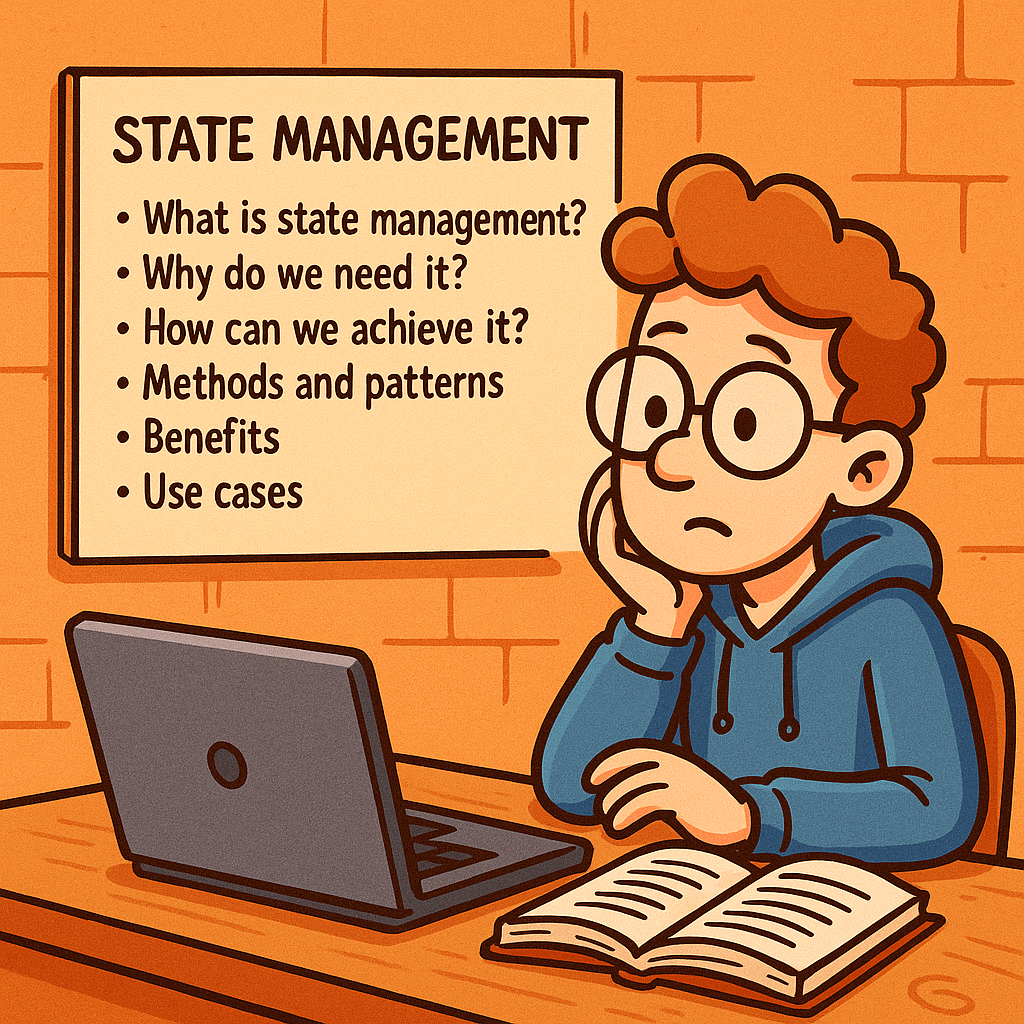
What Is State Management?
State is the “memory” of a system—the data that captures what has happened so far and what things look like right now.
State management is the set of techniques you use to represent, read, update, persist, share, and synchronize that data across components, services, devices, and time.
Examples of state:
- A user’s shopping cart
- The current screen and filters in a UI
- A microservice’s cache
- A workflow’s step (“Pending → Approved → Shipped”)
- A distributed ledger’s account balances
Why Do We Need It?
- Correctness: Make sure reads/writes follow rules (e.g., no negative inventory).
- Predictability: Same inputs produce the same outputs; fewer “heisenbugs.”
- Performance: Cache and memoize expensive work.
- Scalability: Share and replicate state safely across processes/regions.
- Resilience: Recover after crashes with snapshots, logs, or replicas.
- Collaboration: Keep many users and services in sync (conflict handling included).
- Auditability & Compliance: Track how/when state changed (who did what).
How Can We Achieve It? (Core Approaches)
- Local/In-Memory State
- Kept inside a process (e.g., component state in a UI, service memory cache).
- Fast, simple; volatile and not shared by default.
- Centralized Store
- A single source of truth (e.g., Redux store, Vuex/Pinia, NgRx).
- Deterministic updates via actions/reducers; great for complex UIs.
- Server-Side Persistence
- Databases (SQL/NoSQL), key-value stores (Redis), object storage.
- ACID/transactions for strong consistency; or tunable/BASE for scale.
- Event-Driven & Logs
- Append-only logs (Kafka, Pulsar), pub/sub, event sourcing.
- Rebuild state from events; great for audit trails and temporal queries.
- Finite State Machines/Statecharts
- Explicit states and transitions (e.g., XState).
- Eliminates impossible states; ideal for workflows and UI flows.
- Actor Model
- Isolated “actors” own their state and communicate via messages (Akka, Orleans).
- Avoids shared memory concurrency issues.
- Sagas/Process Managers
- Coordinate multi-service transactions with compensating actions.
- Essential for long-running, distributed workflows.
- Caching & Memoization
- In-memory, Redis, CDN edge caches; read-through/write-through patterns.
- Synchronization & Consensus
- Leader election and config/state coordination (Raft/etcd, Zookeeper).
- Used for distributed locks, service discovery, cluster metadata.
- Conflict-Friendly Models
- CRDTs and operational transforms for offline-first and collaborative editing.
Patterns & When To Use Them
- Repository Pattern: Encapsulate persistence logic behind an interface.
- Unit of Work: Group changes into atomic commits (helpful with ORMs).
- CQRS: Separate reads and writes for scale/optimization.
- Event Sourcing: Store the events; derive current state on demand.
- Domain-Driven Design (DDD) Aggregates: Keep invariants inside boundaries.
- Idempotent Commands: Safe retries in distributed environments.
- Outbox Pattern: Guarantee DB + message bus consistency.
- Cache-Aside / Read-Through: Balance performance and freshness.
- Statechart-Driven UIs: Model UI states explicitly to avoid edge cases.
Benefits of Good State Management
- Fewer bugs & clearer mental model (explicit transitions and invariants)
- Traceability (who changed what, when, and why)
- Performance (targeted caching, denormalized read models)
- Flexibility (swap persistence layers, add features without rewrites)
- Scalability (independent read/write scaling, sharding)
- Resilience (snapshots, replays, blue/green rollouts)
Real-World Use Cases
- E-commerce: Cart, inventory reservations, orders (Sagas + Outbox + CQRS).
- Banking/FinTech: Double-entry ledgers, idempotent transfers, audit trails (Event Sourcing).
- Healthcare: Patient workflow states, consent, auditability (Statecharts + DDD aggregates).
- IoT: Device twins, last-known telemetry, conflict resolution (CRDTs or eventual consistency).
- Collaboration Apps: Docs/whiteboards with offline editing (CRDTs/OT).
- Gaming/Realtime: Matchmaking and player sessions (Actor model + in-memory caches).
- Analytics/ML: Feature stores and slowly changing dimensions (immutable logs + batch/stream views).
Choosing an Approach (Quick Guide)
- Simple UI component: Local state → lift to a small store if many siblings need it.
- Complex UI interactions: Statecharts or Redux-style store with middleware.
- High read throughput: CQRS with optimized read models + cache.
- Strong auditability: Event sourcing + snapshots + projections.
- Cross-service transactions: Sagas with idempotent commands + Outbox.
- Offline/collaborative: CRDTs or OT, background sync, conflict-free merges.
- Low-latency hot data: In-memory/Redis cache + cache-aside.
How To Use It In Your Software Projects
1) Model the Domain and State
- Identify entities, value objects, and aggregates.
- Write down invariants (“inventory ≥ 0”) and state transitions as a state diagram.
2) Define Read vs Write Paths
- Consider CQRS if reads dominate or need different shapes than writes.
- Create projections or denormalized views for common queries.
3) Pick Storage & Topology
- OLTP DB for strong consistency; document/column stores for flexible reads.
- Redis/memory caches for latency; message bus (Kafka) for event pipelines.
- Choose consistency model (strong vs eventual) per use case.
4) Orchestrate Changes
- Commands → validation → domain logic → events → projections.
- For cross-service flows, implement Sagas with compensations.
- Ensure idempotency (dedupe keys, conditional updates).
5) Make Failures First-Class
- Retries with backoff, circuit breakers, timeouts.
- Outbox for DB-to-bus consistency; dead-letter queues.
- Snapshots + event replay for recovery.
6) Testing Strategy
- Unit tests: Reducers/state machines (no I/O).
- Property-based tests: Invariants always hold.
- Contract tests: Between services for event/command schemas.
- Replay tests: Rebuild from events and assert final state.
7) Observability & Ops
- Emit domain events and metrics on state transitions.
- Trace IDs through commands, handlers, and projections.
- Dashboards for lag, cache hit rate, saga success/fail ratios.
8) Security & Compliance
- AuthN/AuthZ checks at state boundaries.
- PII encryption, data retention, and audit logging.
Practical Examples
Example A: Shopping Cart (Service + Cache + Events)
- Write path:
AddItemCommandvalidates stock → updates DB (aggregate) → emitsItemAdded. - Read path: Cart view uses a projection kept fresh via events; Redis caches the view.
- Resilience: Outbox ensures
ItemAddedis published even if the service restarts.
Example B: UI Wizard With Statecharts
- States:
Start → PersonalInfo → Shipping → Payment → Review → Complete - Guards prevent illegal transitions (e.g., can’t pay before shipping info).
- Tests assert allowed transitions and side-effects per state.
Example C: Ledger With Event Sourcing
- Only store
TransferInitiated,Debited,Credited,TransferCompleted/Failed. - Current balances are projections; rebuilding is deterministic and auditable.
Common Pitfalls (and Fixes)
- Implicit state in many places: Centralize or document owners; use a store.
- Mutable shared objects: Prefer immutability; copy-on-write.
- Missing idempotency: Add request IDs, conditional updates, and dedupe.
- Tight coupling to DB schema: Use repositories and domain models.
- Ghost states in UI: Use statecharts or a single source of truth.
- Cache incoherence: Establish clear cache-aside/invalidations; track TTLs.
Lightweight Checklist
- Enumerate state, owners, and lifecycle.
- Decide consistency model per boundary.
- Choose patterns (CQRS, Sagas, ES, Statecharts) intentionally.
- Plan storage (DB/log/cache) and schemas/events.
- Add idempotency and the Outbox pattern where needed.
- Write reducer/state machine/unit tests.
- Instrument transitions (metrics, logs, traces).
- Document invariants and recovery procedures.
Final Thoughts
State management is not one tool—it’s a discipline. Start with your domain’s invariants and consistency needs, then choose patterns and storage that make those invariants easy to uphold. Keep state explicit, observable, and testable. Your systems—and your future self—will thank you.

 Software Engineer's Notes
Recent Comments