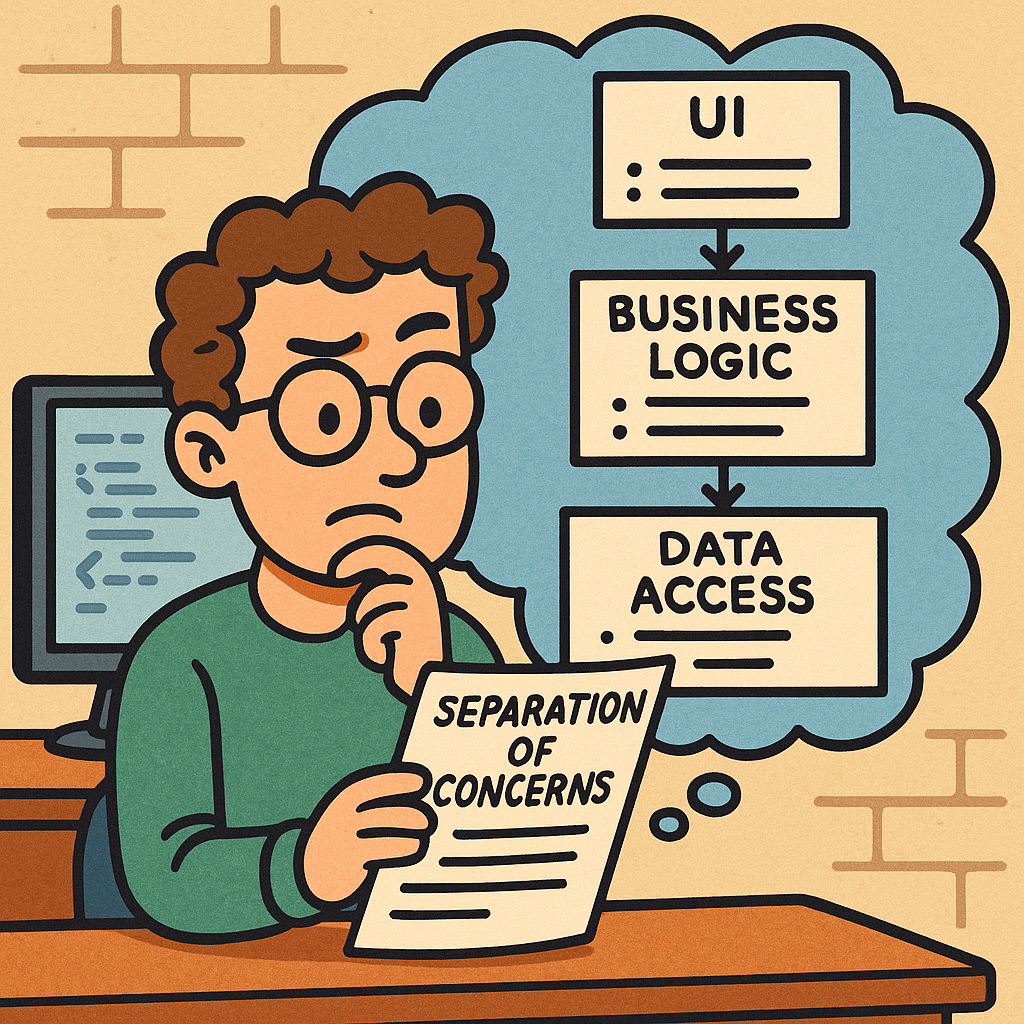
Separation of Concerns (SoC) is a foundational design principle: split your system into parts, where each part focuses on a single, well-defined responsibility. Done well, SoC makes code easier to understand, test, change, scale, and secure.
What is Separation of Concerns?
SoC means organizing software so that each module addresses one concern (a responsibility or “reason to change”) and hides the details of that concern behind clear interfaces.
- Concern = a cohesive responsibility: UI rendering, data access, domain rules, logging, authentication, caching, configuration, etc.
- Separation = boundaries (files, classes, packages, services) that prevent concerns from leaking into each other.
Related but different concepts
- Single Responsibility Principle (SRP): applies at the class/function level. SoC applies at system/module scale.
- Modularity: a property of structure; SoC is the guiding principle that tells you how to modularize.
- Encapsulation: the technique that makes separation effective (hide internals, expose minimal interfaces).
How SoC Works
- Identify Axes of Change
Ask: If this changes, what else would need to change? Group code so that each axis of change is isolated (e.g., UI design changes vs. database vendor changes vs. business rules changes). - Define Explicit Boundaries
- Use layers (Presentation → Application/Service → Domain → Infrastructure/DB).
- Or vertical slices (Feature A, Feature B), each containing its own UI, logic, and data adapters.
- Or services (Auth, Catalog, Orders) with network boundaries.
- Establish Contracts
- Interfaces/DTOs so layers talk in clear, stable shapes.
- APIs so services communicate without sharing internals.
- Events so features integrate without tight coupling.
- Enforce Directional Dependencies
- High-level policy (domain rules) should not depend on low-level details (database, frameworks).
- In code, point dependencies inward to abstractions (ports), and keep details behind adapters.
- Extract Cross-Cutting Concerns
- Logging, metrics, auth, validation, caching → implement via middleware, decorators, AOP, or interceptors, not scattered everywhere.
- Automate Guardrails
- Lint rules and architecture tests (e.g., “controllers must not import repositories directly”).
- Package visibility (e.g., Java package-private), access modifiers, and module boundaries.
Benefits of SoC
- Change isolation: Modify one concern without ripple effects (e.g., swap PostgreSQL for MySQL by changing only the DB adapter).
- Testability: Unit tests target a single concern; integration tests verify boundaries; fewer mocks in the wrong places.
- Reusability: A cleanly separated module (e.g., a pricing engine) can be reused in multiple apps.
- Parallel development: Teams own concerns or slices without stepping on each other.
- Scalability & performance: Scale just the hot path (e.g., cache layer or read model) instead of the whole system.
- Security & compliance: Centralize auth, input validation, and auditing, reducing duplicate risky code.
- Maintainability: Clear mental model; easier onboarding and refactoring.
- Observability: Centralized logging/metrics make behavior consistent and debuggable.
Real-World Examples
Web Application (Layered)
- Presentation: Controllers/Views (HTTP/JSON rendering)
- Application/Service: Use cases, orchestration
- Domain: Business rules, entities, value objects
- Infrastructure: Repositories, messaging, external APIs
Result: Changing UI styling, a pricing rule, or a database index touches different isolated areas.
Front-End (HTML/CSS/JS + State)
- Structure (HTML/Components) separated from Style (CSS) and Behavior (JS/state).
- State management (e.g., Redux/Pinia) isolates data flow from view rendering.
Microservices
- Auth, Catalog, Orders, Billing → each is a concern with its own storage and API.
- Cross-cutters (logging, tracing, authN/Z) handled via API gateway or shared middleware.
Data Pipelines
- Ingestion, Normalization, Enrichment, Storage, Serving/BI → separate stages with contracts (schemas).
- You can replace enrichment logic without touching ingestion.
Cross-Cutting via Middleware
- Input validation, rate limiting, and structured logging implemented as filters or middleware so business code stays clean.
How to Use SoC in Your Projects
Step-by-Step
- Map your concerns
List core domains (billing, content, search), technical details (DB, cache), and cross-cutters (logging, auth). - Choose a structuring strategy
- Layers for monoliths and small/medium teams.
- Vertical feature slices to reduce coordination overhead.
- Services for independently deployable boundaries (start small—modular monolith first).
- Define contracts and boundaries
- Create interfaces/ports for infrastructure.
- Use DTOs/events to decouple modules.
- For services, design versioned APIs.
- Refactor incrementally
- Extract cross-cutters into middleware or decorators.
- Move data access behind repositories or gateways.
- Pull business rules into the domain layer.
- Add guardrails
- Architecture tests (e.g., ArchUnit for Java) to forbid forbidden imports.
- CI checks for dependency direction and circular references.
- Document & communicate
- One diagram per feature or layer (C4 model is a good fit).
- Ownership map: who maintains which concern.
- Continuously review
- Add “Does this leak a concern?” to PR checklists.
- Track coupling metrics (instability, afferent/efferent coupling).
Mini Refactor Example (Backend)
Before:
OrderController -> directly talks to JPA Repository
                 -> logs with System.out
                 -> performs validation inline

After:
OrderController -> OrderService (use case)
OrderService -> OrderRepository (interface)
              -> ValidationService (cross-cutter)
              -> Logger (injected)
JpaOrderRepository implements OrderRepository
Logging via middleware/interceptor
Result: You can swap JPA for another store by changing only JpaOrderRepository. Validation and logging are reusable elsewhere.
Patterns That Support SoC
- MVC/MVP/MVVM: separates UI concerns (view) from presentation and domain logic.
- Clean/Hexagonal (Ports & Adapters): isolates domain from frameworks and IO.
- CQRS: separate reads and writes when their concerns diverge (performance, scaling).
- Event-Driven: decouple features with async events.
- Dependency Injection: wire implementations to interfaces at the edges.
- Middleware/Interceptors/Filters: centralize cross-cutting concerns.
Practical, Real-World Examples
- Feature flags as a concern: toggle new rules in the app layer; domain remains untouched.
- Search adapters: your app depends on a
SearchPort; switch from Elasticsearch to OpenSearch without changing business logic. - Payments: domain emits
PaymentRequested; payment service handles gateways and retries—domain doesn’t know vendor details. - Mobile app MVVM: ViewModel holds state/logic; Views remain dumb; repositories handle data sources.
Common Mistakes (and Fixes)
- Over-separation (micro-everything): too many tiny modules → slow delivery.
- Fix: start with a modular monolith, extract services only for hot spots.
- Leaky boundaries: UI reaches into repositories, or domain knows HTTP.
- Fix: enforce through interfaces and architecture tests.
- Cross-cutters sprinkled everywhere: copy-paste validation/logging.
- Fix: move to middleware/decorators/aspects.
- God objects/modules: a “Utils” that handles everything.
- Fix: split by concern; create dedicated packages.
Quick Checklist
- Does each module have one primary reason to change?
- Are dependencies pointing inward toward abstractions?
- Are cross-cutting concerns centralized?
- Can I swap an implementation (DB, API, style) by touching one area?
- Do tests cover each concern in isolation?
- Are there docs/diagrams showing boundaries and contracts?
How to Start Using SoC This Week
- Create a dependency graph of your project (most IDEs or linters can help).
- Pick one hot spot (e.g., payment, auth, reporting) and extract its interfaces/adapters.
- Introduce a middleware layer for logging/validation/auth.
- Write one architecture test that forbids controllers from importing repositories.
- Document one boundary with a simple diagram and ownership.
FAQ
Is SoC the same as microservices?
No. Microservices are one way to enforce separation at runtime. You can achieve strong SoC inside a monolith.
How small should a concern be?
A concern should map to a cohesive responsibility and an axis of change. If changes to it often require touching multiple modules, your boundary is probably wrong.
Is duplication ever okay?
Yes, small local duplication can be cheaper than a shared module that couples unrelated features. Optimize for change cost, not just DRY.
Final Thoughts
Separation of Concerns is about clarity and change-friendliness. Start by identifying responsibilities, draw clean boundaries, enforce them with code and tests, and evolve your structure as the product grows. Your future self (and your teammates) will thank you.

 Software Engineer's Notes
Recent Comments