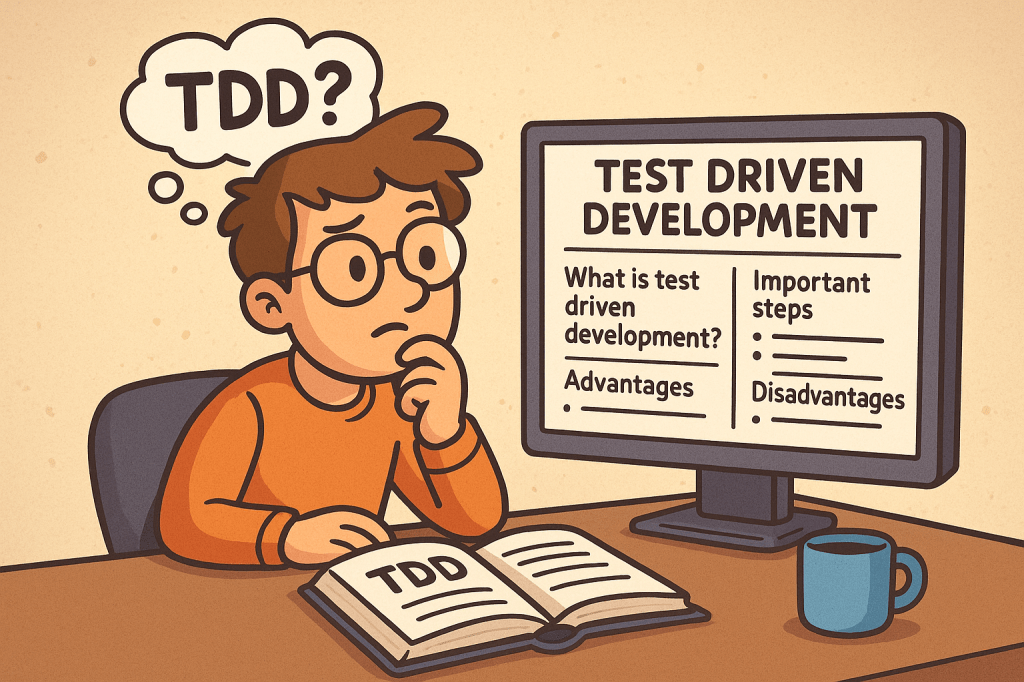
What is Test Driven Development?
Test Driven Development (TDD) is a software development practice where tests are written before the actual code. The main idea is simple: first, you write a failing test that defines what the software should do, then you write just enough code to make the test pass, and finally, you improve the code through refactoring.
TDD encourages developers to focus on requirements and expected behavior rather than jumping directly into implementation details.
A Brief History of TDD
TDD is closely tied to Extreme Programming (XP), introduced in the late 1990s by Kent Beck. Beck emphasized automated testing as a way to improve software quality and developer confidence. While unit testing existed earlier, TDD formalized the cycle of writing tests before writing code and popularized it as a disciplined methodology.
How Does TDD Work?
TDD typically follows a simple cycle, often called Red-Green-Refactor:
- Red – Write a small test that fails because the functionality does not exist yet.
- Green – Write the minimum code required to pass the test.
- Refactor – Improve the code structure without changing its behavior, while keeping all tests passing.
This cycle is repeated for each new piece of functionality until the feature is fully developed.
Important Steps in TDD
- Understand requirements clearly before starting.
- Write a failing test case for the expected behavior.
- Implement code to make the test pass.
- Run all tests to ensure nothing else is broken.
- Refactor code for clarity, performance, and maintainability.
- Repeat for each new requirement or functionality.
Advantages of TDD
- Ensures better code quality and fewer bugs.
- Encourages modular and clean code design.
- Provides a safety net for refactoring and adding new features.
- Reduces debugging time since most errors are caught early.
- Improves developer confidence and project maintainability.
Disadvantages of TDD
- Initial learning curve can be steep for teams new to the practice.
- Writing tests first may feel slower at the beginning.
- Requires discipline and consistency; skipping steps reduces its effectiveness.
- Not always practical for UI-heavy applications or experimental projects.
Should We Use TDD in Our Projects?
The decision depends on your project type, deadlines, and team maturity. TDD works best in:
- Long-term projects that need high maintainability.
- Systems requiring reliability and accuracy (e.g., finance, healthcare, safety systems).
- Teams practicing Agile or XP methodologies.
For quick prototypes or proof-of-concepts, TDD might not always be the best choice.
Integrating TDD into the Software Development Cycle
- Combine TDD with Agile or Scrum for iterative development.
- Use Continuous Integration (CI) pipelines to automatically run tests on every commit.
- Pair TDD with code review practices for stronger quality control.
- Start with unit tests, then expand to integration and system tests.
- Train your team with small exercises, such as Kata challenges, to build TDD discipline.
Conclusion
Test Driven Development is more than just writing tests; it’s a mindset that prioritizes quality, clarity, and confidence in your code. While it requires discipline and may feel slow at first, TDD pays off in the long run by reducing bugs, improving maintainability, and making your development process more predictable.
If your project values stability, collaboration, and scalability, then TDD is a powerful practice to adopt.

 Software Engineer's Notes
Recent Comments